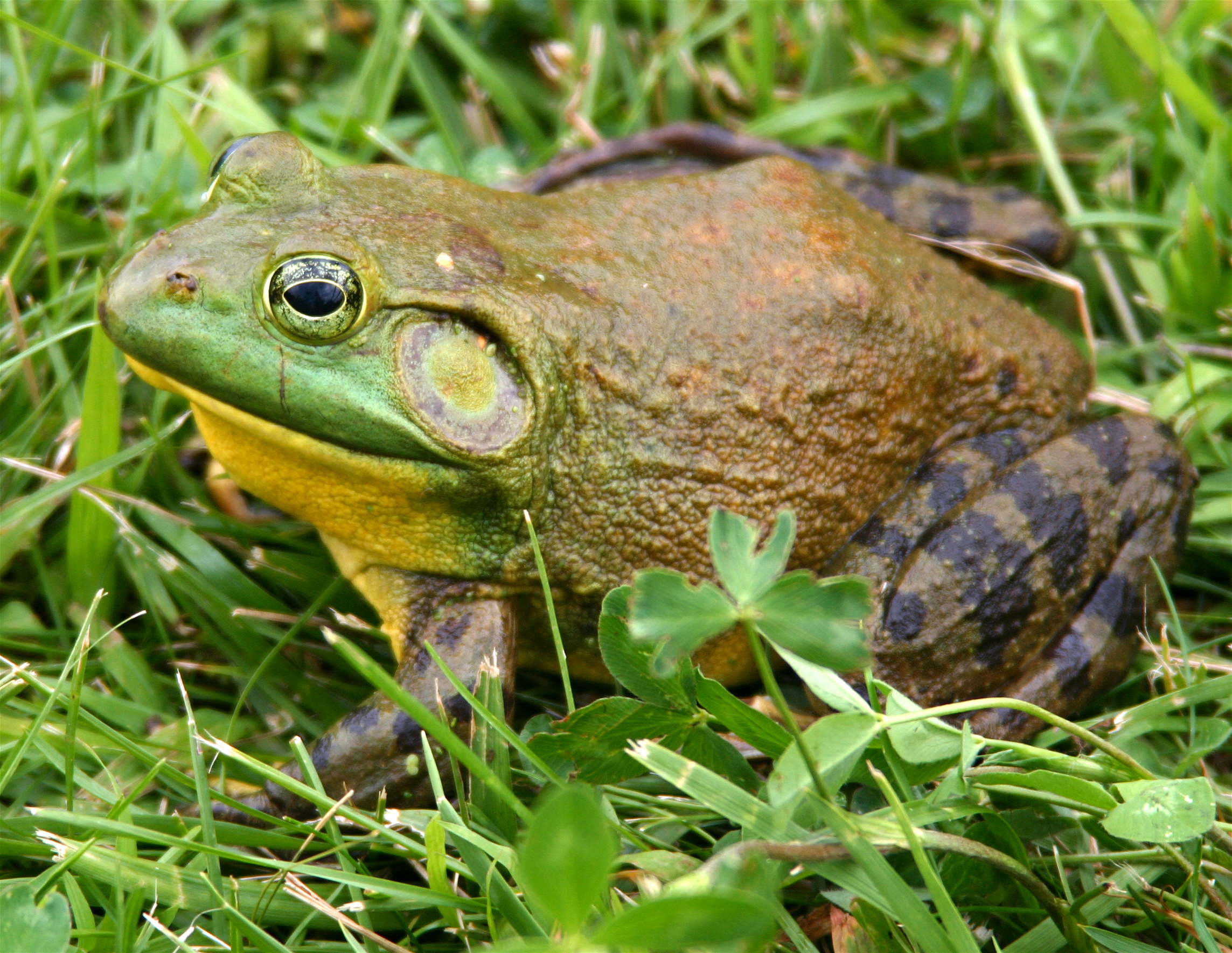
North America's largest native frog, a powerful, predatory semi-aquatic species; impressive but space-hungry, messy, and an invasive pest outside its native range.
ℹ️
Educational only. KinStation content is reviewed by licensed veterinarians but cannot replace an in-person exam. Always consult a licensed veterinarian or board-certified specialist for diagnosis, treatment, or any decision affecting your pet's health.
🩺 Need expert help with your american bullfrog?
Connect with a specialist near you or ask a licensed vet — never substitute online guidance for hands-on care in an emergency.
Very large for a frog, with bodies of 3.5-6 in (9-15 cm) and some females exceeding 8 in (20 cm) and over a pound.
Lifespan
8–16 years
Social needs
solo
Native region
Eastern and central North America (introduced and invasive elsewhere)
Origin
New World
Climate
🍂 Temperate
Water type
💧 Freshwater
Family
Ranidae
Genus
Lithobates
Part of the True Frogs
Robust, semi-aquatic frogs of the family Ranidae kept in large paludariums with substantial clean water and land access. Powerful predators that are housed solo and observed rather than handled.
More true frogs coming soon.
Habitat & space requirements
From the minimum an animal needs to be kept humanely, up to the ideal setup. Bigger is almost always better — minimums are floors, not targets.
Photo coming soon
Minimum
Large semi-aquatic enclosure
40-gal breeder (36 × 18 × 16 in)
Lithobates catesbeianus grows huge (up to 8 in body length) and is invasive outside native range — check local law. Minimum 40-gal breeder paludarium with ~2/3 water, hardy land area with cork-bark hides, filter, 65–80 °F. Powerful jumper — secure lid essential.
Photo coming soon
Recommended
Larger paludarium
75 gal (48 × 18 × 21 in) paludarium
Wider paludarium with substantial water volume, strong filtration (bullfrogs are messy), land platform with hides, and a tight-fitting lid. Solitary — bullfrogs eat tankmates including other bullfrogs.
Photo coming soon
Ideal
Pond-style enclosure
Outdoor pond or 100+ gal indoor paludarium
Outdoor pond (where legal and climate-appropriate) or 100+ gallon indoor paludarium with extensive filtration, live plants, basking platform, and seasonal temperature cycle. Lives 8–10 years in good husbandry.
Life & growth stages
How this animal changes through its life — each stage often has its own care, diet and space needs.
Photo coming soon
Egg
Amphibian eggs are soft, jelly-coated spheres laid in or near water — in floating clutches, strings, or foam nests depending on the species. The dark embryo is visible within the clear gel as it develops.
Photo coming soon
Tadpole / Larva
The aquatic larva (a tadpole in frogs/toads, a gilled larva in salamanders and newts) breathes through gills and feeds and grows in water. Frog/toad tadpoles are limbless at first, then sprout hind then front legs as metamorphosis nears.
Photo coming soon
Juvenile (froglet / eft)
At metamorphosis the animal develops legs and lungs and typically leaves the water as a froglet or, in many newts, a terrestrial eft. It resembles a small adult but is not yet sexually mature and its coloration may still be changing.
Adult
Adults reach full size and breeding condition, with the species' mature skin coloration and pattern. Many amphibians return to water to breed and can show seasonal or sex-specific changes such as nuptial coloration or crests.
(c) Ty Smith, some rights reserved (CC BY-NC) via iNaturalist — https://www.inaturalist.org/observations/97524274
Color & pattern variants
Natural variants occur in the wild; selectively bred (man-made) variants were developed in captivity.
American bullfrogs are large, semi-aquatic, and need a spacious enclosure built around a substantial, clean water area plus a land platform; a single adult realistically needs the equivalent of a 40-gallon (about 150-liter) or larger setup, ideally a paludarium or a large tub-style enclosure with deep water for swimming and a haul-out area to bask and rest. Because they are big eaters and heavy waste producers, strong filtration and frequent water changes are essential, and a tight, secure lid is a must for these powerful jumpers. Use easy-to-clean surfaces or large, non-ingestible substrate around the water.
They tolerate a wide temperature range; aim for roughly 70-80 F (21-27 C) in the active season with cooler nights, and keep water dechlorinated and well maintained. Provide some hiding cover and floating or marginal plants for security. A normal photoperiod is adequate, and intense UVB is not strictly required, though low-level UVB and good husbandry support long-term health.
Substrate
For a semi-aquatic adult setup, provide a large water section (dechlorinated, well-filtered) with a sloped or platform land area of smooth river rock, slate, or large smooth pebbles too big to swallow. Bare-bottom or large smooth stone in the water zone is easiest to keep clean; avoid gravel and sand, which cause impaction in these big, voracious feeders.
Equipment & setup
This is a very large, powerful, semi-aquatic frog needing a spacious, secure, tightly-lidded enclosure with a deep water area kept filtered (a strong canister or sump filter) and frequent water changes due to heavy waste output. Keep temps around 70-80F with a basking spot near 85F under a low heat bulb, ambient UVB (5%), and a secure escape-proof lid since they are strong jumpers.
Diet
Bullfrogs are opportunistic, almost indiscriminate carnivores that in the wild eat insects, other frogs, fish, small reptiles, and even small birds and mammals. In captivity, feed a varied diet of large gut-loaded insects (nightcrawlers, crickets, dubia roaches), and, for large adults, occasional appropriately sized vertebrate prey such as feeder fish or rodents, kept infrequent to prevent obesity and nutritional imbalance. Dust insect feeders with calcium and a multivitamin periodically.
Feed juveniles frequently to support rapid growth and adults a few times per week, matching portions to a healthy body condition. Do not house bullfrogs with any animal small enough to be swallowed, including other frogs, because they are highly cannibalistic and predatory.
Behavior & temperament
Bullfrogs are bold, powerful, sit-and-wait predators that spend time floating at the water's surface or sitting at the waterline waiting to ambush prey; males produce the famous deep, resonant jug-o-rum call. They are solitary and must be housed alone, as they readily eat smaller frogs and even similarly sized individuals. They are strong, squirmy, and can deliver a hard bite, so they are a display animal rather than a handling pet; handle only when necessary with clean, wet hands.
Important: the American bullfrog is a serious invasive species in many parts of the world and in U.S. states outside its native range, where it preys on and outcompetes native wildlife and helps spread chytrid fungus. Keepers must never release them, and possession, sale, or transport is restricted or prohibited in various jurisdictions, so confirming local laws before acquiring one is essential.
Health
Common captive problems include obesity from overfeeding vertebrate prey, metabolic bone disease from inadequate calcium, and bacterial skin infections (such as red-leg) and fungal disease driven by poor water quality, which is a frequent issue given how much waste these large frogs produce. Chytrid and ranavirus are significant concerns, and bullfrogs are notorious carriers of chytrid.
Prevention hinges on robust filtration and frequent water changes, a measured and varied diet, appropriate space, and strict quarantine and hygiene to avoid spreading disease. Watch for skin reddening or sores, bloating, lethargy, or appetite loss and consult an amphibian-experienced veterinarian. This entry is informational only and not a substitute for veterinary care.
Tips, DIY & hacks
Bullfrogs are aggressive ambush predators and cannibalistic, so house them singly unless similarly sized, and never cohabit with smaller animals they will eat. Feed a varied diet of gut-loaded insects, earthworms, and occasional appropriately sized prey while avoiding overfeeding to prevent obesity. Strong filtration plus weekly partial water changes is the cheapest way to control the heavy ammonia load from their large appetite and waste.