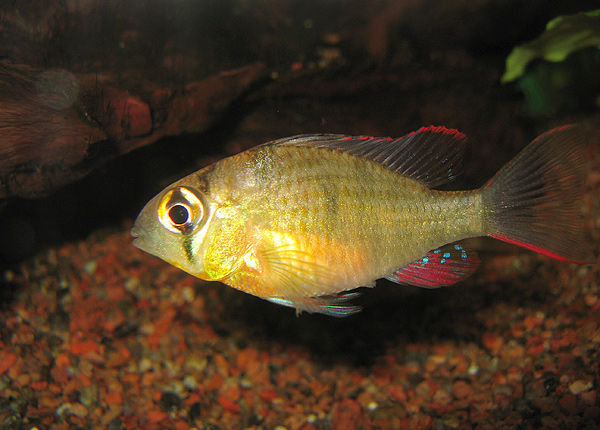
A peaceful, golden-bodied dwarf cichlid with a ruby-flushed crown and delicate fin extensions. Hardier and more forgiving than its cousin the German blue ram, the Bolivian ram is an excellent first dwarf cichlid for the planted community aquarium.
ℹ️
Educational only. KinStation content is reviewed by licensed veterinarians but cannot replace an in-person exam. Always consult a licensed veterinarian or board-certified specialist for diagnosis, treatment, or any decision affecting your pet's health.
🩺 Need expert help with your bolivian ram?
Connect with a specialist near you or ask a licensed vet — never substitute online guidance for hands-on care in an emergency.
South America (Amazon Basin in Bolivia and Brazil — Rio Mamoré and Guaporé drainages)
Origin
New World
Climate
🌴 Tropical
Water type
💧 Freshwater
Family
Cichlidae
Genus
Mikrogeophagus
Part of the Dwarf Cichlids
Small, intelligent, colorful cichlids - mostly South American Apistogramma and rams plus West African species - prized for big personality in modest planted tanks. Many are cave- or substrate-spawners with rewarding parental behavior, suited to soft-water community setups.
From the minimum an animal needs to be kept humanely, up to the ideal setup. Bigger is almost always better — minimums are floors, not targets.
Photo coming soon
Minimum
Pair tank
30 gal / 114 L planted
Mikrogeophagus altispinosus is a peaceful dwarf cichlid hardier than the German ram. A 30-gallon planted tank is the practical minimum for a pair, with sand substrate, driftwood, soft to moderate water, and 24–27 °C.
Recommended
Planted community
40 gal / 151 L long planted
40-gal long planted community with a pair, multiple flat stones for spawning, peaceful dither fish (tetras/rasboras), and gentle flow. Forms strong pair bonds and breeds readily.
Chris Walker / Public domain (Wikimedia Commons)
Photo coming soon
Ideal
Amazon biotope
55 gal+ / 208 L+ Amazon biotope
Amazon-style biotope with leaf litter, driftwood, sand, dim light, and a Bolivian pair plus appropriate schoolers. Excellent natural parental behaviour displayed.
Life & growth stages
How this animal changes through its life — each stage often has its own care, diet and space needs.
Photo coming soon
Egg
Fish eggs are small, translucent spheres, often laid in clutches on plants, substrate, or in a nest — or carried/brooded by a parent in livebearing and mouth-brooding species. A dark eye spot and the curled embryo become visible inside as development progresses.
Photo coming soon
Fry
Newly hatched fry are tiny and semi-transparent, frequently still carrying a yolk sac that fuels them before they feed freely. They lack full fin structure and adult coloration, staying near cover until they can swim and forage on their own.
Photo coming soon
Juvenile
Juveniles look like miniature adults but with developing fins and muted or different markings; many species shift pattern and color as they mature. Growth is rapid at this stage given clean water and steady feeding.
Adult
Adults show the species' full size, finnage, and mature coloration, and are sexually mature. Many fish develop sex-specific differences in size, color, or fin shape, which can intensify during breeding.
Color & pattern variants
Natural variants occur in the wild; selectively bred (man-made) variants were developed in captivity.
A pair needs a minimum of 20 gallons (about 75 L); larger tanks comfortably hold a small group with tankmates. Keep temperatures at 72-79°F (22-26°C), pH 6.0-7.5, and soft to moderately hard water. They are more tolerant of cooler water and a wider parameter range than German blue rams, which makes them far more beginner-friendly.
Provide a sand substrate for sifting, gentle flow, driftwood, rocks, and planted cover with some open foraging space. Subdued lighting and a few floating plants help them feel secure; leaf litter and tannins mimic their natural habitat.
Substrate
Fine, soft sand is ideal, allowing them to sift mouthfuls of substrate to forage naturally and protecting their delicate mouths. Add leaf litter, smooth stones, and driftwood to provide spawning surfaces and cover.
Equipment & setup
A gentle canister or sponge filter provides clean water with low flow, which they prefer. Use a reliable heater and modest planted-tank lighting. Botanicals such as almond leaves help replicate their soft, tannin-stained native waters.
Diet
Bolivian rams are omnivores that sift the substrate for food. Feed a varied diet of quality micro-pellets and flakes alongside regular frozen or live foods such as bloodworms, brine shrimp, daphnia, and cyclops.
Feed small amounts once or twice daily. They forage naturally over sand, so sinking foods and a soft substrate let them feed as they would in the wild.
Behavior & temperament
Peaceful, hardy, and well-suited to community life — a genuinely good-tempered dwarf cichlid that only defends a small territory when spawning. Ideal tankmates include tetras, rasboras, Corydoras, peaceful catfish, and other gentle community fish; keep just one pair per tank to avoid squabbles between males. Not aggressive toward dissimilar species.
They form pair bonds and are diligent, comparatively easy substrate-spawning parents, often a good first 'project' for breeding cichlids.
Health
Hardier than German blue rams and reasonably disease-resistant, but still sensitive to poor water quality and nitrate buildup. Watch for ich, fin issues, and stress from rapid parameter swings or bright, exposed tanks. Clean, stable, well-filtered water and good cover keep them healthy.
Tips, DIY & hacks
Choose Bolivian rams over German blue rams if you want a hardier, cooler-tolerant dwarf cichlid for a community tank. Provide flat stones or broad leaves as spawning sites, keep a single bonded pair, and use sand so they can sift and display natural foraging behavior.