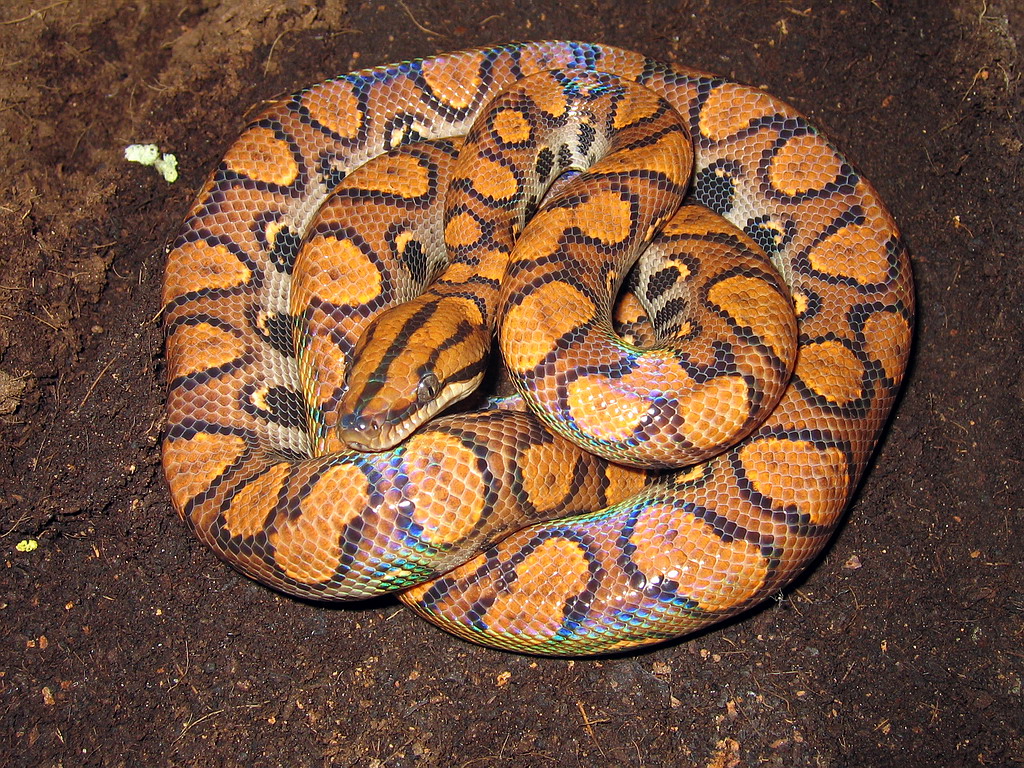
Photo: No machine-readable author provided. KaroH assumed (based on copyright claims). · CC BY-SA 3.0
A stunning, slender boa famous for the iridescent rainbow sheen of its brown-and-black ringed body. Its strict humidity requirements make it an intermediate species best suited to keepers ready to manage a humid setup.
ℹ️
Educational only. KinStation content is reviewed by licensed veterinarians but cannot replace an in-person exam. Always consult a licensed veterinarian or board-certified specialist for diagnosis, treatment, or any decision affecting your pet's health.
🩺 Need expert help with your brazilian rainbow boa?
Connect with a specialist near you or ask a licensed vet — never substitute online guidance for hands-on care in an emergency.
Medium; adults typically 5-6 ft (1.5-1.8 m), slender and muscular.
Lifespan
20–25 years
Social needs
solo
Native region
South America (Amazon Basin, Brazil and surrounding countries)
Origin
New World
Climate
🌴 Tropical
Family
Boidae
Genus
Epicrates
Part of the Boas
Boas are mostly non-venomous constrictors that give live birth, ranging from small sand boas to giant boa constrictors; many are popular, long-lived pets valued for calm temperaments.
From the minimum an animal needs to be kept humanely, up to the ideal setup. Bigger is almost always better — minimums are floors, not targets.
Photo coming soon
Minimum
Adult enclosure
5 × 2 × 2 ft (≈ 90 gal)
Brazilian rainbows reach 5–6 ft. Minimum is a 5×2×2 with high humidity (80–90%), basking 28–30 °C, cool 24 °C, and multiple hides. Humidity stability is critical — front-opening + sealed PVC recommended.
Photo coming soon
Recommended
Front-opening vivarium
6 × 2 × 2 ft, planted
A 6×2×2 with deep moist substrate, climbing branches, multiple hides, and large water bowl. Mist daily. Low UVB (5%) brings out iridescence.
Photo coming soon
Ideal
Bioactive Amazonian
6–8 ft bioactive, planted
Bioactive Amazonian enclosure with deep substrate, dense planting, leaf litter, and humidity stability. Mimics South American rainforest. Spectacular display species.
Life & growth stages
How this animal changes through its life — each stage often has its own care, diet and space needs.
Photo coming soon
Egg / Neonate
Most reptiles lay leathery- or hard-shelled eggs incubated by ambient warmth, though some snakes and lizards give live birth. Incubation temperature can influence sex and development in many species.
Photo coming soon
Hatchling
Hatchlings emerge as fully formed miniatures of the adult, often using an egg tooth to slit the shell. They are independent from birth but small and vulnerable, and may show brighter or different juvenile patterning.
Photo coming soon
Juvenile
Juveniles grow steadily, shedding their skin periodically as they enlarge. Coloration and proportions shift toward the adult form, and growth rate depends heavily on temperature, diet, and basking/UVB access.
Adult
Adults reach the species' full length and mass and become sexually mature. Many reptiles show sex differences in size, coloration, or features (such as larger heads, hemipenal bulges, or femoral pores), and continue to shed throughout life.
Color & pattern variants
Natural variants occur in the wild; selectively bred (man-made) variants were developed in captivity.
An adult Brazilian rainbow boa is well housed in an enclosure of about 4 x 2 x 2 ft. The defining husbandry challenge is humidity: these boas need a consistently high 75-90% humidity, so a sealed PVC or wood enclosure, a moisture-retaining substrate like cypress mulch or coconut fiber, a large water bowl, and ample hides are essential. Misting, a substrate that holds moisture, and good (but not stagnant) airflow keep humidity up without causing scale rot.
Keep temperatures moderate, with a warm side of 82-85 F (28-29 C) and a cool side around 78-80 F (26-27 C); they do not tolerate high basking temperatures well, so avoid hot spots above the upper 80s F. A gentle nighttime drop is fine. Use thermostat-controlled radiant heat and monitor with reliable digital thermometers and a hygrometer. UVB is optional.
Substrate
Use a moisture-holding substrate such as cypress mulch, coconut husk/coir, or sphagnum-amended bedding to sustain the high humidity this species demands; keep it damp but never soggy or mold-prone. Spot-clean waste promptly to prevent scale rot and respiratory issues.
Equipment & setup
Provide a thermostat-controlled heat source (radiant panel or low-watt overhead bulb) for a basking zone around 82-85F and an ambient/cool side near 75-80F, never exceeding ~90F. Critically, maintain 75-90% humidity with a large water bowl, daily misting or a misting system, and good but not drafty ventilation; UVB is optional but beneficial.
Diet
Brazilian rainbow boas eat appropriately sized frozen-thawed rodents, from mice and rat pups for juveniles to adult rats for grown snakes. Feed juveniles every 7 days and adults every 10-14 days, sizing prey to the snake's girth and avoiding overly large meals.
They have a strong feeding response and good appetites, so portion control matters to prevent obesity. Use long tongs, and as with all boas, do not handle for a day or two after feeding to allow proper digestion.
Behavior & temperament
Neonates and juveniles can be defensive and quick to strike, but with patient, consistent handling many settle into calm, tractable adults. They are primarily nocturnal and terrestrial, though juveniles may climb, and they appreciate hides and a secure, clutter-rich environment.
Handle gently and regularly once the snake is established, supporting the body fully. Enrichment includes varied hides, branches, and a humid microclimate that lets them thermoregulate and shed properly. Their main behavioral 'requirement' is a stable, humid, low-stress setup.
Health
Husbandry-driven problems dominate this species: too-low humidity causes bad sheds, retained eye caps, and dehydration, while excessively wet, dirty conditions cause scale rot and respiratory infections. The goal is high humidity with cleanliness and airflow, not a swampy cage. Watch for wheezing or open-mouth breathing as signs of respiratory illness.
Overheating is a particular risk because they tolerate heat poorly, so keep basking temperatures moderate and thermostat-controlled. Obesity from overfeeding, mites, and standard reptile concerns apply. Given the 20+ year lifespan, build a relationship with a reptile vet and quarantine new arrivals.
Tips, DIY & hacks
Humidity is the make-or-break factor — use a humid hide packed with damp sphagnum moss and consider a fogger or automatic mister on a timer for consistency. A reverse-cycle/RHP on a quality thermostat avoids drying the air the way a heat lamp can. Watch for incomplete sheds (a sign humidity is too low).