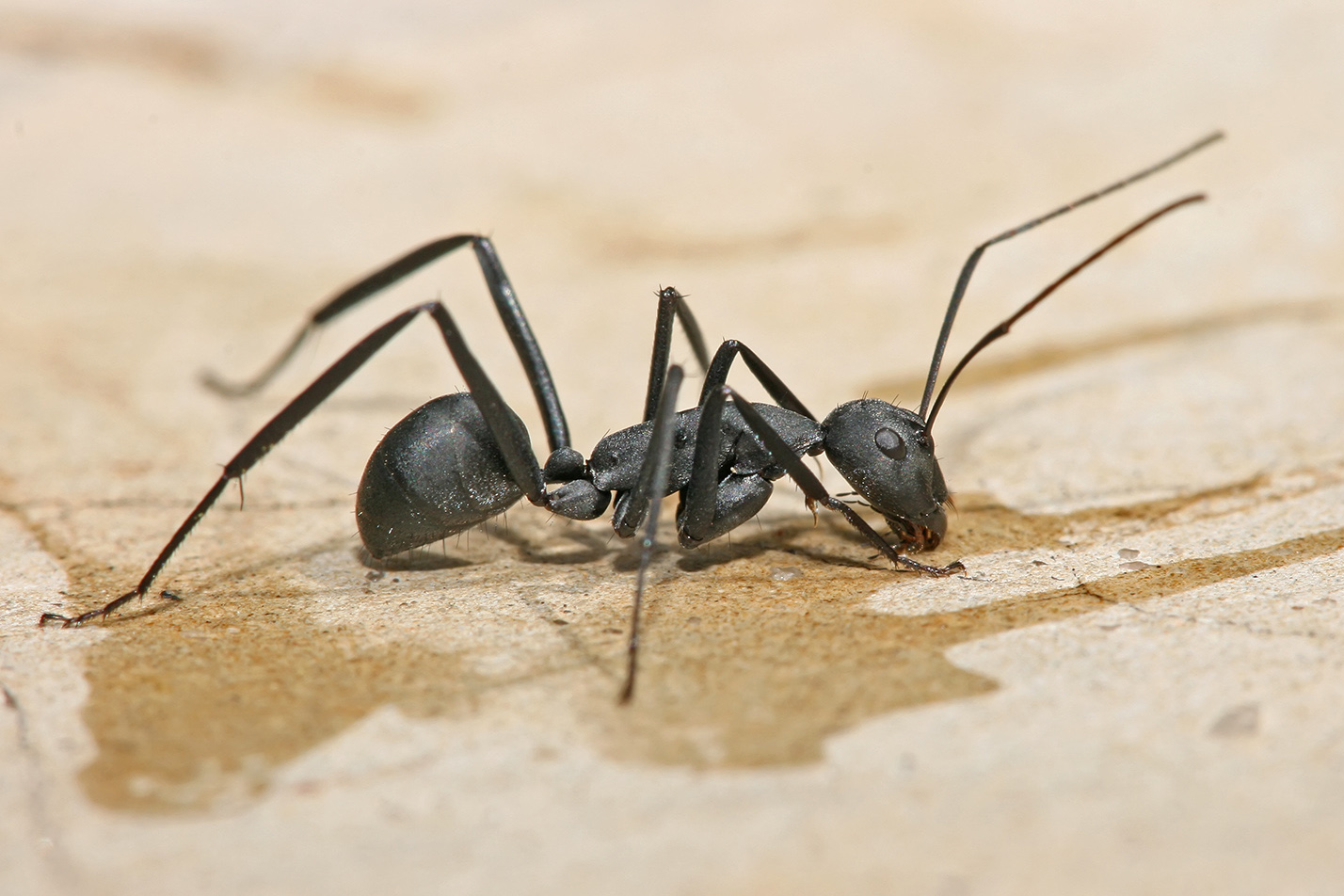
A large, charismatic genus of wood-dwelling ants with big queens and dramatic size differences between worker castes, making them one of the most popular and forgiving genera for new ant keepers. The pet is the colony, founded claustrally from one mated queen.
ℹ️
Educational only. KinStation content is reviewed by licensed veterinarians but cannot replace an in-person exam. Always consult a licensed veterinarian or board-certified specialist for diagnosis, treatment, or any decision affecting your pet's health.
🩺 Need expert help with your carpenter ant?
Connect with a specialist near you or ask a licensed vet — never substitute online guidance for hands-on care in an emergency.
Highly polymorphic: minor workers ~6 mm up to majors 13-16 mm; queens 15-20 mm in large species. Mature colonies range from a few hundred to several thousand wo
Lifespan
10–25 years
Social needs
group
Native region
Worldwide; the genus occurs on every continent except Antarctica, across temperate forests and tropical regions
Origin
Worldwide
Climate
🌍 Varied
Family
Formicidae
Genus
Camponotus
Part of the Ants
Ants are kept as living colonies rather than individual pets: a single mated queen and her workers are housed in a formicarium (nest) connected to an outworld for foraging. Keepers feed sugars and protein, manage humidity, and watch complex social behavior unfold over years. In the US, ants are regulated by USDA APHIS as plant pests, so collecting and moving queens across state lines is restricted
From the minimum an animal needs to be kept humanely, up to the ideal setup. Bigger is almost always better — minimums are floors, not targets.
Photo coming soon
Minimum
Test tube founding setup
Founding queen in test-tube
Carpenter ant (Camponotus spp.) founding queens are kept in test tubes (water-stoppered) until first workers emerge. Larger species — slower founding stage than Lasius.
Photo coming soon
Recommended
Wood / acrylic formicarium
Medium formicarium + 10 × 10 in outworld
Medium formicarium with wood or acrylic chambers (Camponotus naturally nest in wood) connected to a large outworld. Provide sugar water, protein, and a humidity gradient.
Photo coming soon
Ideal
Large modular formicarium
Large modular formicarium + 16 × 16 in arena
Large modular formicarium with multiple connected nest types, escape-proof arena with fluon, and a long-term feeding schedule. Carpenter ant colonies can grow into the thousands over many years.
Life & growth stages
How this animal changes through its life — each stage often has its own care, diet and space needs.
Photo coming soon
Egg
Insects begin as eggs, laid singly or in clusters on or near a food source. Egg size, shape, and incubation time vary widely; some are glued to surfaces, others inserted into plant tissue or soil.
Photo coming soon
Larva / Nymph
The immature stage either looks grub- or caterpillar-like and very different from the adult (a larva, in beetles, flies, and butterflies) or like a wingless miniature adult (a nymph, in roaches, mantises, and stick insects). It eats and molts repeatedly as it grows.
Photo coming soon
Pupa
In insects with complete metamorphosis, the larva pupates — often in a cocoon, chrysalis, or sealed cell — and its body is reorganized into the adult form. Nymph-developing insects skip a true pupa and molt straight to the adult.
Adult
The adult is the sexually mature, usually winged stage with the species' full coloration and form. Adults are typically the dispersing and reproducing stage, and in many insects do not grow further once mature.
Habitat & enclosure
Found and raise the queen in a **test-tube setup** (water reservoir behind cotton). Carpenter ants nest in wood in the wild but in captivity thrive in **acrylic, plaster, or aerated-concrete (Ytong) formicariums** connected to an **outworld**. Most temperate Camponotus need a **winter diapause (hibernation)** at roughly 10-15 C for 2-3 months to stay healthy and fertile long-term; tropical species do not. Provide a **humidity gradient** (one hydrated end, one dry) rather than a uniformly wet nest.
Substrate
Nest material is usually **plaster, AAC/Ytong, or acrylic with a hydration channel**. Some keepers offer a piece of soft wood or cork bark in the outworld to satisfy nesting instinct. Outworld floor can be **sand, sand-soil, or bare acrylic** with a small misted corner for humidity.
Equipment & setup
16 mm test tubes + cotton; a **heat mat/cable on a thermostat** for a warm 24-28 C spot (tropical species appreciate steady warmth); formicarium + outworld; **escape barrier** (Fluon/PTFE, talc-alcohol, or Vaseline) on outworld walls; a cool space or wine cooler for **winter diapause** of temperate species; red film; tweezers and a feeding dish.
Diet
Carpenter ants are **not** wood-eaters; they have a strong sweet tooth. Provide a constant **sugar source** (honey water, sugar water 1:3, or hummingbird-style nectar) and regular **protein** in the form of insects (mealworms, crickets, roaches, flies). Brood production is driven by protein, so increase insects when larvae are present. Fresh water must always be available via the hydration tube or a water feeder.
Behavior & temperament
Calm, slow, and easy to observe. **Polymorphism** is the highlight: tiny minors tend brood while massive majors with oversized heads serve as soldiers and food processors. Many species are nocturnal foragers. They do not sting but **larger majors can bite** and some spray formic acid defensively. Queens are **fully claustral** founders that need no food until the first workers emerge.
Health
Main risks are **mold and mites** from leftover food, **dehydration**, and skipping required hibernation (which shortens queen life and can stop egg-laying). Keep outworlds clean and dry food scraps removed. Avoid insecticide and aerosol exposure. A thriving colony has glossy brood piles and an active queen; declining colonies show shrinking brood and rising worker deaths.
Tips, DIY & hacks
Carpenter ants are forgiving of beginner mistakes, which is why they are a top first colony. Start in a test tube and only move to a nest once 20+ workers exist. Heat only part of the setup. For temperate species, do not skip hibernation - drop the temperature gradually in late autumn. Provide a sugar source at all times; a hungry Camponotus colony declines fast. In the US, USDA APHIS regulates ants as plant pests: **moving native ant queens across US state lines requires a PPQ 526 permit**, and import/keeping rules vary by country. Keep species native or already established in your area.