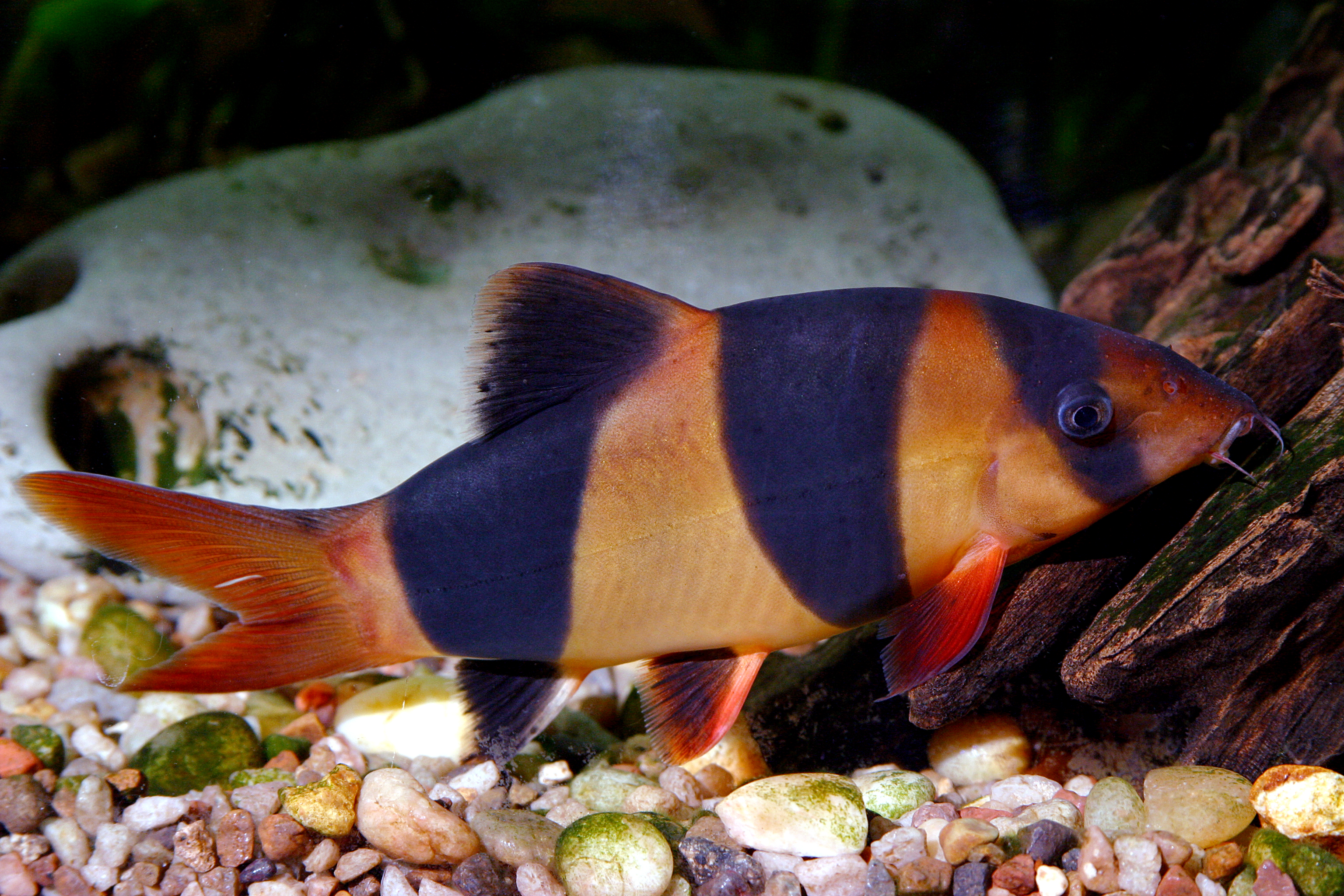
A striking orange-and-black banded loach that grows large, lives for decades, and must be kept in active social groups. Their adult size and lifespan make them a serious, advanced-level commitment despite their cute, small juvenile appearance.
ℹ️
Educational only. KinStation content is reviewed by licensed veterinarians but cannot replace an in-person exam. Always consult a licensed veterinarian or board-certified specialist for diagnosis, treatment, or any decision affecting your pet's health.
🩺 Need expert help with your clown loach?
Connect with a specialist near you or ask a licensed vet — never substitute online guidance for hands-on care in an emergency.
Large botiid loach commonly reaching 20-30 cm (8-12 in) in captivity, occasionally larger.
Lifespan
15–25 years
Social needs
group
Native region
Southeast Asia (islands of Borneo and Sumatra, Indonesia)
Origin
Old World
Climate
🌴 Tropical
Water type
💧 Freshwater
Family
Botiidae
Genus
Chromobotia
Part of the Loaches
Bottom-dwelling, often social fish prized for sifting substrate, controlling pest snails, and adding constant motion to the lower levels of the aquarium. Most are scaleless or fine-scaled and sensitive to medications.
From the minimum an animal needs to be kept humanely, up to the ideal setup. Bigger is almost always better — minimums are floors, not targets.
Photo coming soon
Minimum
Sub-adult shoal
75 gal / 284 L long tank
Chromobotia macracanthus reaches 10–12 in and is a social schooler — keep 5+. 75-gal long is a strict minimum for sub-adults; adults rapidly outgrow this size. Soft slightly acidic, warm 26–30 °C, strong flow.
Recommended
Adult shoal display
125 gal / 473 L long, 6 ft
Six-foot 125-gallon for an adult shoal of 5+, with multiple driftwood caves, sand substrate, strong filtration, and strong flow. They are long-lived (20+ years) and social — single specimens decline.
BACbKA / CC BY-SA 4.0 (Wikimedia Commons)
Ideal
SE Asian biotope display
180 gal+ / 681 L+ biotope
180-gal+ SE Asian river biotope with sand, driftwood tangles, strong flow, and a shoal of 6+. Provides the lifelong space this fish needs to thrive.
Emőke Dénes / CC BY-SA 4.0 (Wikimedia Commons)
Life & growth stages
How this animal changes through its life — each stage often has its own care, diet and space needs.
Photo coming soon
Egg
Fish eggs are small, translucent spheres, often laid in clutches on plants, substrate, or in a nest — or carried/brooded by a parent in livebearing and mouth-brooding species. A dark eye spot and the curled embryo become visible inside as development progresses.
Photo coming soon
Fry
Newly hatched fry are tiny and semi-transparent, frequently still carrying a yolk sac that fuels them before they feed freely. They lack full fin structure and adult coloration, staying near cover until they can swim and forage on their own.
Photo coming soon
Juvenile
Juveniles look like miniature adults but with developing fins and muted or different markings; many species shift pattern and color as they mature. Growth is rapid at this stage given clean water and steady feeding.
Adult
Adults show the species' full size, finnage, and mature coloration, and are sexually mature. Many fish develop sex-specific differences in size, color, or fin shape, which can intensify during breeding.
Habitat & enclosure
Often sold as small juveniles, clown loaches reach 20-30 cm and need a large aquarium; plan for at least 450-560 litres (120-150 US gal) for a proper group of five or more adults, with a long footprint and strong filtration. Use a soft sand substrate, plenty of caves, driftwood, rockwork, and robust plants, and cover the tank well. They are highly social and become stressed, sickly, or aggressive when kept alone or in too-small groups.
They are tropical: keep water at 25-30 C (77-86 F), pH 6.0-7.5, soft to moderately hard, with brisk, well-oxygenated flow and meticulous water quality. As scaleless fish they need stable, pristine conditions and a fully matured tank. Their long lifespan and eventual size mean the enclosure must be planned for the adult animal, not the juvenile.
Substrate
Use smooth, fine sand or rounded gravel so these bottom-rooting loaches can sift and forage without scratching their barbels or delicate scaleless skin. Avoid sharp or coarse substrate entirely.
Equipment & setup
Clown loaches grow large (8-12 inches) and need a 100+ gallon tank with very strong filtration (canister-grade) and high oxygenation, kept at 78-86F. Provide plenty of caves, PVC pipes, and driftwood clusters for hiding, since they are social and seek tight retreats during the day.
Diet
Omnivorous foragers that eat sinking pellets and wafers, frozen and live foods (bloodworms, brine shrimp), blanched vegetables, and notably snails, which they hunt readily. Offer a varied diet with both meaty and plant components to keep them in good condition and color.
Feed once or twice daily, using sinking foods so these bottom-oriented fish get their share. They have hearty appetites as they grow. A varied, well-rounded diet supports their long-term health, immunity, and the rich coloration the species is prized for.
Behavior & temperament
Active, intelligent, and highly social, clown loaches form hierarchies and are most confident and playful in groups of five or more, where they pile together, follow each other, and explore constantly. They sometimes rest on their sides (alarming to new keepers but normal), produce audible clicking sounds, and can be boisterous, so pair them with similarly sturdy, non-timid tankmates.
Enrich with caves, tunnels, driftwood, and open swimming space; a well-decorated tank with a strong group brings out their natural curiosity and antics. They are long-term companions that recognize feeding routines. Avoid keeping them with very small or delicate fish that could be stressed by their energy.
Health
Clown loaches are scaleless and famously prone to ich (white spot), often being the first fish in a tank to show it; they are sensitive to copper and full-strength medications, so treat with heat and reduced-dose protocols. Maintain warm, pristine, stable water to prevent outbreaks.
Stress from being kept singly, in small tanks, or in immature aquariums leads to disease and poor growth. Their decades-long lifespan and large adult size make impulse purchases a frequent welfare problem. Quarantine new fish, keep strong groups in large tanks, and provide excellent water quality to keep them healthy for the long haul.
Tips, DIY & hacks
Keep a minimum of 5-6 together; lone or paired clowns become stressed and prone to ich. Because they are scaleless and ich-prone, dose medications at half strength and quarantine new arrivals carefully; cut PVC elbows make cheap, secure group hides.