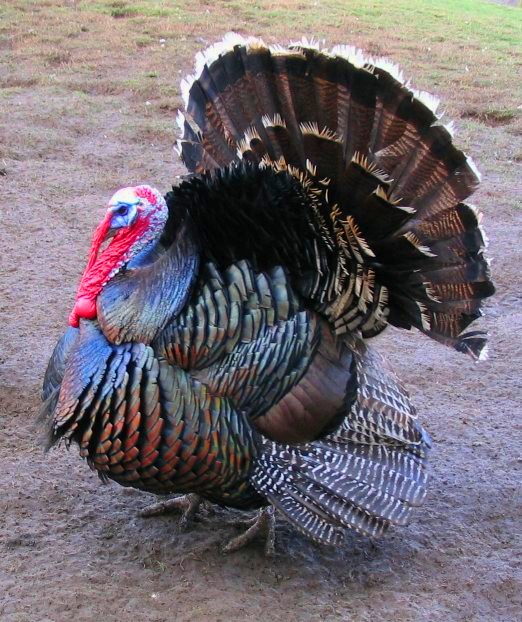
Photo: photo taken by Lupin on en:Wikipedia · CC BY-SA 3.0
A large galliform domesticated from the North American wild turkey, kept for meat and increasingly as friendly, personable pets. Heritage breeds are hardy and long-lived; fast-growing commercial strains have serious health limits.
ℹ️
Educational only. KinStation content is reviewed by licensed veterinarians but cannot replace an in-person exam. Always consult a licensed veterinarian or board-certified specialist for diagnosis, treatment, or any decision affecting your pet's health.
🩺 Need expert help with your domestic turkey?
Connect with a specialist near you or ask a licensed vet — never substitute online guidance for hands-on care in an emergency.
Heritage hens ~3.5-5 kg, toms ~7-11 kg; commercial Broad Breasted toms can exceed 18 kg. Heritage breeds can fly; broad-breasted cannot.
Lifespan
3–10 years
Social needs
group
Native region
North America and Mexico (domesticated from the wild turkey; the South Mexican subspecies founded modern breeds)
Origin
New World
Climate
🍂 Temperate
Family
Phasianidae
Genus
Meleagris
Part of the Turkeys
Large galliform birds domesticated from the North American wild turkey, kept for meat and as personable pets. Heritage breeds are hardy, naturally-mating, and long-lived; fast-growing commercial strains trade longevity for size.
More turkeys coming soon.
Habitat & space requirements
From the minimum an animal needs to be kept humanely, up to the ideal setup. Bigger is almost always better — minimums are floors, not targets.
Photo coming soon
Minimum
Turkey shelter + run
8 sq ft shelter + 20 sq ft run per bird, roost height by breed
For a generic domestic turkey (Meleagris gallopavo domesticus), provide at least 8 sq ft of predator-proof shelter and a 20 sq ft fenced run per bird. Heritage breeds need a 3–4 ft roost; broad-breasted production breeds need GROUND-LEVEL roosting only (high roosts = broken legs).
Photo coming soon
Recommended
Pasture run + roost barn
10 sq ft shelter + 75 sq ft pasture per bird, shade
Open-sided pole barn with breed-appropriate roosting and 75 sq ft of grass pasture per bird with shade. Heritage breeds graze and forage well; broad-breasted varieties exercise gently. Predator-proofing is critical — turkeys are night targets.
Photo coming soon
Ideal
Free-range pasture flock
Free-range 1–2 acres + roost barn, flock of 5–10
Free-range or paddock-rotated pasture with a barn they return to at dusk. Heritage breeds (Bourbon, Bronze, Narragansett) thrive in this system; broad-breasted commercial lines benefit from gentle pasture but need slaughter by 18–22 wk to avoid lameness and heart failure.
Life & growth stages
How this animal changes through its life — each stage often has its own care, diet and space needs.
Photo coming soon
Egg
Birds develop inside a hard-shelled egg incubated by the parent(s). Egg size, shell color, and clutch size vary by species; the embryo develops over days to weeks before hatching.
Photo coming soon
Hatchling / Chick
Hatchlings are either altricial — naked, blind, and dependent on parents (typical of parrots and songbirds) — or precocial — downy, mobile, and self-feeding soon after hatching (typical of poultry and waterfowl). Down gives way to the first feathers.
Photo coming soon
Juvenile / Fledgling
Fledglings grow in their juvenile plumage and begin to fly and feed themselves, though they may still beg from parents at first. Juvenile feathering is often duller than the adult and is replaced as the bird matures.
Adult
Adults attain full body size and mature plumage, and are capable of breeding. Many species show distinct adult coloration, and in sexually dimorphic birds males and females differ in plumage, size, or markings.
(c) Eric Schmidt, some rights reserved (CC BY) via iNaturalist — https://www.inaturalist.org/observations/93649779
Color & pattern variants
Natural variants occur in the wild; selectively bred (man-made) variants were developed in captivity.
Turkeys need **more space than chickens**: a **predator-proof house** (~**0.5-1 m² floor per bird**) with **sturdy, wide roosts**, plus a generous **run or range**. Heritage turkeys are strong **fliers and high roosters** — provide tall, secure fencing or a covered run, and high perches they instinctively seek. Broad-breasted (commercial meat) strains can't fly or roost well and need low, easy-access roosting platforms. They forage widely and benefit from pasture. Provide shade in heat and dry, draft-free, well-ventilated shelter in cold; they are quite cold-hardy but the toms' fleshy heads can frostbite.
Substrate
Use **pine shavings or straw**, kept dry and deep; ammonia and damp litter hit poults' respiratory systems hard. Brooder substrate should be non-slip (paper towels over shavings at first) to prevent **splayed legs**. On range, **well-drained ground** matters because soil-borne cecal worms transmit blackhead — rotate ground and keep it from getting fouled. Avoid cedar.
Equipment & setup
Provide **wide, sturdy roosts**, **tall secure fencing or a covered run**, and **larger feeders/waterers** than for chickens. Poults need a **carefully managed brooder** (start ~35°C) with **shallow, easily found water** (add marbles to prevent drowning) and high-protein starter — they are less robust than chicks. Heritage birds appreciate high perches. In cold areas, dry deep bedding and wattle protection beat supplemental heat for adults.
Diet
Turkeys, especially **poults**, need **higher protein** than chickens: feed a **gamebird/turkey starter (~28% protein)**, stepping down to grower and then a maintenance/breeder or all-flock ration (~16-20%). Provide **grit** and free-choice **oyster shell** for laying hens. They forage well on insects and greens. **Do not feed medicated chick feed not labeled for turkeys** and avoid raising poults with chickens because of **blackhead disease** (histomoniasis) risk. Clean water beside feed at all times; poults are fragile and need warm, clean, easily found water early on.
Behavior & temperament
Turkeys are **social, curious, and surprisingly affectionate** — many become tame, follow keepers, and enjoy attention. Toms **strut, gobble, and display** their tail fans and color-changing head wattles, especially in spring, and can become **pushy or territorial** in breeding season. They are flock birds and should not be kept singly. Poults are notoriously delicate at first and need warmth, attention, and easy access to food/water ('teaching' them to eat/drink helps). Heritage birds fly to roost in trees if allowed.
Health
The signature turkey disease is **blackhead (histomoniasis)** — a protozoal infection spread via cecal worms and often carried symptomlessly by chickens; **don't co-house turkeys and chickens** and control earthworm-borne cecal worms. Poults are vulnerable to **chilling, coccidiosis, and starvation early on**. **Broad-breasted strains** suffer **leg, joint, and heart problems** from rapid growth and rarely live long without diet restriction; heritage breeds are far healthier and can live many years. Watch for respiratory disease, parasites, and frostbite of head wattles. Turkeys are highly susceptible to **avian influenza** — strict biosecurity is critical.
Tips, DIY & hacks
Choose a **heritage breed** (Narragansett, Bourbon Red, Royal Palm, Standard Bronze) if you want hardy, naturally-mating, long-lived pet or homestead turkeys — broad-breasted strains are meat birds that struggle past their first year. **Never raise turkeys with chickens** (blackhead). Brood poults warm, clean, and attentively, dipping beaks to teach drinking. Give heritage birds tall roosts and strong fencing for their flight. Toms strut and gobble — fun, but supervise them around children in spring. **Check local rules** and practice **avian-influenza biosecurity**, to which turkeys are especially sensitive.