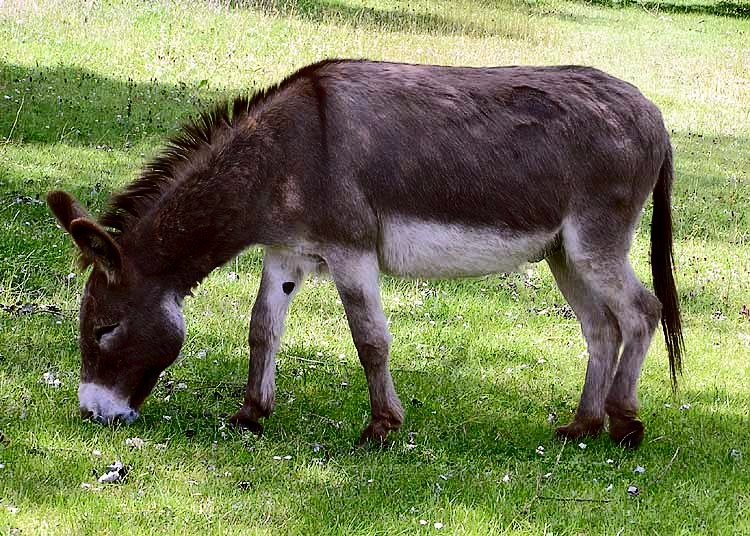
The donkey is a hardy, long-lived equine domesticated from the African wild ass, kept as a companion, guard, pack, and driving animal. Adapted to arid scrubland, it is a stoic browser that needs low-sugar forage, dry conditions, a bonded companion, and an owner who understands it is metabolically and behaviorally different from a horse.
ℹ️
Educational only. KinStation content is reviewed by licensed veterinarians but cannot replace an in-person exam. Always consult a licensed veterinarian or board-certified specialist for diagnosis, treatment, or any decision affecting your pet's health.
🩺 Need expert help with your donkey?
Connect with a specialist near you or ask a licensed vet — never substitute online guidance for hands-on care in an emergency.
From Miniature Mediterranean donkeys under 36 inches (91 cm) to Standard donkeys ~36–48 inches and Mammoth donkeys 54–60+ inches (137–152+ cm); roughly 80–500+
Lifespan
30–40 years
Social needs
group
Native region
Domesticated from the African wild ass (Equus africanus) in Northeast Africa around 5,000–7,000 years ago; now kept worl
Origin
Worldwide
Climate
🏜️ Arid
Family
Equidae
Genus
Equus
Part of the Donkeys
Donkeys are hardy, long-lived equines domesticated from the African wild ass for pack, draft, guard, and companion roles. Adapted to dry, marginal land, they are intelligent and cautious rather than stubborn, form intense lifelong pair bonds, and need low-sugar forage, dry footing and shelter, and donkey-specific health management to avoid laminitis and hyperlipemia.
More donkeys coming soon.
Habitat & space requirements
From the minimum an animal needs to be kept humanely, up to the ideal setup. Bigger is almost always better — minimums are floors, not targets.
Photo coming soon
Minimum
Stall + dry shelter + bonded companion
12×12 ft stall + 0.5 ac dry-lot + DRY 3-sided shed + bonded mate
Donkeys are NOT waterproof — they need DRY shelter (rain rot risk). Solo donkeys are deeply unhappy; bond them to another donkey or equid. Generic donkey entry — adapt template to specific breed size (mini vs standard vs mammoth).
Photo coming soon
Recommended
Pasture rotation + dry barn
12×12 stall + 1-2 ac pasture + dry barn + bonded pair
Donkeys are easy keepers — prone to obesity/laminitis on rich pasture; supplement hay rather than grass.
Photo coming soon
Ideal
Managed pasture + working role
Barn + 2+ ac per donkey + bonded herd + work/companion role
Acreage + herd + a job (LGD for stock, driving, riding for larger donkeys). Heritage donkeys preserve genetics. Generic donkey entry — adapt template to specific breed size (mini vs standard vs mammoth).
Life & growth stages
How this animal changes through its life — each stage often has its own care, diet and space needs.
Photo coming soon
Newborn
Newborn mammals are nursed on their mother's milk. Many are born helpless — blind, deaf, and sparsely furred (altricial, as in dogs, cats, and rodents) — while others stand and follow within hours (precocial, as in hoofed livestock).
Photo coming soon
Juvenile
After weaning, juveniles grow quickly and become increasingly active, playful, and independent. Adult coat, proportions, and (in many species) the permanent teeth come in as they approach full size.
Photo coming soon
Adult
Adults reach full body size and sexual maturity, with the species' mature coat and build. Sexual dimorphism — differences in size, mane, horns, or markings — is pronounced in some mammals and subtle in others.
Senior
Senior animals show aging signs such as graying fur, reduced activity, and a greater need for veterinary monitoring of joints, teeth, and organ function. Lifespan and the onset of old age vary widely by species and size.
Color & pattern variants
Natural variants occur in the wild; selectively bred (man-made) variants were developed in captivity.
Donkeys evolved in **dry, marginal habitats** and are not built for wet, lush ground. They need a **paddock or pasture with a dry loafing area and shelter** — and critically, **donkeys must have access to a roof.** Unlike horses, their coat is not very waterproof, so prolonged rain and damp predispose them to chills, hoof disease, and rain scald; a dry, well-ventilated shelter is essential.
Fencing should be **secure and donkey-proof** — donkeys are clever, strong, and persistent, and minis can slip through gaps. Provide firm, dry footing; soft, muddy, over-rich pasture is a recipe for laminitis and white line disease. They appreciate space to move and forage, plus dry standing areas to rest their feet.
Substrate
Provide **deep, dry bedding** in the shelter — **straw is traditional and donkeys often nibble it**, so good-quality barley straw doubles as bedding and low-calorie forage; wood shavings or pellets work where straw isn't suitable. Muck out daily to keep the lying area clean and dry and to control ammonia.
Outdoors, prioritize **dry, firm footing**: stone-dust or gravel loafing pads keep feet healthy, whereas standing in mud causes hoof disease. Pick up droppings regularly to limit worm burdens, including lungworm.
Equipment & setup
Basics: **well-fitted halter and lead, grooming kit, and a hoof pick**. Donkeys still benefit from a **dry shelter, slow-feed hay nets**, secure feed storage, and **fly/insect protection** in summer. Mini and standard donkeys used for driving need a correctly fitted **harness and cart**; pack donkeys need properly fitting **pack saddles** to avoid sores.
Property needs include **secure fencing**, **dry footing/loafing areas**, **clean water (heated in winter)**, and a **first-aid kit**. A weight tape and body-condition chart are important husbandry tools, since donkeys hide fat under a thick coat and easily become overweight.
Diet
Donkeys are **browsers adapted to extracting nutrition from poor, fibrous forage**, so they need a **low-sugar, high-fiber, lower-calorie diet than horses**. The base is **barley straw and/or mature grass hay**, often with limited or muzzled grazing — rich pasture and any grain rapidly cause obesity and **laminitis**, the leading welfare killer of pet donkeys.
Feed mostly **clean straw plus measured hay**, provide a **donkey-appropriate vitamin/mineral and salt**, and unlimited fresh water (donkeys drink less than horses but still need constant access). Avoid sugary treats, bread, and large amounts of fruit/vegetables. Because donkeys hide illness, a sudden drop in appetite is an emergency — fasting donkeys can develop **hyperlipemia** quickly. Adjust forage with body-condition scoring, not appetite.
Behavior & temperament
Donkeys are often misread as 'stubborn,' but they are actually **highly intelligent, cautious, and slow to flee** — instead of bolting like a horse, a frightened or unsure donkey tends to **freeze and assess**. Force makes them dig in; patience, trust, and clear, fair training win their cooperation. They are very smart and respond well to positive reinforcement.
They form **intense pair bonds**, frequently bonding for life with another donkey. Separating bonded donkeys (or losing a companion to sale or death) causes severe stress and can trigger hyperlipemia, so they should be kept **at least in pairs**, ideally with the same companion long-term. Donkeys are also used as **livestock guardians**, deterring foxes and coyotes from sheep and goats, though guarding ability varies by individual and a guard donkey still needs proper care and companionship.
Health
Donkeys need the **same routine care as horses — regular farrier, dental floating, vaccination, and fecal-guided deworming** — but with donkey-specific dosing and timing, since they metabolize some drugs and dewormers differently. **Hoof care is critical**: the donkey hoof is more upright and the horn responds badly to wet ground, making them prone to laminitis, seedy toe/white line disease, and abscesses.
Key health threats: **obesity and laminitis**, **hyperlipemia** (triggered by stress, illness, or going off feed — especially dangerous in overweight donkeys), **lungworm** (donkeys are often symptomless carriers that can infect co-grazed horses), and dental disease in their long lives. Because donkeys are **stoic and mask pain**, subtle changes — quietness, not eating, separating from a companion — are red flags that warrant prompt veterinary attention.
Tips, DIY & hacks
- **Keep donkeys in bonded pairs** and avoid splitting bonded companions — loss of a partner is a genuine medical risk (stress-induced hyperlipemia).
- Feed **straw-based, low-sugar forage** and resist the urge to spoil them; treats and rich grass are the fast road to laminitis.
- **Never force a hesitant donkey** — give it time to think; trust-based handling beats pressure every time.
- A **wet donkey needs shelter**, not romanticizing — always provide a roof and dry standing.
- Watch appetite closely; a donkey that **stops eating is an emergency**, not a 'wait and see.'
- Use **donkey-specific dosing** for dewormers/medications (they differ from horses) and deworm/test for lungworm if co-grazing with horses.