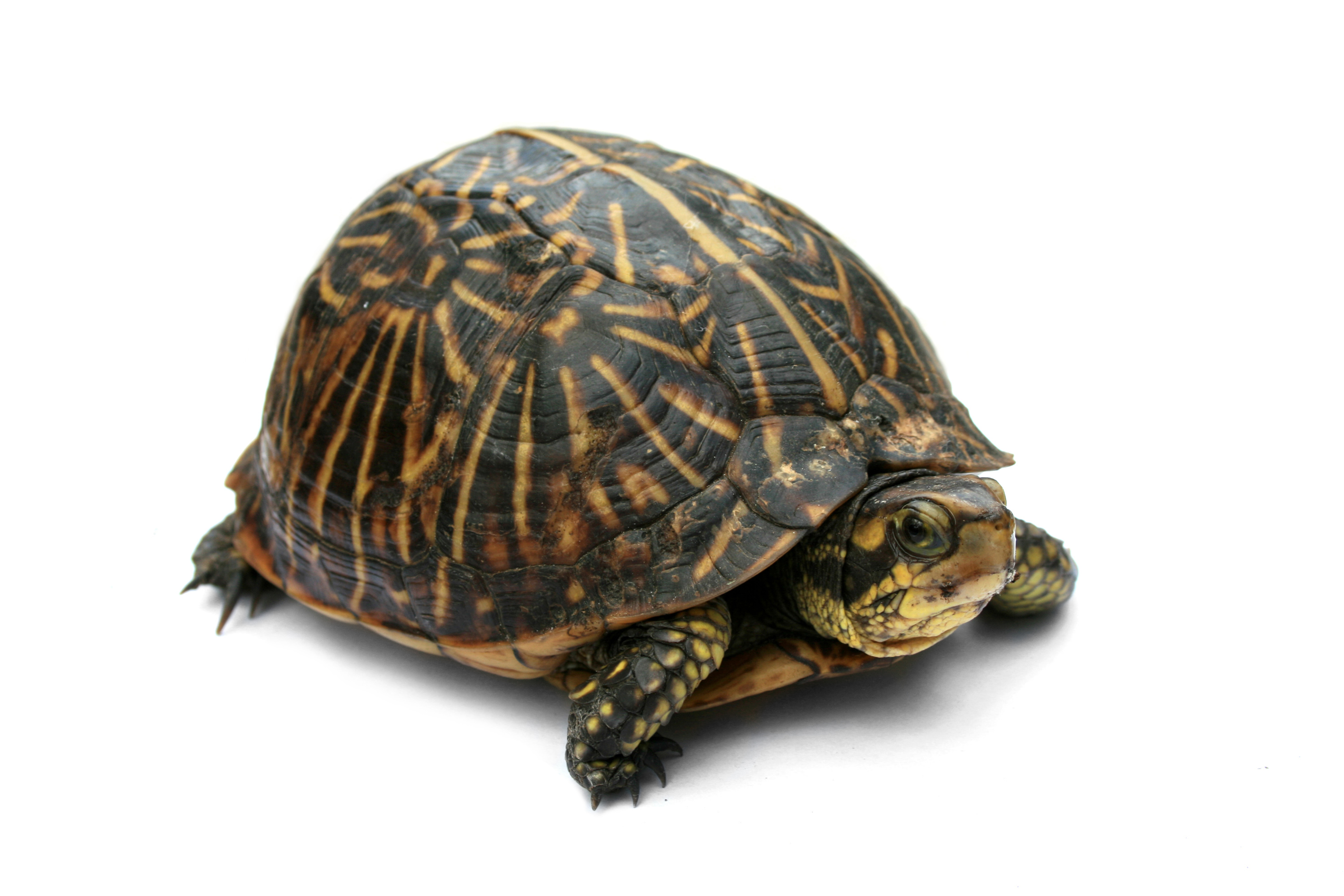
Photo: “Jonathan Zander ( Digon3 )" · CC BY-SA 3.0
A terrestrial North American turtle with a hinged plastron that lets it close its shell completely. Extremely long-lived and a poor terrarium animal — it does best in large outdoor enclosures and is protected or collection-restricted in many US states.
ℹ️
Educational only. KinStation content is reviewed by licensed veterinarians but cannot replace an in-person exam. Always consult a licensed veterinarian or board-certified specialist for diagnosis, treatment, or any decision affecting your pet's health.
🩺 Need expert help with your eastern box turtle?
Connect with a specialist near you or ask a licensed vet — never substitute online guidance for hands-on care in an emergency.
Medium: 11-15 cm (4.5-6 in) carapace; high-domed shell with hinged plastron
Lifespan
30–100 years
Social needs
solo
Native region
Eastern United States (Maine to Florida, west to the Great Plains)
Origin
New World
Climate
🍂 Temperate
Family
Emydidae
Genus
Terrapene
Part of the Freshwater turtles
Aquatic and semi-aquatic turtles kept in heated, filtered aquariums or ponds with basking areas, UVB, and clean water — from tiny musk turtles to large sliders.
From the minimum an animal needs to be kept humanely, up to the ideal setup. Bigger is almost always better — minimums are floors, not targets.
Photo coming soon
Minimum
Indoor pen
6 × 3 ft pen (semi-terrestrial)
Terrapene carolina reaches 5–7 in and is terrestrial (NOT aquatic). Minimum is a 6×3 indoor pen with deep humid substrate, leaf litter, soaking dish, basking 30 °C, 5–10% UVB, humidity 70–80%.
Photo coming soon
Recommended
Larger humid pen
8 × 4 ft+ humid pen
An 8×4 enclosure with deep humid substrate, dense leaf litter, hides, soaking pool, and live plants. Box turtles forage actively — provide varied food and hunting opportunity.
Photo coming soon
Ideal
Outdoor enclosure (seasonal)
Outdoor predator-proof pen, ≥ 50 sq ft
Seasonal outdoor predator-proof pen with sun/shade, dense planting, dig substrate, and soaking pool. Native to the eastern US — outdoor housing matches their evolved climate.
Life & growth stages
How this animal changes through its life — each stage often has its own care, diet and space needs.
Photo coming soon
Egg / Neonate
Most reptiles lay leathery- or hard-shelled eggs incubated by ambient warmth, though some snakes and lizards give live birth. Incubation temperature can influence sex and development in many species.
Photo coming soon
Hatchling
Hatchlings emerge as fully formed miniatures of the adult, often using an egg tooth to slit the shell. They are independent from birth but small and vulnerable, and may show brighter or different juvenile patterning.
Photo coming soon
Juvenile
Juveniles grow steadily, shedding their skin periodically as they enlarge. Coloration and proportions shift toward the adult form, and growth rate depends heavily on temperature, diet, and basking/UVB access.
Adult
Adults reach the species' full length and mass and become sexually mature. Many reptiles show sex differences in size, coloration, or features (such as larger heads, hemipenal bulges, or femoral pores), and continue to shed throughout life.
Color & pattern variants
Natural variants occur in the wild; selectively bred (man-made) variants were developed in captivity.
Natural
representative
Eastern box turtle (T. c. carolina)
CommonIntermediate
The nominate subspecies, with a high-domed dark shell richly patterned in yellow-orange radiating lines and blotches; males often show striking red eyes. The classic box turtle of the eastern US woodlands.
Tip: This is a temperate, cool-climate animal — provide an outdoor pen with deep moist substrate for natural brumation rather than keeping it warm indoors year-round. Wild-caught adults stress badly; seek captive-bred stock.
representative
Three-toed box turtle (T. c. triunguis)
CommonIntermediate
A more westerly subspecies, typically olive-tan with a duller, less contrasting carapace pattern and usually three hind toes; males may develop orange/red head markings. Considered one of the hardier, more adaptable box turtles.
Tip: Often the most forgiving box turtle for beginners to the species, but it still needs high humidity and a planted outdoor enclosure — dry indoor setups cause ear abscesses and shell pyramiding.
representative
Gulf Coast box turtle (T. c. major)
UncommonAdvanced
The largest subspecies, from the Gulf states, with an elongated flared rear carapace, often darker/duller coloration and a tendency to mahogany or near-black shells. Frequently intergrades with other subspecies.
Tip: Coming from warm, humid Gulf habitat it is less cold-tolerant — do not brumate it as hard as northern Easterns, and keep humidity high. Its larger size demands a correspondingly bigger outdoor pen.
representative
Florida box turtle (T. c. bauri)
UncommonAdvanced
A small, bright subspecies endemic to Florida, with a narrow domed shell carrying bold radiating yellow lines and two distinctive yellow stripes on each side of the head. One of the most ornate box turtles.
Tip: Being subtropical, it is the least cold-hardy Eastern box turtle — never brumate it in cold-winter regions; overwinter indoors warm and humid or keep it strictly in a frost-free climate.
A land turtle that needs space, humidity, and a natural day/night and seasonal cycle. Outdoor predator-proof pens (at minimum ~3.7 m² / 40 sq ft per adult) with planted cover, hides, a shallow soaking dish, and shade are strongly preferred over indoor tanks. If kept indoors, use a large enclosure (minimum ~1.2 x 0.6 m floor) — not a glass aquarium. Daytime gradient 24-29°C (75-85°F) with a basking spot near 30-32°C (86-90°F), nighttime drop, and high humidity (60-80%). UVB is essential. Many keepers brumate temperate stock in winter.
Substrate
Deep, moisture-retaining, burrowable substrate: a mix of topsoil, coco coir, and leaf litter, kept slightly damp to hold humidity and allow digging. Outdoors, planted soil with leaf litter and logs is ideal. Avoid sand-heavy or dusty mixes and anything that stays soggy.
Equipment & setup
UVB (T5 10.0 or mercury-vapor) over a basking area, a basking heat lamp, and a thermostat. Hygrometer and thermometers to track the warm/cool and humid gradient. Large shallow water dish for soaking, multiple hides, and live or sturdy plants for cover. For outdoor pens: secure walls, a dig barrier, and overhead netting against predators.
Diet
Omnivore with a strong appetite for animal protein, especially when young. Offer earthworms, snails, slugs, crickets, dubia roaches, and the occasional pinky; plus a wide variety of leafy greens, vegetables, mushrooms, and fruit (berries, melon). Dust with calcium and provide a multivitamin with vitamin A periodically. Variety is key — monotonous diets cause deficiencies.
Behavior & temperament
Generally docile and not prone to biting, but it is a shy, easily stressed land turtle that does not enjoy frequent handling. Wild-caught adults often fail to acclimate and may chronically refuse food. They have strong homing instincts and site fidelity, which is one reason wild collection is so damaging. Best observed in a naturalistic pen rather than handled.
Health
Sensitive to poor husbandry: low humidity and inadequate UVB lead to dehydration, swollen eyes/aural abscesses (often vitamin A deficiency), and metabolic bone disease. Respiratory infections follow cold or damp-and-cold conditions. Provide regular soaks, dietary variety, and proper UVB. Like all turtles they can carry Salmonella — wash hands after contact. Always buy captive-bred — wild-caught box turtles carry high stress, parasite loads, and poor survival, and removing them harms declining wild populations.
Tips, DIY & hacks
Check your local laws first — Terrapene carolina and its subspecies are protected, collection-restricted, or require permits in many US states (and the whole genus Terrapene was listed on CITES Appendix II in 2023; IUCN lists the species as Vulnerable), so keeping, selling, or moving them across state or national borders may be regulated. Never release a captive or relocate a wild one; their homing drive and site fidelity make displacement often fatal. Provide an outdoor pen and consider brumation for temperate animals to mimic their natural cycle.