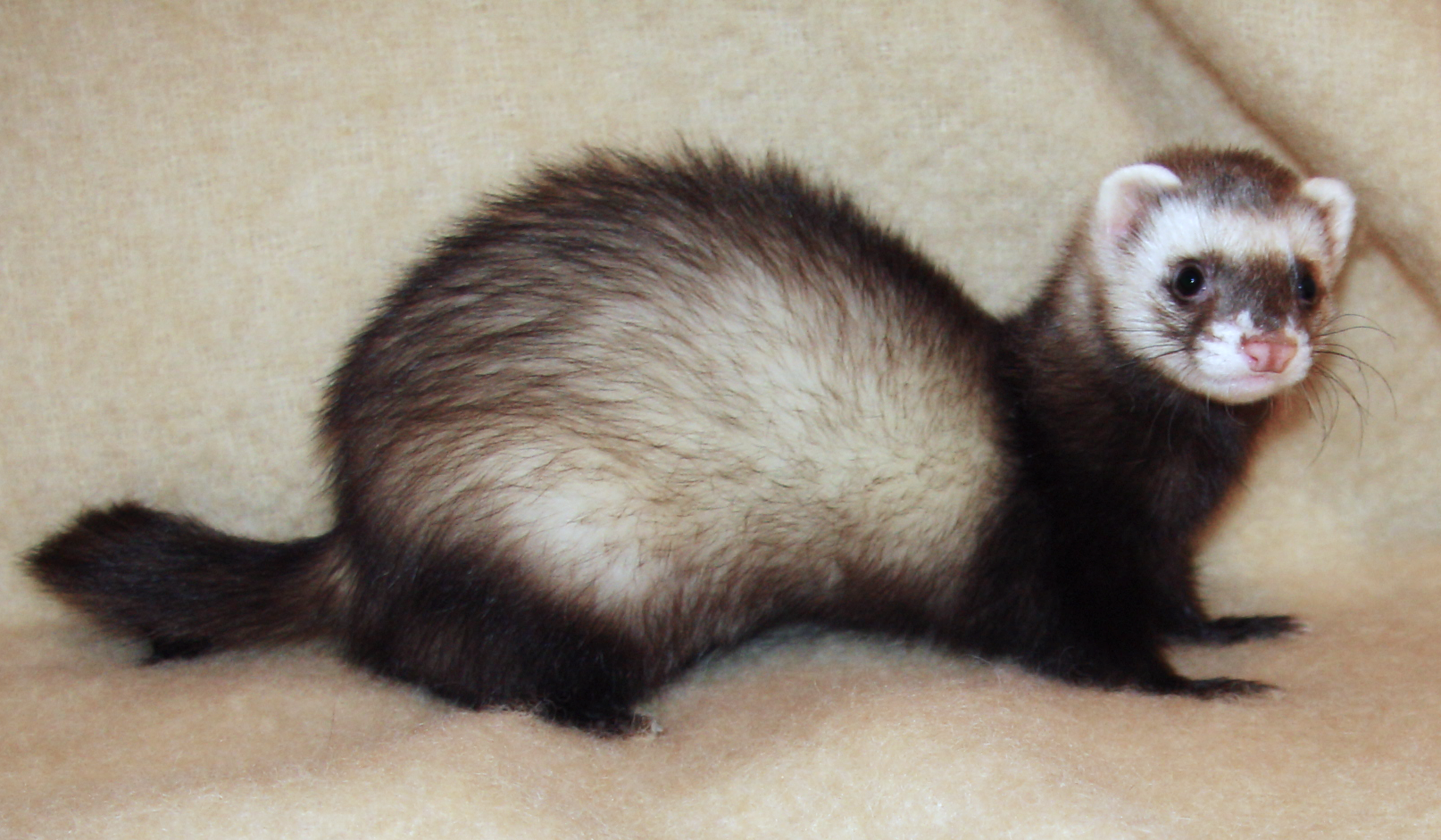
Ferrets are domesticated mustelids kept as energetic, intensely playful companion animals. Their legal status varies by state and city, and they require ferret-proofing, vaccinations, and a high-protein diet.
ℹ️
Educational only. KinStation content is reviewed by licensed veterinarians but cannot replace an in-person exam. Always consult a licensed veterinarian or board-certified specialist for diagnosis, treatment, or any decision affecting your pet's health.
🩺 Need expert help with your ferret?
Connect with a specialist near you or ask a licensed vet — never substitute online guidance for hands-on care in an emergency.
Adults 13–16 inches body plus tail, 0.7–4.5 lb (males larger).
Lifespan
6–10 years
Social needs
pair
Native region
domesticated (worldwide); derived from the European polecat
Climate
🍂 Temperate
Family
Mustelidae
Genus
Mustela
Part of the Ferrets
Domesticated mustelids descended from the European polecat, kept as playful, highly social carnivorous pets.
More ferrets coming soon.
Sounds & video
🎬 Video
Ferrets (Mustela putorius furo)
Dani Winter · Wikimedia Commons · CC BY 3.0
Habitat & space requirements
From the minimum an animal needs to be kept humanely, up to the ideal setup. Bigger is almost always better — minimums are floors, not targets.
Minimum
Multi-level wire cage
≈ 24 × 24 × 18 in per level (multi-level)
A single-ferret floor of cage is never enough; the welfare floor is a tall multi-level wire cage of roughly 24 × 24 in per shelf with solid (not wire) flooring, multiple levels, hammocks, a litter box, and a closed sleeping sack. Ferrets are obligate social animals and need a same-species companion plus at least 4 hours of daily out-of-cage play, since the cage is only for sleeping and feeding, not living.
DracoEssentialis / CC BY 3.0 (Wikimedia Commons)
Photo coming soon
Recommended
Large multi-level ferret cage
≈ 36 × 24 × 60 in tall, 3–4 levels
A responsible keeper provides a tall, multi-level cage around 36 × 24 in footprint with three or four solid levels connected by ramps, several hammocks, tunnels, a dig box, and a dedicated litter corner. Keep at least a bonded pair at a stable 15–24 °C (ferrets overheat easily above 27 °C), with several hours of supervised free-roam time daily for the climbing, tunnelling, and play this curious species demands.
Photo coming soon
Ideal
Ferret-proofed free-roam room
Dedicated ferret-proofed room / open free-roam
The best welfare outcome is a fully ferret-proofed room or open free-roam home (cage only as a base) with tunnels, multiple hammock and hide options, dig boxes, and climbing furniture for constant enrichment. A bonded group thrives here at 15–24 °C with rotating toys and foraging games, giving the natural exploring, burrowing, and play behaviour a cage simply cannot provide.
Life & growth stages
How this animal changes through its life — each stage often has its own care, diet and space needs.
Photo coming soon
Newborn
Newborn mammals are nursed on their mother's milk. Many are born helpless — blind, deaf, and sparsely furred (altricial, as in dogs, cats, and rodents) — while others stand and follow within hours (precocial, as in hoofed livestock).
Photo coming soon
Juvenile
After weaning, juveniles grow quickly and become increasingly active, playful, and independent. Adult coat, proportions, and (in many species) the permanent teeth come in as they approach full size.
Photo coming soon
Adult
Adults reach full body size and sexual maturity, with the species' mature coat and build. Sexual dimorphism — differences in size, mane, horns, or markings — is pronounced in some mammals and subtle in others.
Senior
Senior animals show aging signs such as graying fur, reduced activity, and a greater need for veterinary monitoring of joints, teeth, and organ function. Lifespan and the onset of old age vary widely by species and size.
Color & pattern variants
Natural variants occur in the wild; selectively bred (man-made) variants were developed in captivity.
Ferrets do best with a tall, multi-level wire cage furnished with hammocks, soft hides, a litter pan, and chew-safe toys — but the cage is only their home base. They need several hours of supervised play outside it every day in a thoroughly ferret-proofed room, because confinement alone does not meet their activity needs.
Ferret-proofing is its own discipline. They squeeze through astonishingly small gaps, burrow into furniture, and chew soft rubber, foam, and plastic — materials that can cause life-threatening intestinal blockages. Block holes, secure low cabinets and appliances, and remove swallowable soft items before free time.
They tolerate normal household temperatures but are heat-sensitive, so keep them out of hot, unventilated spaces. Legal status varies: ferrets are prohibited in some U.S. states and historically restricted in some cities, and rabies-vaccination requirements apply in many places — check local laws before acquiring one.
Substrate
Ferrets do not need loose bedding in living areas; use a wire multi-level cage with solid or coated platforms and provide soft fabric hammocks, fleece blankets, and sleep sacks for nesting. Train them to a corner litter box filled with paper-based or wood-pellet litter, never clay or clumping litter, which causes respiratory and ingestion problems. Wash fabric bedding frequently to control the natural musky odor.
Equipment & setup
Provide a large, secure multi-tier cage with tight bar spacing (they squeeze through tiny gaps) for when unsupervised, plus several hours of daily out-of-cage play in a ferret-proofed space. Keep them cool (below about 26 C) since they are very prone to heatstroke and have no heat lamp requirement. Feed a high-protein, high-fat, meat-based diet (quality ferret kibble or raw) and keep them current on rabies and distemper vaccines.
Diet
Ferrets are obligate carnivores with a fast metabolism and a short digestive tract. The standard diet is a high-quality ferret kibble, or an appropriately balanced whole-prey or raw diet, built on high animal protein and fat with minimal carbohydrate. They are not adapted to fruits, vegetables, or sugary treats, and high-carbohydrate or plant-based foods are inappropriate.
Because of that quick transit time, ferrets typically eat small amounts often, so food is usually available throughout the day. A common, serious mistake is offering sugary 'treats' — these are linked to health problems and should be avoided. Toxic foods include chocolate, onion, garlic, and xylitol. Provide fresh water at all times.
Swallowed foreign material is a feeding-adjacent hazard worth repeating: ferrets that chew and ingest rubber or foam can develop blockages, so diet management goes hand in hand with rigorous ferret-proofing.
Behavior & temperament
Ferrets are intensely playful, curious, and social, and many keepers house them in pairs or small groups. Their waking hours are a whirlwind of investigating, wrestling, and stashing 'treasure' — anything portable and unattended may be stolen and hidden. They also sleep deeply for long stretches, sometimes so soundly that new owners worry, before bouncing back into play.
The signature behaviour is the 'weasel war dance': a frenzied, sideways hopping bounce that signals excitement and an invitation to play, often accompanied by soft clucking 'dooks.' Hisses signal annoyance or fear. They are smart and trainable but persistent and mischievous, so consistency and supervision matter.
Their boldness and burrowing instinct make them escape artists and chewers, which is why behaviour and habitat safety are inseparable for this species.
Health
Ferrets benefit from a relationship with a ferret-experienced veterinarian, annual wellness exams, and the vaccinations standard for the species (rabies and canine distemper), with timing set by your veterinarian. Distemper is uniformly serious in ferrets, which is why prevention is emphasised.
Several conditions are notably common as ferrets age. Adrenal disease causes hormone overproduction with hair loss and other changes; insulinoma, a pancreatic tumour, causes dangerously low blood sugar and can lead to weakness, collapse, or seizures; lymphoma and dental disease are also frequently seen. These require veterinary diagnosis and management — not home remedies.
Owner vigilance pays off: sudden lethargy, hind-end weakness, hair loss, weight loss, or pawing at the mouth all warrant prompt evaluation. Many ferret diseases are very treatable when caught early.
Tips, DIY & hacks
Build cheap enrichment with dryer-hose tunnels, ball pits, and dig boxes of rice or pellets, as ferrets love tunneling and stashing items. Ferret-proof aggressively: block holes behind appliances, secure reclining furniture, and remove soft rubber/foam objects they may chew and swallow (a common intestinal-blockage emergency). Keep them in bonded pairs or groups for company, and budget for adrenal disease and insulinoma, which are very common as they age.
Origin & history
The domestic ferret (Mustela putorius furo) was domesticated thousands of years ago, most likely from the European polecat, and was historically used for hunting rabbits and rodents — a practice called 'ferreting.' Their name and slinky build still reflect that working past.
Today they are kept primarily as companions, bred in a range of coat colours and patterns (such as sable, albino, and silver). In the United States their legality is uneven — banned in some states and regulated in some municipalities, frequently tied to rabies-vaccination and licensing rules — so checking local law is an essential first step.
Anecdotes & owner lore
Community experience and cultural notes — not veterinary advice. Every animal is an individual; treat these as colour, not care instructions.
A group of ferrets is delightfully called a 'business,' and the term fits: a business of ferrets is a chaotic, joyful operation. Owners universally describe the 'weasel war dance' — the bouncing, head-flung, dooking frenzy that means a ferret is having the time of its life — as the moment they fell for the species.
Their other defining habit is theft. Ferrets are compulsive hoarders who will spirit away keys, socks, remote controls, and phone chargers into a secret stash behind the couch; many a household keeps a 'ferret cache' checklist for missing items. They are also champion sleepers, conking out so completely that the 'dead sleep' startles first-time owners before the ferret springs up ready to wrestle again.
Common ailments
Dental disease — common
Adrenal disease (hyperadrenocorticism) — very common — Most often seen in ferrets over about three years old; symmetrical hair loss is a classic prompt for a vet visit.
Insulinoma — very common — Frequently diagnosed in ferrets older than about three years; episodes of weakness or collapse are an emergency.
Lymphoma — common
Reviewed and signed off by: KinStation Editorial - pre-launch draft (pending DVM review)