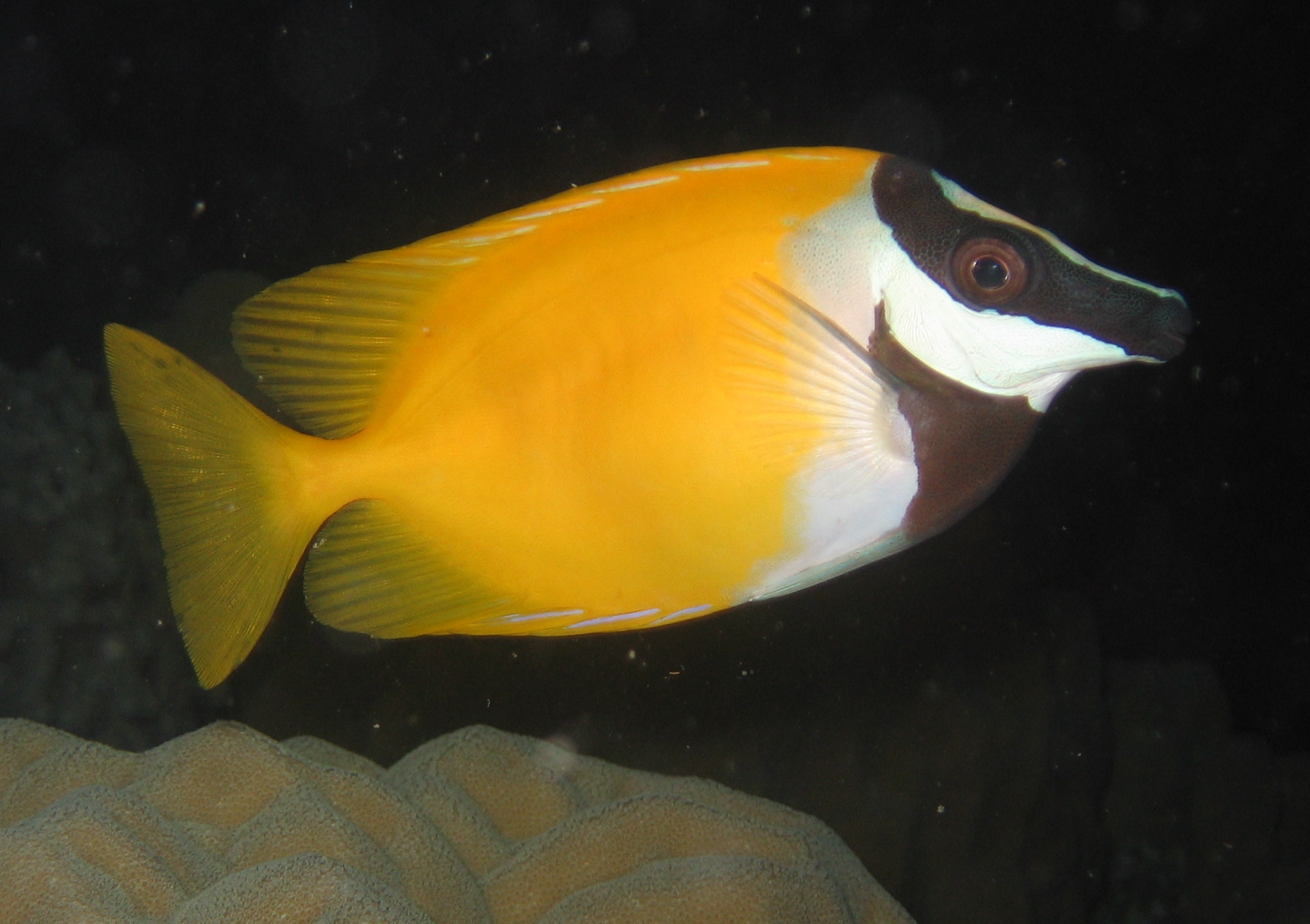
A striking yellow-bodied rabbitfish with a black-and-white foxlike face and venomous dorsal spines. Hardy, largely reef-safe, and a superb natural algae grazer, though it needs a big tank and careful handling because of its venom.
ℹ️
Educational only. KinStation content is reviewed by licensed veterinarians but cannot replace an in-person exam. Always consult a licensed veterinarian or board-certified specialist for diagnosis, treatment, or any decision affecting your pet's health.
🩺 Need expert help with your foxface rabbitfish?
Connect with a specialist near you or ask a licensed vet — never substitute online guidance for hands-on care in an emergency.
Rabbitfish (Siganidae) are hardy, algae-grazing marine fish with gentle rabbit-like faces and, crucially, venomous fin spines that demand careful handling. Most are peaceful, largely reef-safe herbivores that earn their keep as natural algae control in larger reef and FOWLR aquariums.
More rabbitfish coming soon.
Habitat & space requirements
From the minimum an animal needs to be kept humanely, up to the ideal setup. Bigger is almost always better — minimums are floors, not targets.
Photo coming soon
Minimum
Reef-safe algae grazer
75 gal / 284 L FOWLR or reef
Siganus vulpinus reaches 9 in. 75-gal minimum FOWLR or reef with abundant macroalgae for grazing, mature live rock, and peaceful tankmates. Reef-safe but may nip soft corals. Venomous dorsal spines — handle carefully.
Recommended
Reef display grazer
125 gal / 473 L reef
125-gal reef with abundant algae, mature aquascape, and peaceful tankmates. One of the best algae grazers in saltwater — handles hair algae well.
miszamisik / CC BY-SA 3.0 (Wikimedia Commons)
Photo coming soon
Ideal
Large mature reef
180 gal+ / 681 L+ mature reef
Mature 180-gal+ reef with deep aquascape, established algae, and peaceful community. Long-lived and stunning yellow colour with black face mask.
Life & growth stages
How this animal changes through its life — each stage often has its own care, diet and space needs.
Photo coming soon
Egg
Fish eggs are small, translucent spheres, often laid in clutches on plants, substrate, or in a nest — or carried/brooded by a parent in livebearing and mouth-brooding species. A dark eye spot and the curled embryo become visible inside as development progresses.
Photo coming soon
Fry
Newly hatched fry are tiny and semi-transparent, frequently still carrying a yolk sac that fuels them before they feed freely. They lack full fin structure and adult coloration, staying near cover until they can swim and forage on their own.
Photo coming soon
Juvenile
Juveniles look like miniature adults but with developing fins and muted or different markings; many species shift pattern and color as they mature. Growth is rapid at this stage given clean water and steady feeding.
Adult
Adults show the species' full size, finnage, and mature coloration, and are sexually mature. Many fish develop sex-specific differences in size, color, or fin shape, which can intensify during breeding.
Habitat & enclosure
Because it grows to nearly 10 inches and is an active swimmer, a foxface needs a large aquarium of at least 75 gallons (285 L), with 100+ gallons better for a full-grown adult. Provide abundant live rock with caves and overhangs for grazing and a secure sleeping spot, plus open water for cruising; foxfaces often adopt a hideout where they turn a mottled brown at night.
Maintain stable tropical reef conditions: temperature 72-80 F (22-27 C), pH 8.1-8.4, salinity 1.020-1.025 specific gravity, and moderate flow. They appreciate plenty of algae growth on the rockwork to browse, making a mature, established reef ideal.
Substrate
A bed of fine aragonite sand suits a reef display and supports biological filtration. Aquascape with plenty of mature live rock so the fish has algae to graze and caves to shelter and sleep in.
Equipment & setup
Provide strong biological filtration and a protein skimmer with a reliable heater and moderate flow from one or two powerheads. Reef-grade lighting is beneficial because it encourages the algae growth this grazer thrives on; it pairs well with a coral display.
Diet
Foxface rabbitfish are primarily herbivores and excellent algae grazers, helping control hair algae and other nuisance growth. Provide dried marine algae or nori on a clip daily, plus a varied diet of spirulina-based foods, mysis, and other prepared marine fare to keep them well-conditioned. Feed once or twice daily, supplementing the natural grazing.
A herbivore-forward diet keeps colors vivid and prevents deficiencies; relying only on meaty foods is not ideal. Established tanks with natural algae give them constant foraging and enrichment.
Behavior & temperament
Foxfaces are peaceful, somewhat shy at first, and generally reef-safe, usually leaving corals alone — though a hungry or under-fed individual may occasionally nip soft corals or LPS, so feed them well. They are best kept singly unless in a very large system, as two unfamiliar rabbitfish may quarrel; they coexist peacefully with most community reef fish. They can be territorial toward other rabbitfish or similar-shaped fish.
Their dorsal, anal, and pelvic spines are venomous and deliver a painful sting, so handle with extreme care and net cautiously. They become confident once settled and patrol the tank grazing; ample algae and rockwork provide natural enrichment.
Health
Foxfaces are hardy once acclimated but susceptible to marine ich (Cryptocaryon) and velvet, especially when stressed; their color-changing to a blotchy pattern is normal at night or when alarmed and is not illness. Lateral line erosion (HLLE) can appear with poor diet or water quality, so feed vitamin-rich greens and keep nitrate low.
The venomous spines are a hazard to the keeper, not the fish — a sting is painful but rarely dangerous; soak the wound in hot water and seek care if reactions are severe. Quarantine new fish and acclimate slowly to prevent parasite outbreaks.
Tips, DIY & hacks
Handle and net with great care to avoid the venomous spines; if stung, immerse the area in hot (not scalding) water to break down the venom. Clip nori or dried algae daily so the foxface stays well-fed and is less tempted to sample corals, and quarantine before adding to a display.