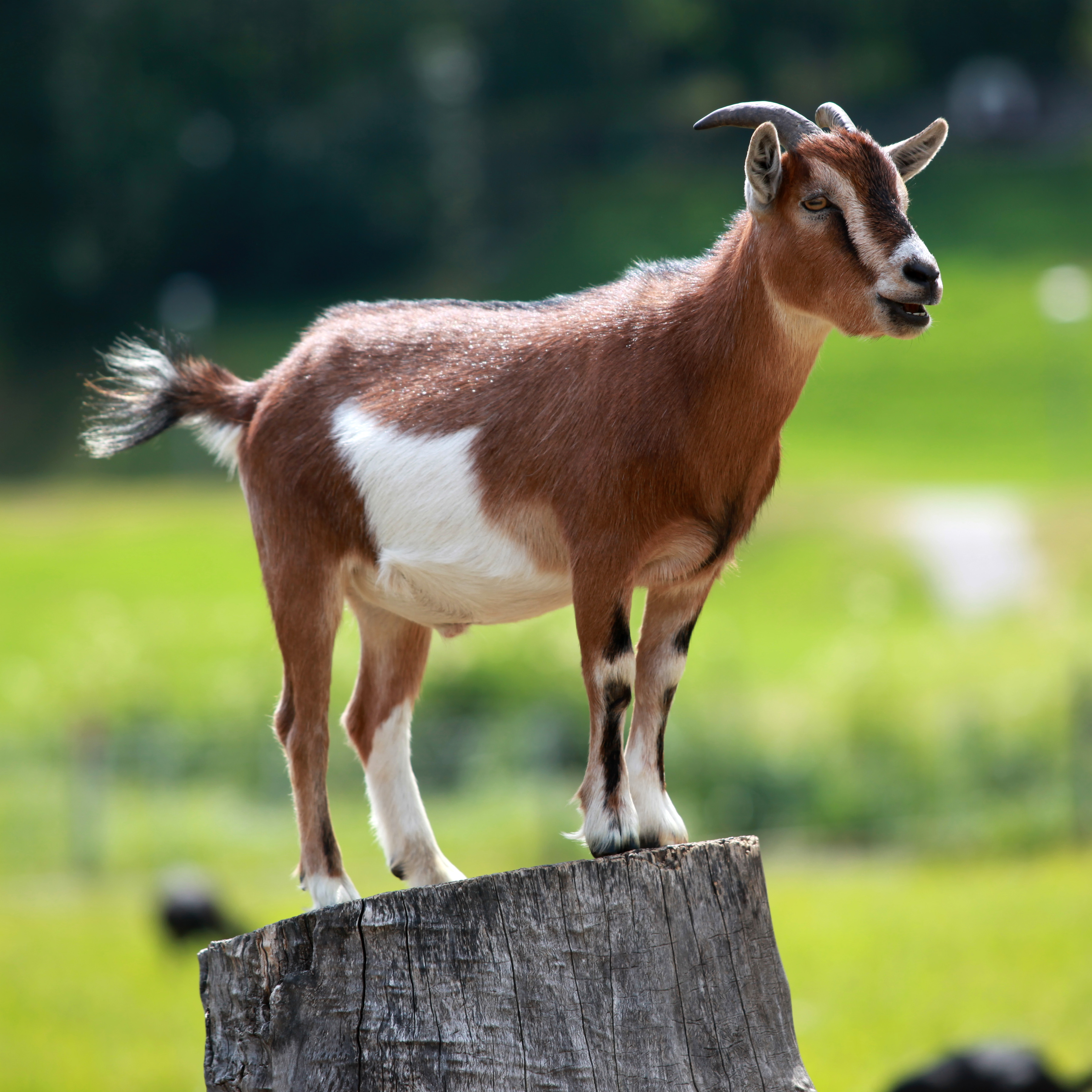
The domestic goat is a hardy, intelligent, intensely social browsing ruminant kept for milk, fiber, brush control, and increasingly as a companion animal. Goats must be kept in pairs or herds and need secure fencing, a dry shelter, and free-choice forage plus loose minerals.
ℹ️
Educational only. KinStation content is reviewed by licensed veterinarians but cannot replace an in-person exam. Always consult a licensed veterinarian or board-certified specialist for diagnosis, treatment, or any decision affecting your pet's health.
🩺 Need expert help with your domestic goat?
Connect with a specialist near you or ask a licensed vet — never substitute online guidance for hands-on care in an emergency.
Highly breed-dependent: Nigerian Dwarf wethers ~35-75 lb and 17-23 in at the withers; standard dairy breeds (Nubian, Alpine, Saanen) 100-200+ lb and 28-36 in.
Lifespan
10–18 years
Social needs
group
Native region
Southwest Asia / Middle East (domesticated from the wild bezoar ibex)
Origin
Old World
Climate
🌍 Varied
Family
Bovidae
Genus
Capra
Part of the Goats
Domestic goats kept for milk, fiber, brush control, and companionship — from Nigerian Dwarfs to full-size dairy and meat breeds. Hardy, clever, climbing herd animals that need company, secure fencing, and goat-specific minerals.
More goats coming soon.
Habitat & space requirements
From the minimum an animal needs to be kept humanely, up to the ideal setup. Bigger is almost always better — minimums are floors, not targets.
Photo coming soon
Minimum
Pair + browse paddock + shed
0.25 ac paddock for 2 head + 3-sided shed + climb area
Meat goats are still herd animals — keep at least 2. Paddock with browse, climbing logs/rocks, a 3-sided shed, hay, minerals (copper + selenium where deficient), and a 5 ft tight-bottom fence.
Photo coming soon
Recommended
Rotated browse pasture
≈ 0.5 ac per goat, rotated paddocks
Rotate paddocks across varied browse to manage parasites and forage. Provide free-choice minerals, clean water, a shelter/windbreak, and an LGD or strong perimeter fence against coyotes and stray dogs.
Photo coming soon
Ideal
Pasture + browse + barn
Managed rotation, barn, separate buck pen
Mixed pasture and browse with climbing terrain, a kidding barn, and a separate buck pen. Hoof trimming every 6–8 weeks, parasite monitoring, and routine vet/breed health checks. Domestic goats range from dwarf companions to large meat and dairy lines — all are browsers, all are herd animals, all need tight fencing and climbing enrichment.
Life & growth stages
How this animal changes through its life — each stage often has its own care, diet and space needs.
Photo coming soon
Newborn
Newborn mammals are nursed on their mother's milk. Many are born helpless — blind, deaf, and sparsely furred (altricial, as in dogs, cats, and rodents) — while others stand and follow within hours (precocial, as in hoofed livestock).
Photo coming soon
Juvenile
After weaning, juveniles grow quickly and become increasingly active, playful, and independent. Adult coat, proportions, and (in many species) the permanent teeth come in as they approach full size.
Photo coming soon
Adult
Adults reach full body size and sexual maturity, with the species' mature coat and build. Sexual dimorphism — differences in size, mane, horns, or markings — is pronounced in some mammals and subtle in others.
Senior
Senior animals show aging signs such as graying fur, reduced activity, and a greater need for veterinary monitoring of joints, teeth, and organ function. Lifespan and the onset of old age vary widely by species and size.
Color & pattern variants
Natural variants occur in the wild; selectively bred (man-made) variants were developed in captivity.
Goats need a dry, draft-free, well-ventilated shelter (a three-sided run-in shed or a simple barn stall) plus a fenced pasture or dry lot. Plan a rough minimum of **15-20 sq ft of indoor space per goat** and **200+ sq ft of outdoor space each**, more if you want them to graze rather than be hand-fed. They are notorious escape artists and climbers, so fencing is the single biggest investment: woven-wire field fence, cattle panels, or electrified high-tensile wire at least 4-4.5 ft high, with no gaps a head can fit through (goats get their horned heads stuck and then panic). Provide raised platforms, stumps, rocks, or spools to climb on — climbing is a core behavioral need. Shelter floors should stay dry; goats are very susceptible to respiratory disease and foot rot in damp, ammonia-laden conditions.
Substrate
Bed the shelter deep and dry. Straw is the most common bedding (warm, good for kidding); pine shavings or a deep-litter straw/wood-shavings pack work well and compost beautifully afterward. Avoid cedar shavings (aromatic oils) and never let bedding stay damp — wet, ammonia-soaked litter drives respiratory disease and foot rot. The **deep-litter method** (adding fresh bedding over packed older layers through winter) generates warmth and is popular for cold climates; just muck heavily soiled spots and do a full clean-out periodically. Pasture and dry-lot areas should drain well to keep hooves dry.
Equipment & setup
Essentials: secure goat fencing (woven wire / cattle panels / electric), a dry shelter, **hay feeder or keyhole/manger feeder** mounted off the ground to cut waste and parasite load, a heavy non-tip water trough or heated bucket for winter, a free-choice loose-mineral feeder, and a baking-soda feeder. Husbandry tools: hoof trimmers, a FAMACHA card, a fitting/milking stand (doubles as a restraint stand for hoof trims and exams), and a livestock scale or weight tape. For milkers add a stainless milk pail, teat dip, and filtration. A good first-aid kit (thermometer, electrolytes, probiotics, vet wrap) and the contact info of a ruminant vet round it out.
Diet
Goats are **browsers**, not grazers — they naturally prefer shrubs, weeds, brambles, and leaves over grass, which makes them excellent at brush clearing. The bulk of the diet should be forage: pasture/browse plus free-choice grass hay (legume hay like alfalfa for lactating does and growing kids). Provide **free-choice loose goat minerals** (not a block — goats can't lick enough off a block) with adequate copper and selenium; goat copper needs are higher than sheep, so never feed sheep mineral to goats. Grain/concentrate is only needed for milkers, late-pregnant does, and growing kids, and must be limited to avoid acidosis, urinary calculi (especially in wethers and bucks), and obesity. Always provide clean fresh water and a baking-soda (sodium bicarbonate) free-choice option to buffer the rumen. Many common ornamentals (rhododendron, azalea, mountain laurel, yew, wilted cherry/plum leaves) are deadly — fence them out.
Behavior & temperament
Goats are curious, playful, and highly social herd animals with a clear dominance hierarchy expressed by head-butting and 'pecking-order' resource control. A lone goat is a stressed goat — they cry, escape, and decline, so two is the practical minimum. They are very intelligent and trainable (clicker, lead, agility, even cart-pulling), bond strongly with humans and herd-mates, and recognize their keeper. Disbudded or naturally polled goats are safer to keep around children and easier to keep from snagging on fences than horned goats. Bucks in rut develop a strong odor and rough behavior and are best kept separately from does; most pet owners keep wethers (castrated males), which stay friendly, odor-free, and healthy if their diet manages urinary-calculi risk.
Health
Core preventive care: an annual **CDT vaccine** (clostridial enterotoxemia types C & D plus tetanus), routine hoof trimming every 6-8 weeks, and a parasite-management plan built on **FAMACHA eyelid scoring and fecal egg counts** rather than blind deworming (barber-pole worm resistance is now widespread). Watch for the big killers: enterotoxemia ('overeating disease'), pneumonia, urinary calculi in males, bloat, and pregnancy toxemia/ketosis in late-pregnant does. Keep copper and selenium adequate (deficiency is common and region-dependent). Test/manage the contagious herd diseases CAE, CL, and Johne's, especially when buying new stock. Find a large-animal or small-ruminant vet *before* you need one, as not all companion-animal vets see goats.
Tips, DIY & hacks
Get **at least two** goats — companionship is a welfare requirement, not a preference. Buy disbudded or polled stock if you want a kid-friendly, fence-safe goat. Walk your fence line as if you were a goat: anything they can climb, lean on, or stick a head through is a problem. Use a milking/fitting stand as your all-purpose handling station — feed grain on it and even fractious goats learn to load themselves for hoof trims and shots. Manage parasites with FAMACHA + fecals, not calendar deworming, to slow resistance. Watch wether diets closely (limit grain, ensure a 2:1 calcium:phosphorus ratio and good water intake) to prevent urinary stones, a top cause of pet-wether death. Browse-clearing 'goat rental' is real, but always check that nothing toxic grows in the area first. Many municipalities zone goats as livestock and restrict or ban them in residential areas, so confirm local rules before buying.