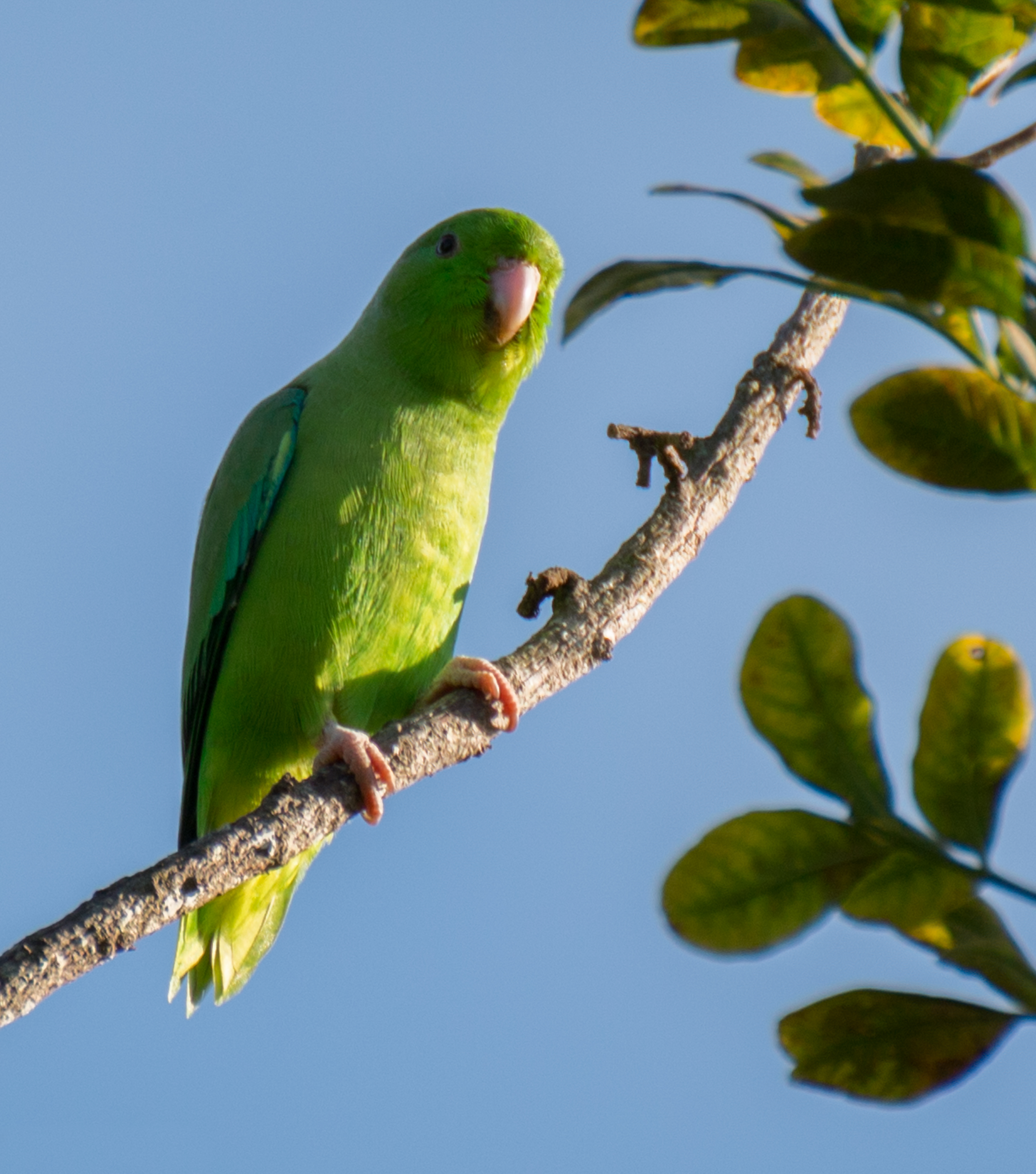
One of the smallest true parrots, the green-rumped parrotlet is a tiny, feisty South American bird often called a 'pocket parrot.' It packs the attitude and intelligence of a large parrot into a finch-sized body.
ℹ️
Educational only. KinStation content is reviewed by licensed veterinarians but cannot replace an in-person exam. Always consult a licensed veterinarian or board-certified specialist for diagnosis, treatment, or any decision affecting your pet's health.
🩺 Need expert help with your green-rumped parrotlet?
Connect with a specialist near you or ask a licensed vet — never substitute online guidance for hands-on care in an emergency.
Northern South America (and parts of the Caribbean)
Origin
New World
Climate
🌴 Tropical
Family
Psittacidae
Genus
Forpus
Part of the Parrotlets
Parrotlets (genus Forpus and relatives) are among the smallest parrots in the world, tiny New World birds with bold, big-parrot personalities and strong pair bonds.
From the minimum an animal needs to be kept humanely, up to the ideal setup. Bigger is almost always better — minimums are floors, not targets.
Photo coming soon
Minimum
Pair cage + out time
≈ 18 × 18 × 24 in, ½ in bar spacing
Green-rumped Parrotlets are tiny (≈ 25 g) South American parrots best kept in bonded pairs or with intense single-keeper bonding. A welfare minimum is an 18 × 18 × 24 in cage with ½ in bar spacing, multiple varied perches, foraging toys, a bath dish, and daily supervised out-of-cage time.
Photo coming soon
Recommended
Flight cage / small aviary
≈ 30 × 18 × 30 in flight cage
A 30 × 18 × 30 in flight cage with rotating foraging toys, varied perches, a bath, and daily out-of-cage time keeps Parrotlets healthy. Despite their tiny size they have a big personality — single birds need many hours of human time, or pair them with a compatible mate.
Photo coming soon
Ideal
Walk-in aviary / bird room
Walk-in aviary or bird-safe room
A walk-in aviary or bird-safe room with branches, foraging substrate, and bathing gives Parrotlets room for short flights and natural behaviour. Provide a nest box, calcium, varied seed/pellet/veg diet, and avoid mixed-species aviaries — they can be feisty toward larger birds.
Life & growth stages
How this animal changes through its life — each stage often has its own care, diet and space needs.
Photo coming soon
Egg
Birds develop inside a hard-shelled egg incubated by the parent(s). Egg size, shell color, and clutch size vary by species; the embryo develops over days to weeks before hatching.
Photo coming soon
Hatchling / Chick
Hatchlings are either altricial — naked, blind, and dependent on parents (typical of parrots and songbirds) — or precocial — downy, mobile, and self-feeding soon after hatching (typical of poultry and waterfowl). Down gives way to the first feathers.
Photo coming soon
Juvenile / Fledgling
Fledglings grow in their juvenile plumage and begin to fly and feed themselves, though they may still beg from parents at first. Juvenile feathering is often duller than the adult and is replaced as the bird matures.
Adult
Adults attain full body size and mature plumage, and are capable of breeding. Many species show distinct adult coloration, and in sexually dimorphic birds males and females differ in plumage, size, or markings.
(c) Alejandro Luy, some rights reserved (CC BY-NC) via iNaturalist — https://www.inaturalist.org/observations/221693556
Color & pattern variants
Natural variants occur in the wild; selectively bred (man-made) variants were developed in captivity.
Despite their size, parrotlets are active and need room to fly; provide a cage of at least roughly 45 x 45 x 60 cm for one bird and larger for a pair, with bar spacing of about 1 cm to prevent escape and head entrapment. Furnish natural-wood perches of varied diameter, plenty of small chew and foraging toys, and a shallow bathing dish. A flight cage or aviary is ideal for exercise.
Keep them at comfortable room temperatures (about 18-29 C), away from drafts and cold; they are not cold-hardy. They need no UVB indoors with a balanced diet, though full-spectrum lighting is beneficial. Note that parrotlets are territorial and are usually housed singly or as a single bonded pair rather than in mixed groups.
Substrate
Use plain newspaper or paper towels on the cage floor for easy daily cleaning and droppings monitoring. Avoid loose corncob or shell litter, which can mold and be ingested by these small, curious birds.
Equipment & setup
Despite their tiny size, parrotlets need a roomy cage with narrow 1/2-inch bar spacing (they squeeze through wider bars) and natural perches of varied diameter for foot health. No heat lamp is required at room temperature; full-spectrum lighting aids vitamin D, and a shallow dish provides bathing.
Diet
Offer a base of formulated pellets or a small-parrot/parrotlet seed mix, supplemented daily with chopped vegetables and greens such as broccoli, carrot, leafy greens, and sprouts, plus small amounts of fruit. Their tiny size means obesity from fatty seeds (millet, sunflower) sets in quickly, so keep high-fat seeds limited.
Provide cuttlebone or a mineral block for calcium and clean fresh water daily. Avoid avocado, chocolate, caffeine, alcohol, and salty foods, all of which are toxic or harmful to such a small bird.
Behavior & temperament
Green-rumped parrotlets are bold, curious, and surprisingly fearless, behaving like miniature Amazons. Hand-raised single birds can be tame and devoted, while pairs bond strongly to each other and may be less interested in people. They can be nippy and territorial, especially in breeding condition, and do not always tolerate other birds.
They are intelligent and need daily enrichment and interaction: foraging toys, shreddables, swings, and gentle training. Some learn a few words. Consistent, gentle handling from a young age prevents the cage territoriality and nipping that can develop in under-socialized birds.
Health
Parrotlets are generally hardy but are prone to obesity and fatty liver disease on seed-rich diets, as well as respiratory infections, PBFD, polyomavirus, and egg-binding in breeding hens. Their small size means even minor illness or injury can become serious quickly.
Prevention includes a varied, controlled-fat diet, clean housing, quarantine of new arrivals, and routine avian-vet care. Because they mask illness well, any lethargy, fluffing, tail-bobbing, or reduced appetite should be treated as an emergency.
Tips, DIY & hacks
These bold, big-personality birds can be nippy and territorial, so handle daily from a young age and house singly unless deliberately pair-bonding. Provide plenty of small shreddable and foraging toys (millet sprays, palm strips, soft wood) for their busy beaks, and supervise around larger pets since they fearlessly challenge much bigger animals.