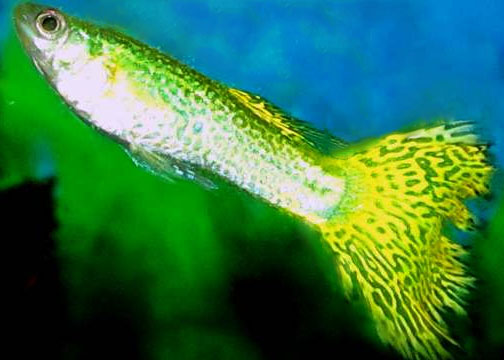
A hardy, brilliantly colored livebearer that breeds readily in the home aquarium, making it one of the most popular beginner fish in the hobby.
ℹ️
Educational only. KinStation content is reviewed by licensed veterinarians but cannot replace an in-person exam. Always consult a licensed veterinarian or board-certified specialist for diagnosis, treatment, or any decision affecting your pet's health.
🩺 Need expert help with your guppy?
Connect with a specialist near you or ask a licensed vet — never substitute online guidance for hands-on care in an emergency.
Northeastern South America (Venezuela, Guyana, Trinidad and the Caribbean); now widely introduced worldwide
Origin
New World
Climate
🌴 Tropical
Water type
💧 Freshwater
Family
Poeciliidae
Genus
Poecilia
Part of the Livebearers
Egg-free breeders that give birth to free-swimming fry — guppies, mollies, platies, swordtails and their dwarf relatives. Hardy, prolific, and beginner-friendly favorites of the freshwater hobby.
Soares D, Bierman H · Wikimedia Commons · CC BY 2.5
Habitat & space requirements
From the minimum an animal needs to be kept humanely, up to the ideal setup. Bigger is almost always better — minimums are floors, not targets.
Minimum
Small group planted
10 gal / 38 L planted
Poecilia reticulata reaches 1.5–2.5 in. 10-gallon planted tank for a single-sex group of 6+, or all-male group to avoid endless breeding. Hard slightly alkaline water, dense plants, gentle filtration.
Tamilbible / CC BY-SA 4.0 (Wikimedia Commons)
Photo coming soon
Recommended
Planted shoal display
15 gal / 57 L planted
15-gal planted with all-male group of 8–10 (best colour), or breeding colony with dense floating plants for fry survival. Peaceful tankmates only — long fins are nip targets.
Photo coming soon
Ideal
Selective-breeding display
20 gal+ / 76 L+ planted
Mature 20-gal+ planted with a selectively-bred line or pure-strain endler/guppy colony. Striking fin and colour variety in well-maintained displays.
Life & growth stages
How this animal changes through its life — each stage often has its own care, diet and space needs.
Photo coming soon
Egg
Fish eggs are small, translucent spheres, often laid in clutches on plants, substrate, or in a nest — or carried/brooded by a parent in livebearing and mouth-brooding species. A dark eye spot and the curled embryo become visible inside as development progresses.
Photo coming soon
Fry
Newly hatched fry are tiny and semi-transparent, frequently still carrying a yolk sac that fuels them before they feed freely. They lack full fin structure and adult coloration, staying near cover until they can swim and forage on their own.
Photo coming soon
Juvenile
Juveniles look like miniature adults but with developing fins and muted or different markings; many species shift pattern and color as they mature. Growth is rapid at this stage given clean water and steady feeding.
Adult
Adults show the species' full size, finnage, and mature coloration, and are sexually mature. Many fish develop sex-specific differences in size, color, or fin shape, which can intensify during breeding.
Color & pattern variants
Natural variants occur in the wild; selectively bred (man-made) variants were developed in captivity.
A small group does well in a 40-75 liter (10-20 gallon) tank, with larger tanks allowing more stable water chemistry and room for fry. Use a gentle filter (guppies dislike strong current), a fine gravel or sand substrate, and live or silk plants such as Java moss and Vallisneria to give fry hiding places and the adults grazing surfaces.
Guppies prefer warm, slightly hard, alkaline water: 22-28 C (72-82 F), pH 7.0-8.0, and moderate to high hardness (GH 8-20). A small amount of aquarium salt is not required and is best avoided in planted tanks. Keep ammonia and nitrite at zero with a fully cycled filter and weekly partial water changes.
Substrate
Any inert substrate works; a dark fine gravel or sand best displays their colorful tails and is easy to vacuum. Add live or silk plants and floating cover so fry have somewhere to hide from adults.
Equipment & setup
A 10-gallon-plus tank with a sponge or gentle HOB filter and a heater at 74-82 F. Guppies prefer moderately hard, slightly alkaline water (pH 7-8); standard LED lighting suits both fish and plants, and a lid helps since they occasionally jump.
Diet
Guppies are omnivores that thrive on variety. Offer a quality micro-pellet or tropical flake as a staple, supplemented several times a week with live or frozen foods such as baby brine shrimp, daphnia, microworms, and bloodworms. Including some plant matter or vegetable-based flake (spirulina) helps digestion and color.
Feed small amounts once or twice daily, only what is eaten within a minute or two. Overfeeding fouls the water quickly in small tanks and contributes to obesity and bloating.
Behavior & temperament
Guppies are peaceful, active, constantly swimming shoaling fish best kept in groups. To reduce stress and constant chasing, keep more females than males (a ratio of about 2-3 females per male) or an all-male group for color without breeding. They mix well with other small peaceful community fish.
Enrichment comes from planted cover, gentle flow, and open swimming space. Males display continuously to females, which is normal courtship rather than aggression. Watch for fin-nippers such as some barbs and tetras, which target the guppy's flowing tail.
Health
Common problems include fin rot, ich (white spot), columnaris, and the protozoan disease often called guppy disease or 'shimmies' linked to poor or unstable water quality. Inbreeding of fancy strains has reduced hardiness, so source stock from a reputable breeder and quarantine new arrivals for 2-4 weeks.
Prevention rests on stable, clean, well-cycled water, a varied diet, and avoiding overcrowding. Females can suffer if bred continuously, so provide rest and cover. This is general care information for vet review and is not a substitute for diagnosis by an aquatic veterinarian.
Tips, DIY & hacks
They breed prolifically, so keep more females than males to spread male harassment, and use a planted tank or breeder box to save fry rather than buying a separate setup. Quarantine new stock since pet-store guppies are often weakened by inbreeding and ship in diseases; spot-feed crushed flake plus the occasional live/frozen treat for best color and finnage.