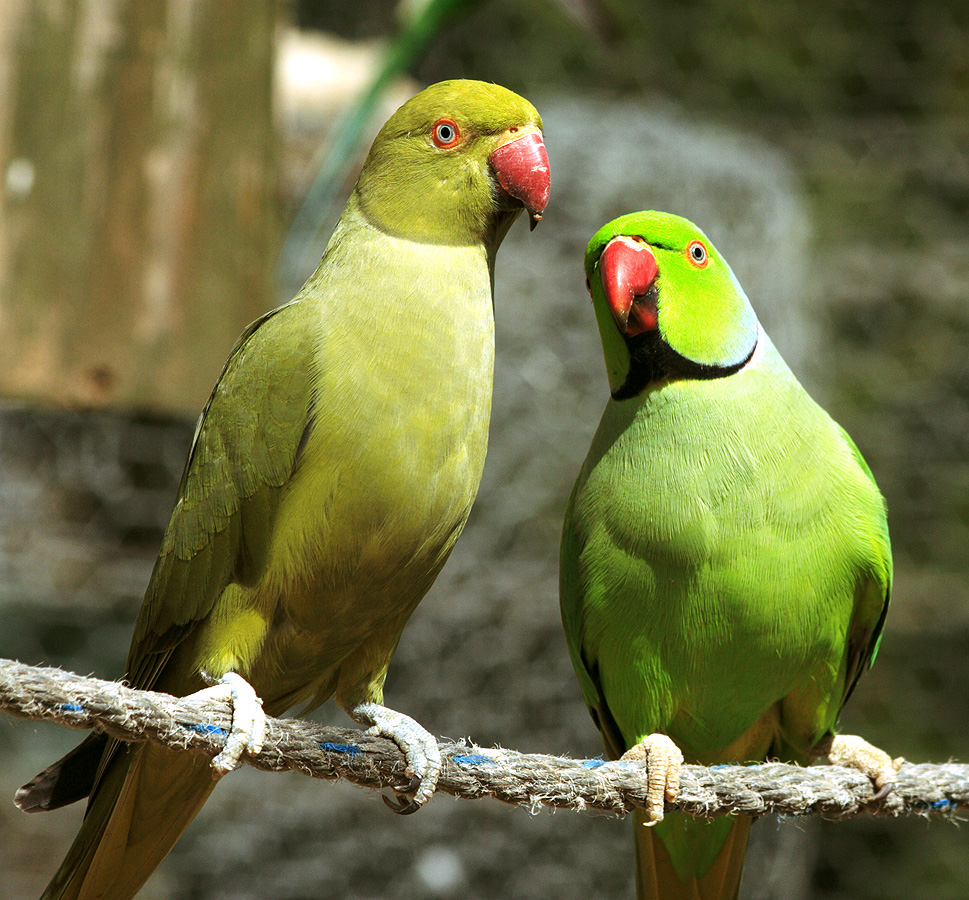
The Indian ringneck is a slender, long-tailed parakeet famous for clear, articulate speech and a striking neck ring in mature males. Intelligent and beautiful but prone to a 'bluffing' phase, it suits attentive intermediate keepers willing to invest in consistent training.
ℹ️
Educational only. KinStation content is reviewed by licensed veterinarians but cannot replace an in-person exam. Always consult a licensed veterinarian or board-certified specialist for diagnosis, treatment, or any decision affecting your pet's health.
🩺 Need expert help with your indian ringneck parakeet?
Connect with a specialist near you or ask a licensed vet — never substitute online guidance for hands-on care in an emergency.
Medium — about 16 inches head to tail (long tail), 110–130 g.
Lifespan
25–35 years
Social needs
pair
Native region
South Asia (Indian subcontinent)
Origin
Old World
Climate
⛅ Subtropical
Family
Psittacidae
Genus
Psittacula
Part of the Ringneck Parakeets
Ringneck and Asiatic parakeets (genus Psittacula) are slender, long-tailed parrots of Africa and Asia, known for their elegant proportions, ringed or richly colored heads, and intelligent, talkative natures.
🔊 What does a indian ringneck parakeet sound like?
Talking Parrot (Psittacula krameri)
Amada44 · Wikimedia Commons · CC BY 3.0
🎬 Video
Psittacula krameri -pet eating a peanut-male-8a
brownpau · Wikimedia Commons · CC BY 2.0
Habitat & space requirements
From the minimum an animal needs to be kept humanely, up to the ideal setup. Bigger is almost always better — minimums are floors, not targets.
Photo coming soon
Minimum
Long flight cage
36 × 24 × 36 in, ≤ 1/2 in bar spacing
Indian ringnecks have long tails and need a horizontally roomy cage at least 36 in wide with bar spacing no wider than half an inch, kept indoors at stable room temperature with several perches of varying diameter, foraging toys, and bathing access. They are not cuddly birds and need daily out-of-cage flight time plus a calm routine. This is the welfare floor only if the bird gets substantial free-flight time outside the cage each day.
Photo coming soon
Recommended
Walk-in or large flight cage
5 × 3 × 4 ft (or larger)
A large flight cage or small walk-in aviary lets a ringneck actually fly between perches and use its full tail length without damage, furnished with natural branch perches, rotating foraging and chewing enrichment, and a daily bath. Pairs or bonded companions are ideal as these are social flock birds, and daily interaction prevents boredom screaming. This gives the bird room to express normal flight and reduces feather-destructive behaviour.
Ideal
Aviary / bird room
Walk-in aviary, 8+ ft flight length
A planted walk-in aviary or dedicated bird room with at least 8 ft of clear flight length, kept above freezing and protected from draughts, with natural perches, foraging substrate, and bathing pools. Housed with a compatible mate or in a compatible group, ringnecks thrive on sustained flight and social contact. This is the most natural setup and the best outcome for long-term physical and psychological welfare.
Richard Taylor / CC BY 2.0 (Wikimedia Commons)
Life & growth stages
How this animal changes through its life — each stage often has its own care, diet and space needs.
Photo coming soon
Egg
Birds develop inside a hard-shelled egg incubated by the parent(s). Egg size, shell color, and clutch size vary by species; the embryo develops over days to weeks before hatching.
Photo coming soon
Hatchling / Chick
Hatchlings are either altricial — naked, blind, and dependent on parents (typical of parrots and songbirds) — or precocial — downy, mobile, and self-feeding soon after hatching (typical of poultry and waterfowl). Down gives way to the first feathers.
Photo coming soon
Juvenile / Fledgling
Fledglings grow in their juvenile plumage and begin to fly and feed themselves, though they may still beg from parents at first. Juvenile feathering is often duller than the adult and is replaced as the bird matures.
Adult
Adults attain full body size and mature plumage, and are capable of breeding. Many species show distinct adult coloration, and in sexually dimorphic birds males and females differ in plumage, size, or markings.
keine Rechte vorbehalten via iNaturalist — https://www.inaturalist.org/observations/323787735
Color & pattern variants
Natural variants occur in the wild; selectively bred (man-made) variants were developed in captivity.
Ringnecks have long tails and active dispositions, so cage width and length matter as much as height. MINIMUM cage for a single bird is roughly 24 in W × 24 in D × 36 in H — long enough that the tail does not constantly drag or break — with bar spacing about 1/2 to 5/8 inch. RECOMMENDED is a larger cage (around 30 × 24 × 40+ in) plus several hours of daily out-of-cage flight in a bird-safe room. IDEAL is a long flight cage or aviary several feet in length, which suits this strong, fast-flying species particularly well.
Place the cage in a sociable area away from kitchen fumes, direct sun, and drafts, with a calm sleeping area on a consistent light cycle. Provide natural-wood perches of varied diameters positioned so the long tail has clearance, plus secure hardware.
Ringnecks are intelligent and need steady enrichment to prevent screaming and plucking: foraging toys, shreddable wood, puzzle feeders, bells, and flight opportunities. Offer regular bathing by mist or dish. As with all birds, PTFE/Teflon fumes, smoke, scented candles, and aerosols are potentially fatal and must be eliminated from the home.
Substrate
Line the cage tray with plain newspaper, paper towel, or paper-based pellet litter for hygienic, replaceable flooring. Avoid sand sheets, ground corncob, or walnut shell, which trap moisture and grow mold. A grate over the tray keeps the bird off droppings and discarded food.
Equipment & setup
Provide a tall, wide cage with horizontal climbing bars and bar spacing of about 1/2 to 5/8 inch; ringnecks need room for their long tail feathers, so depth and height matter. Offer varied natural-wood perches, plenty of chew and foraging toys, and full-spectrum lighting with a 10-12 hour photoperiod. They tolerate normal room temperatures but should be kept out of drafts and direct sun.
Diet
Feed a formulated pellet for small-to-medium parrots as the dietary base, supplemented daily with a variety of vegetables and leafy greens, limited fruit, and cooked legumes or whole grains; ringnecks also enjoy sprouted seeds and some grains as enrichment. Avoid all-seed diets, which cause malnutrition over time.
Keep fresh water available at all times. Never offer avocado, chocolate, caffeine, alcohol, onion, garlic, or salty processed foods, all toxic to parrots. A small portion of seed can be used as a foraging treat rather than a staple.
Behavior & temperament
Indian ringnecks are moderately loud — they have a distinctive ringing call and will chatter and screech, especially morning and evening — which makes them tolerable for many homes but not ideal for shared apartment walls. They are among the best talkers of the medium parrots, often developing clear, extensive vocabularies and famously crisp diction, which is a major part of their appeal.
Temperament is intelligent, independent, and sometimes aloof; ringnecks bond well with consistent handling but are well known for a hormonal 'bluffing' phase, typically around adolescence, when an otherwise sweet bird becomes nippy and territorial. This phase usually passes with patient, steady, positive interaction, but it surprises unprepared owners. Daily handling and training keep them tame, since neglected ringnecks can revert toward skittishness. Reading body language — pinned eyes, fanned tail, raised feathers — helps anticipate bites during hormonal periods.
Health
Indian ringnecks need an avian veterinarian and routine wellness exams with weight tracking; their multi-decade lifespan makes them a long commitment. Like all birds they conceal illness until it is advanced, so subtle changes are significant.
Common concerns include feather-destructive behavior driven by boredom or stress; psittacosis (a zoonosis); aspergillosis and other respiratory disease; and nutritional disease such as hypovitaminosis A and fatty liver from seed-heavy diets. Reproductively active hens can develop egg binding, and as a member of the genus Psittacula, ringnecks can be affected by psittacine beak and feather disease (PBFD).
Seek prompt avian-veterinary care for a fluffed, quiet bird, tail-bobbing or open-mouth breathing, eye or nasal discharge, sudden weight loss, abnormal feathers, or a hen straining to lay. A bird that seems even slightly 'off' warrants a same-day call to an avian vet.
Tips, DIY & hacks
Ringnecks are intelligent and prone to boredom-driven feather plucking, so rotate puzzle feeders, shreddable toys, and foraging trays to keep them busy. DIY enrichment from cardboard, untreated wicker, and paper rolls stuffed with millet is cheap and effective. Daily out-of-cage time and consistent gentle handling, especially through the natural "bluffing" adolescent phase, preserve tameness.
Origin & history
The rose-ringed (Indian ringneck) parakeet is one of the most widespread parrots in the world, native to a broad band across Africa and South Asia and named for the rose-and-black neck ring of mature males. Extraordinarily adaptable, it has established large feral populations far outside its native range — in European cities, the UK, the Middle East, and parts of North America — making it one of the few parrots most temperate-climate residents might see flying wild. This adaptability also means some jurisdictions regulate or restrict it over invasive-species concerns, so prospective owners should check local laws.
The species has an ancient relationship with people: it was kept and admired in South Asia for millennia and prized for its talking ability, with references to ring-necked parakeets appearing in classical Indian writings. In modern aviculture, captive breeding has produced a spectacular array of color mutations — blue, lutino (yellow), albino, cinnamon, and many more — far beyond the wild green, and the bird remains popular worldwide for its beauty, intelligence, and remarkable voice.
Anecdotes & owner lore
Community experience and cultural notes — not veterinary advice. Every animal is an individual; treat these as colour, not care instructions.
Indian ringnecks are celebrated as some of the clearest-talking parrots of their size, and owners delight in birds that hold near-conversational strings of words, count, recite phrases, and mimic the household's voices with uncanny crispness. Equally famous, and far less charming, is the adolescent 'bluffing' stage — countless first-time ringneck owners arrive in bird forums convinced their once-cuddly youngster has turned into a tiny green velociraptor overnight, only to be reassured by veterans that it is a hormonal phase that passes with patience.
In the wild and in feral city flocks, ringnecks are striking: emerald-green birds with impossibly long tails streaming behind them, screeching across parks at dusk in places as far-flung as London, Brussels, and Tehran, where escaped and released pets have built thriving populations. There is a rich body of folklore around them in South Asia, where ringnecks have been companion and 'temple' birds for centuries, and their talking talent features in old stories and royal menageries. Owners often note the contrast between the bird's elegant, almost regal appearance and its cheeky, opinionated personality.
Common ailments
Psittacosis (avian chlamydiosis) — rare — Zoonotic — inform your physician of bird contact if you become ill.
Psittacine beak and feather disease (PBFD) — rare
Feather-destructive behavior (feather plucking) — common
Reviewed and signed off by: KinStation Editorial — pre-launch draft (pending DVM review)