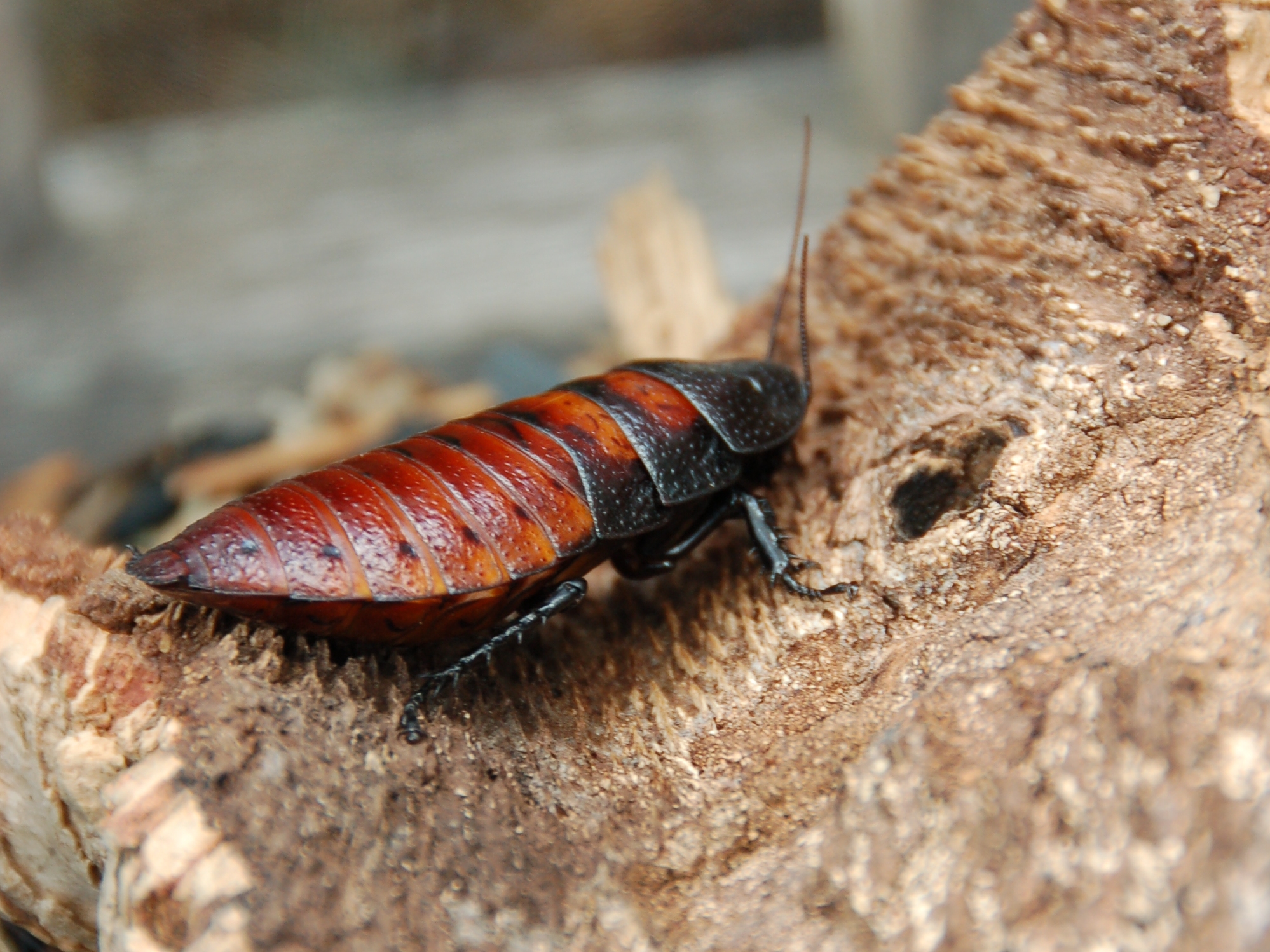
Photo: Almabes at English Wikipedia · Public domain
Madagascar hissing cockroaches are large, wingless cockroaches endemic to Madagascar, named for the audible hiss they produce through modified spiracles. They are popular educational and beginner invertebrate pets, but **possession is restricted in some states** due to agricultural concerns.
ℹ️
Educational only. KinStation content is reviewed by licensed veterinarians but cannot replace an in-person exam. Always consult a licensed veterinarian or board-certified specialist for diagnosis, treatment, or any decision affecting your pet's health.
🩺 Need expert help with your madagascar hissing cockroach?
Connect with a specialist near you or ask a licensed vet — never substitute online guidance for hands-on care in an emergency.
Adults 2–3 inches body length; males have larger horn-like pronotal projections.
Lifespan
2–5 years
Social needs
group
Native region
Madagascar
Origin
Old World
Climate
🌴 Tropical
Family
Blaberidae
Genus
Gromphadorhina
Part of the Hissing Cockroaches
Large, wingless cockroaches that hiss by forcing air through breathing holes, kept communally as docile, handleable insect pets.
More hissing cockroaches coming soon.
Habitat & space requirements
From the minimum an animal needs to be kept humanely, up to the ideal setup. Bigger is almost always better — minimums are floors, not targets.
Photo coming soon
Minimum
Ventilated colony tub
≈ 12 × 8 × 10 in (≈ 5–10 gal)
Because these are social, colony-living insects, never keep a single roach — start with a small group in a smooth-walled, escape-proof tub with a tight ventilated lid and a smear of petroleum jelly along the upper rim (they climb smooth glass easily). Provide 2–3 in of coco-fibre substrate, stacked egg-crate or cork hides, and keep warm at 24–29 °C with moderate humidity (60–70%) via light misting. A cluster of hides and bark to shelter under and climb meets their basic gregarious needs.
Photo coming soon
Recommended
Colony vivarium
≈ 18 × 12 × 12 in (≈ 20-gal long)
A larger escape-proof vivarium for a proper breeding colony, with 3–4 in of coco-fibre substrate, plentiful stacked bark, egg-crate, and hollow logs for hiding, plus a shallow water source with cotton or gel to prevent drowning. Maintain 24–29 °C with one warmer end and 60–70% humidity through occasional misting and good airflow. A secure climb-proof lid and barrier are essential, as these are strong climbers. The extra room and abundant hides let the colony aggregate and breed naturally while reducing crowding stress.
Photo coming soon
Ideal
Bioactive colony terrarium
≈ 24 × 18 × 18 in (≈ 30+ gal)
A planted, bioactive terrarium for a thriving multi-generation colony, with deep coco-fibre and leaf-litter substrate, a springtail and isopod cleanup crew, layered cork bark and logs, and live plants under gentle warmth. Keep a stable 24–29 °C gradient and 60–70% humidity with a drown-proof water source and a climb-proof, well-ventilated lid to recreate the Madagascan forest-floor detritus they live in. The spacious, naturalistic setup supports full social aggregation, climbing, hissing displays, and self-sustaining breeding — the best welfare outcome for this colonial species.
Life & growth stages
How this animal changes through its life — each stage often has its own care, diet and space needs.
Photo coming soon
Egg
Insects begin as eggs, laid singly or in clusters on or near a food source. Egg size, shape, and incubation time vary widely; some are glued to surfaces, others inserted into plant tissue or soil.
Photo coming soon
Larva / Nymph
The immature stage either looks grub- or caterpillar-like and very different from the adult (a larva, in beetles, flies, and butterflies) or like a wingless miniature adult (a nymph, in roaches, mantises, and stick insects). It eats and molts repeatedly as it grows.
Photo coming soon
Pupa
In insects with complete metamorphosis, the larva pupates — often in a cocoon, chrysalis, or sealed cell — and its body is reorganized into the adult form. Nymph-developing insects skip a true pupa and molt straight to the adult.
Adult
The adult is the sexually mature, usually winged stage with the species' full coloration and form. Adults are typically the dispersing and reproducing stage, and in many insects do not grow further once mature.
Habitat & enclosure
Madagascar hissing cockroaches are large, wingless roaches that are easy to house in a secure terrarium with a tight-fitting, escape-proof lid — they are excellent climbers, so a smooth upper rim or barrier helps keep them contained. A modest enclosure houses a small group comfortably; these are social roaches that do well in colonies rather than alone.
Provide a substrate that holds some moisture (such as coconut fiber), along with cardboard tubes, egg-crate, or bark hides for shelter and climbing. As a tropical species they prefer warmth and moderate-to-high humidity, maintained by light misting and a damp area of substrate, balanced with ventilation to prevent mold. A shallow water source or moisture-rich foods keep them hydrated; gel water or a sponge avoids drowning risk.
They are hardy and forgiving, which is part of why they are popular beginner and classroom invertebrates. The main husbandry priorities are security (preventing escape), gentle warmth and humidity, hiding spots, and cleanliness. Note that they are regulated or banned as pets in some U.S. jurisdictions, so check local rules before acquiring them — see the cited overview.
Substrate
A simple 3-5 cm layer of coconut fiber, organic topsoil, or even just clean paper towel works well, kept lightly moist on one side for humidity; deep digging substrate is unnecessary since they are surface dwellers. Avoid cedar and pine shavings, which are toxic.
Equipment & setup
Keep them in a smooth-sided plastic or glass bin with a tight, ventilated lid (they climb glass and squeeze through small gaps), at 24-30 C using an under-tank or side heat mat on a thermostat; a warm gradient encourages breeding. No lighting or UVB is needed, but stack cardboard egg-crate or cork bark vertically to maximize hiding and surface area, plus a shallow dish or water crystals.
Diet
Madagascar hissing cockroaches are scavenging omnivores that eat a wide variety of foods. Captive diets typically center on fresh vegetables and fruit plus a dry component such as appropriate grain-based or commercial insect/roach foods, with leafy greens and produce providing both nutrition and moisture. They are not fussy eaters.
Provide a water source that cannot drown them — a water gel, a shallow dish with pebbles, or moisture-rich vegetables. Remove uneaten fresh food before it molds, since excess decaying matter and poor ventilation invite mold and mites.
The main mistakes are letting the enclosure get moldy from overfeeding wet food, and providing open water that small individuals or nymphs can drown in. These roaches are otherwise among the simplest invertebrates to feed.
Behavior & temperament
These roaches are famous for the hiss that gives them their name: they force air through breathing openings (spiracles) to produce sound used in disturbance, mating, and male-to-male competition. It is a defense and communication display, not a sign of distress requiring intervention, and is harmless to people.
They are docile, slow-moving, and large enough to handle gently, which makes them popular for education and outreach; many tolerate careful handling well, though they should be handled deliberately and low to a surface to prevent falls. They do not bite in any meaningful way and have no venom or sting. Males can be territorial with each other and may 'joust' with the bumps on their pronotum, accompanied by hissing.
They are nocturnal and social, living in groups and often clustering in hides. Their calm temperament, hardiness, and interesting behavior make them a frequently recommended starter invertebrate and a classroom favorite.
Health
Madagascar hissing cockroaches are hardy invertebrates, typically living a few years (often cited around 2 to 5 years) with good care. They have few specific 'diseases' in the conventional sense; the great majority of problems are husbandry-related and preventable.
The most common issues are mite infestations and mold, almost always caused by overly damp, poorly ventilated enclosures or by uneaten food and waste left to decay. Dehydration can occur if no moisture source is provided, and improper humidity can complicate molting, which (as with other inverts) is a vulnerable time when the animal should be left undisturbed.
Preventive themes are simple: balance moisture with ventilation, remove uneaten fresh food promptly, keep the enclosure clean, provide a safe water source, and offer hides. Specialized veterinary care is rarely sought for these animals, but an exotic/invertebrate-experienced veterinarian can advise in unusual cases. This entry is general guidance only.
Tips, DIY & hacks
Smear a band of petroleum jelly around the top inner rim as a cheap, effective escape barrier for these strong climbers. Offer a varied diet of fresh vegetables, fruit, and dry dog/fish food for protein, removing uneaten produce to prevent mold and mites; they make excellent, easy feeders or low-maintenance pets and the adults' loud hiss is a harmless defensive display.
Origin & history
The Madagascar hissing cockroach (Gromphadorhina portentosa) is native to the island of Madagascar, where it lives on the forest floor among leaf litter and decaying wood. Large, wingless, and long-lived for an insect, it became one of the most widely kept invertebrate pets and a fixture of schools, museums, zoos, and nature centers.
It is a wild species, not domesticated, though it breeds readily in captivity. Because it is a non-native insect that could theoretically establish if released, some U.S. states and localities regulate or ban it as a pet — Florida and Hawaii are commonly cited examples — so prospective keepers should verify local rules before acquiring one.
Anecdotes & owner lore
Community experience and cultural notes — not veterinary advice. Every animal is an individual; treat these as colour, not care instructions.
Hissing cockroaches owe much of their fame to that startling, audible hiss — uniquely produced by pushing air through abdominal breathing holes rather than by rubbing body parts like a cricket — which delights (and unnerves) audiences at 'bug zoos' and classroom visits the world over. They are perennial stars of insect-petting tables and even 'cockroach racing' novelty events.
Hobbyists are fond of the males' tournaments: rival males butt their armored, horned pronotums together like tiny rhinos, hissing all the while, to win territory and mates. The roaches' calm, climbable nature has made them go-to 'gateway' invertebrates for kids and squeamish first-timers, and they've made cameo appearances in films and TV whenever a scene needs an impressively large, photogenic 'bug' — turning one of the world's most maligned animal groups into an unlikely ambassador for invertebrates.
Common ailments
Dehydration — common
Molting complications — common
Mite or mold problems — common — Almost always a husbandry issue tied to excess moisture or decaying food.
Legality (US)
Educational only. Confirm current rules with your state wildlife agency or local authority before acquiring an animal.
US · FL — Permit required — Florida requires a USDA APHIS permit to possess Madagascar hissing cockroaches; release into the environment is prohibited under state and federal plant-pest rules.
Reviewed and signed off by: KinStation Editorial - pre-launch draft (pending DVM review)