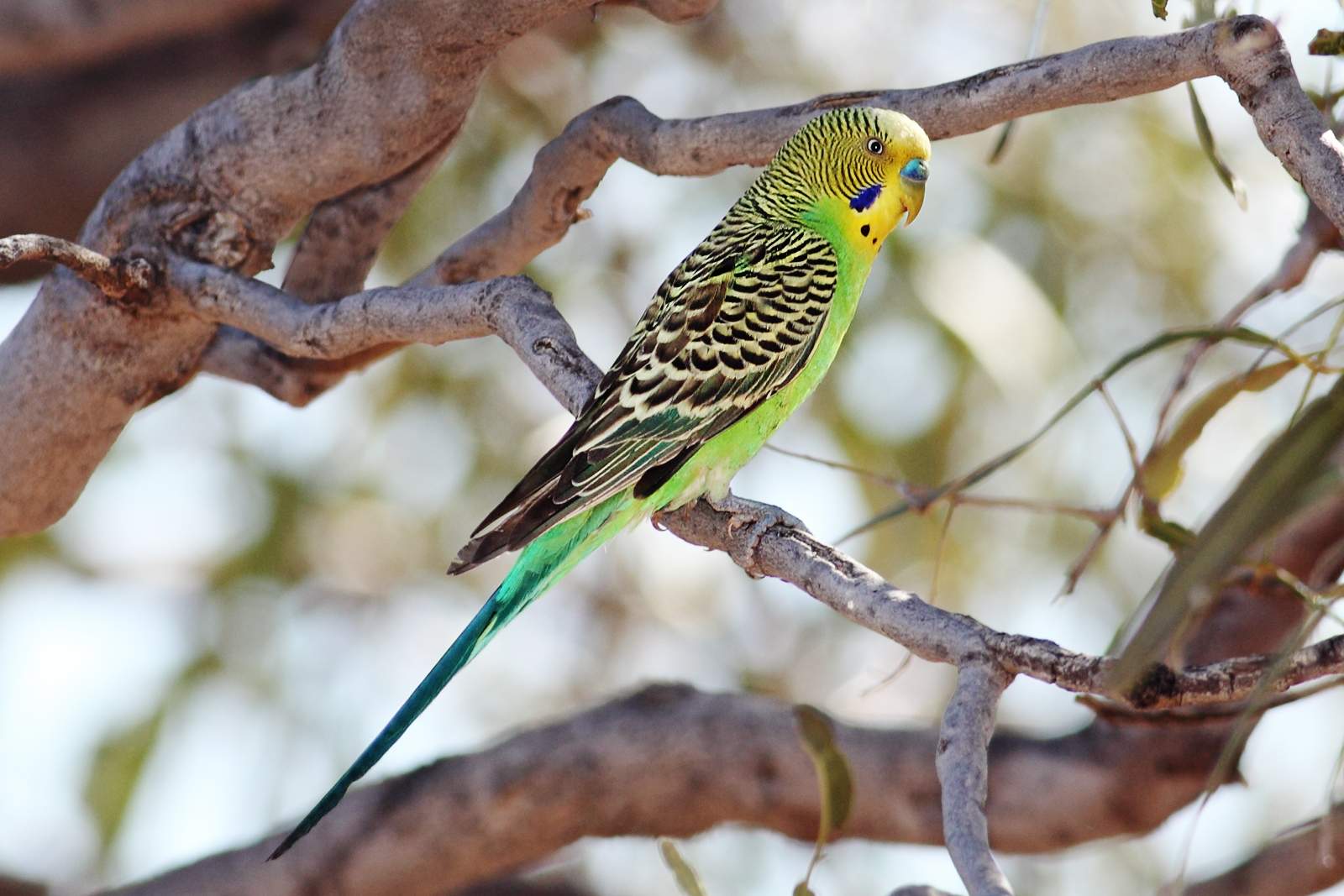
Budgerigars, commonly called parakeets in the United States, are small Australian parrots known for their sociability and ability to mimic speech. They thrive in pairs or small flocks.
ℹ️
Educational only. KinStation content is reviewed by licensed veterinarians but cannot replace an in-person exam. Always consult a licensed veterinarian or board-certified specialist for diagnosis, treatment, or any decision affecting your pet's health.
🩺 Need expert help with your parakeet (budgerigar)?
Connect with a specialist near you or ask a licensed vet — never substitute online guidance for hands-on care in an emergency.
Small, hardy Australian grass parakeets and the world's most popular pet bird.
More budgerigars coming soon.
Sounds & video
🔊 What does a parakeet (budgerigar) sound like?
Melopsittacus undulatus imitating konnichi wa - pone.0038803.s001
Eda-Fujiwara H, Imagawa T, Matsushita M, Matsuda Y, Takeuchi H, Satoh R, Watanabe A, Zandbergen M, Manabe K, Kawashima T, Bolhuis J · Wikimedia Commons · CC BY 2.5
🎬 Video
Melopsittacus undulatus -pet in cage -male-8a
anneh632 · Wikimedia Commons · CC BY-SA 2.0
Habitat & space requirements
From the minimum an animal needs to be kept humanely, up to the ideal setup. Bigger is almost always better — minimums are floors, not targets.
Photo coming soon
Minimum
Wide flight cage (pair)
≈ 30 × 18 × 18 in, ≈ 1/2 in (12 mm) bar spacing
Budgies are flock parrots and should be kept at least in a pair, in a cage wider than it is tall with horizontal bars for climbing and bar spacing around 1/2 in so heads can't get stuck. Provide varied natural perches (not just dowels), chew and foraging toys, a cuttlebone, a bath, and room temperature 18–26 °C. This is the welfare floor only if the birds also get daily out-of-cage flight.
Photo coming soon
Recommended
Large flight cage
≈ 40 × 20 × 24 in, ≈ 1/2 in bar spacing
A large flight cage plus daily free flight in a bird-safe room lets budgies fly, climb, and forage as they would in a flock. Rotate chew toys, ladders, swings, shreddable foraging, and natural branches, and offer a bath and full-spectrum light. The combination of company, space, and enrichment is what keeps these clever, energetic parakeets from becoming bored or feather-chewing.
Photo coming soon
Ideal
Aviary / bird room
Walk-in aviary or dedicated bird room
A flock-sized aviary or a bird-safe room for sustained flight, with branches, foraging stations, swings, and bathing, gives budgies the most natural life. An outdoor aviary needs a dry, draught-free, frost-protected shelter and predator-proofing. Kept as a small flock with abundant space and enrichment, budgies show their full active, social, vocal behaviour.
Life & growth stages
How this animal changes through its life — each stage often has its own care, diet and space needs.
Photo coming soon
Egg
Birds develop inside a hard-shelled egg incubated by the parent(s). Egg size, shell color, and clutch size vary by species; the embryo develops over days to weeks before hatching.
Photo coming soon
Hatchling / Chick
Hatchlings are either altricial — naked, blind, and dependent on parents (typical of parrots and songbirds) — or precocial — downy, mobile, and self-feeding soon after hatching (typical of poultry and waterfowl). Down gives way to the first feathers.
Photo coming soon
Juvenile / Fledgling
Fledglings grow in their juvenile plumage and begin to fly and feed themselves, though they may still beg from parents at first. Juvenile feathering is often duller than the adult and is replaced as the bird matures.
Adult
Adults attain full body size and mature plumage, and are capable of breeding. Many species show distinct adult coloration, and in sexually dimorphic birds males and females differ in plumage, size, or markings.
(c) Mike Letnic, some rights reserved (CC BY-NC) via iNaturalist — https://www.inaturalist.org/observations/323946382
Color & pattern variants
Natural variants occur in the wild; selectively bred (man-made) variants were developed in captivity.
Budgies are small, active parrots built for flight, so cage width matters more than height: a wide flight cage with horizontal bars they can climb is far better than a tall narrow one. Just as important is daily out-of-cage time in a safe, bird-proofed room, where they can stretch their wings and exercise. The cage is a home base, not the whole world.
Furnish the cage with perches of varying natural diameters and textures to keep feet healthy (avoid using only smooth dowels), plus a rotating selection of toys for chewing, foraging, and play, since budgies are intelligent and bore easily. A bath dish or gentle misting lets them bathe, which they often relish. Keep food and water away from under perches so droppings don't contaminate them.
Air quality is a genuine, sometimes overlooked safety issue. Birds have extremely sensitive respiratory systems, and fumes from overheated non-stick (PTFE/Teflon) cookware can kill them rapidly; aerosols, scented products, smoke, and strong cleaners are also hazards. Keep birds well away from the kitchen and ventilate carefully.
Substrate
Use plain newspaper, paper towel, or unprinted paper on the cage floor so droppings are easy to check daily; skip grit-style or sandpaper liners and loose litters, which budgies may eat and which can mask early signs of illness.
Equipment & setup
Provide a wide (horizontally oriented) cage with 1/2-inch bar spacing for climbing, plus several natural-wood perches of varying thickness and a couple of cuttlebone/mineral blocks for beak and calcium needs. They do well at normal room temperature; offer a shallow bath or mister and full-spectrum lighting on a 10-12 hour day to support breeding-free hormonal balance and feather condition.
Diet
An all-seed diet is the classic budgie-care mistake, because seeds are high in fat and low in many nutrients, contributing to obesity and disease over time. A better foundation is a formulated pelleted diet made for small parrots, which provides more balanced nutrition. Many budgies need a gradual, patient transition from seeds to pellets.
Round out the diet with a daily variety of fresh leafy greens and vegetables, occasional fruit, and sprouted seeds, with a small amount of seed mix offered as enrichment or training reward rather than the main course. A cuttlebone or mineral block supports calcium and beak conditioning. Fresh water daily is essential.
Several foods are toxic to birds and must be avoided entirely: avocado, chocolate, caffeine, alcohol, onion and garlic, and very salty foods. Because budgies are small, even minor dietary imbalances add up, so steady good nutrition and weight monitoring go a long way.
Behavior & temperament
Budgerigars are flock birds, gregarious and chatty by nature. In homes where they won't receive many hours of daily human interaction, keeping two or more budgies is kinder, as companionship meets their deep social needs. A single budgie can bond intensely with its owner but then depends on that person for the social contact a flock would normally provide.
They communicate constantly — cheerful chatter and warbling usually mean a content, secure bird, while sudden prolonged silence or a fluffed, hunched, sleepy posture during the day can signal illness and should be taken seriously. Many budgies, especially males, are gifted mimics and can learn to whistle tunes and even 'talk,' building impressive vocabularies with patient repetition.
With gentle, consistent handling, budgies tame readily and enjoy stepping up, sitting on a shoulder, and interacting. Positive, force-free methods work best; grabbing or chasing erodes trust. Watch body language — relaxed feathers and curious head-tilts mean a comfortable bird, while frantic flapping or a wide-eyed crouch signals fear.
Health
Finding an avian veterinarian before you need one is the most important piece of budgie health care, since most general-practice vets do not treat birds. Annual wellness exams that include weighing the bird help establish a baseline, and a kitchen gram scale at home lets owners track weight, an early indicator of trouble.
Common conditions include 'scaly face' caused by Knemidokoptes mites (crusty, honeycomb-looking growths on the cere, beak, and legs), obesity and fatty liver disease often linked to all-seed diets, iodine-deficiency goiter on poor diets, reproductive problems such as egg binding in females, and tumors, to which budgies are notably prone.
Because birds instinctively mask illness, any visible sign of being unwell often means a bird is quite sick and needs prompt veterinary attention. Warning signs include fluffed sitting and sleeping during the day, tail bobbing or labored breathing, discharge from the nostrils or eyes, changes in droppings, loss of appetite, or sitting on the cage floor. Treat these as urgent.
Tips, DIY & hacks
Budgies are flock birds and are far happier kept in pairs or small groups with daily out-of-cage flight time. Make cheap foraging enrichment from millet sprays hidden in shredded paper, cardboard, or a muffin tin, and transition them off all-seed diets onto pellets plus leafy greens to prevent obesity and fatty tumors.
Origin & history
The budgerigar is a small parrot native to the arid interior of Australia, where huge nomadic flocks still follow seasonal food and water across the outback. Europeans encountered them in the early 19th century, and after live birds reached Europe around the 1840s — popularized by the naturalist John Gould — they became a sensation, launching one of the most successful cage-bird hobbies in history.
Generations of selective breeding transformed the wild green-and-yellow budgie into a rainbow of color mutations — blues, whites, yellows, greys, violets, pieds, and more — and produced the larger, fluffier 'English' exhibition budgie alongside the smaller, slimmer 'American' pet type. In the United States these birds are commonly sold simply as 'parakeets,' though strictly the word parakeet refers to many small long-tailed parrot species.
Anecdotes & owner lore
Community experience and cultural notes — not veterinary advice. Every animal is an individual; treat these as colour, not care instructions.
Budgie owners often discover their bird is eavesdropping: phrases repeated around the house — a name, a greeting, the microwave beep, even a sneeze — turn up later in the bird's chatter, sometimes at hilariously inopportune moments. The record holders are astonishing; a budgie named Puck was credited by Guinness with a vocabulary of well over a thousand words, a reminder that these tiny birds punch far above their weight as talkers.
Beyond talking, budgies are full of small endearing habits: the happy beak-grinding ('beak chattering') as a content bird settles to sleep, the mirror-directed serenades of a bird convinced its reflection is a flockmate, and the way a budgie will sidle along a shoulder to preen its favorite human's eyebrow. As Australia's most popular avian export and a fixture of family homes for over a century, the budgie has earned its reputation as the friendly, feathered companion that genuinely seems to enjoy a conversation.
Common ailments
Tumors (neoplasia) — common
Scaly face / leg mites (Knemidocoptes) — common
Fatty liver disease (hepatic lipidosis) — common — Strongly associated with seed-only diets.
Egg binding (dystocia) — common — Affects females; chronic layers are at higher risk.
Reviewed and signed off by: KinStation Editorial - pre-launch draft (pending DVM review)