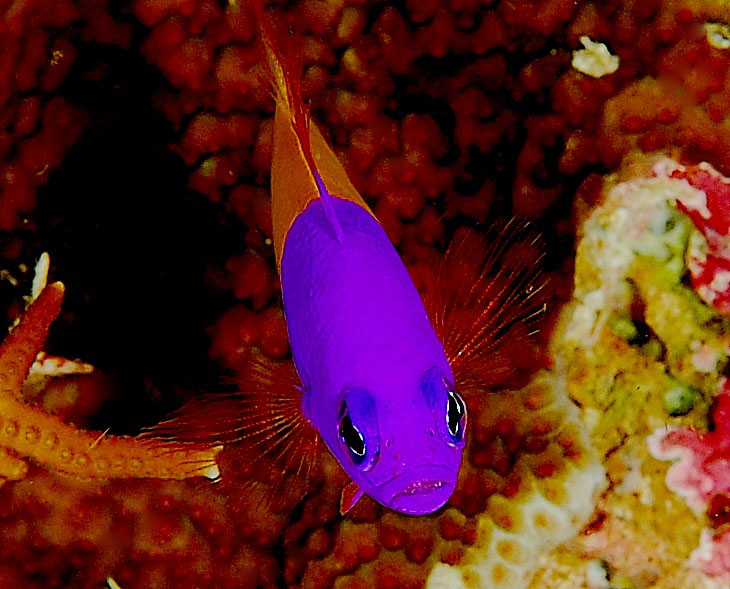
The royal dottyback is a striking magenta-and-yellow reef fish that is exceptionally hardy and easy to feed, but notoriously feisty and territorial for its size. It is best added last to a community tank and kept singly unless you have a confirmed mated pair.
ℹ️
Educational only. KinStation content is reviewed by licensed veterinarians but cannot replace an in-person exam. Always consult a licensed veterinarian or board-certified specialist for diagnosis, treatment, or any decision affecting your pet's health.
🩺 Need expert help with your royal dottyback?
Connect with a specialist near you or ask a licensed vet — never substitute online guidance for hands-on care in an emergency.
Western Pacific: Indo-Australian Archipelago and surrounding reefs.
Origin
Old World
Climate
🌴 Tropical
Water type
🌊 Marine
Family
Pseudochromidae
Genus
Pictichromis
Part of the Dottybacks & Basslets
Small, colorful cave- and ledge-dwelling marine fish popular as hardy reef and nano centerpieces, including the dottybacks (Pseudochromidae) and the longfin basslets and assessors (Plesiopidae). Most are reef-safe, secretive, and prone to jumping, so a covered, rock-rich tank suits them best.
From the minimum an animal needs to be kept humanely, up to the ideal setup. Bigger is almost always better — minimums are floors, not targets.
Photo coming soon
Minimum
Nano reef with caves
30 gal / 110 L reef
Pictichromis paccagnellae is small (8 cm) but extremely aggressive for its size. Cave-rich reef, no smaller tankmates, secure lid. Single specimen.
Photo coming soon
Recommended
Reef with robust tankmates
55 gal / 200 L
Larger reef dilutes aggression. Mix with similarly bold fish (clowns, dwarf angels). Reef-safe with respect to corals but eats ornamental shrimp.
Photo coming soon
Ideal
Mature mixed reef
75 gal+ / 280 L+ mixed reef
Larger reef with abundant rock seams and confident tankmates. Stunning purple-yellow display and bold patrolling behaviour fully visible.
Life & growth stages
How this animal changes through its life — each stage often has its own care, diet and space needs.
Photo coming soon
Egg
Fish eggs are small, translucent spheres, often laid in clutches on plants, substrate, or in a nest — or carried/brooded by a parent in livebearing and mouth-brooding species. A dark eye spot and the curled embryo become visible inside as development progresses.
Photo coming soon
Fry
Newly hatched fry are tiny and semi-transparent, frequently still carrying a yolk sac that fuels them before they feed freely. They lack full fin structure and adult coloration, staying near cover until they can swim and forage on their own.
Photo coming soon
Juvenile
Juveniles look like miniature adults but with developing fins and muted or different markings; many species shift pattern and color as they mature. Growth is rapid at this stage given clean water and steady feeding.
Adult
Adults show the species' full size, finnage, and mature coloration, and are sexually mature. Many fish develop sex-specific differences in size, color, or fin shape, which can intensify during breeding.
Habitat & enclosure
A single fish is comfortable in a reef or fish-with-live-rock tank of about 75 L (20 gallons) or more, with plenty of rockwork providing caves and crevices to claim as territory. Maintain stable reef conditions: temperature 23-27 C (74-80 F), salinity 1.023-1.026 specific gravity, pH 8.1-8.4, ammonia and nitrite 0, nitrate low. Aquascape with abundant interconnected rock so the dottyback has a home base and so more peaceful tankmates have sight breaks and refuges from its aggression.
Substrate
Substrate choice is not critical; fine sand or a bare-bottom both work, as the fish lives among the rockwork rather than in the sand. The priority is generous live rock with caves and overhangs that the dottyback can adopt as territory.
Equipment & setup
Standard reef life support: reliable heater, protein skimmer, and moderate flow. A tight-fitting lid is important because dottybacks are accomplished jumpers and will escape through gaps. No special lighting or supplemental feeding equipment is required beyond what the rest of the system needs.
Diet
Easy-to-feed carnivore. Accepts virtually all standard marine fare: frozen mysis shrimp, frozen and enriched brine shrimp, finely chopped seafood, and good-quality marine pellets and flakes. Feed once or twice daily. In nature it eats small crustaceans and zooplankton, and in the aquarium it will hunt small ornamental shrimp, bristleworms, and tiny crustaceans, which can be a useful pest-control trait but a risk to prized cleaner shrimp and pods.
Behavior & temperament
Bold, curious, and disproportionately aggressive for its size; it will harass and bully fish much larger than itself, especially newcomers added after it. Highly territorial around its chosen cave. It is reef-safe with corals but may pick at small motile invertebrates and ornamental shrimp. Keep only one per tank unless you obtain a bonded pair, as same-species individuals fight fiercely. Not a handleable fish. To reduce conflict, add it last, after calmer tankmates are established, and rearrange rockwork when introducing it to disrupt established territories.
Health
Among the hardiest of marine fish and very disease-resistant when kept in good water. Standard reef-fish precautions apply: quarantine new arrivals and watch for marine ich (Cryptocaryon) and velvet during the stress of shipping and acclimation. Because it is so robust, most health problems trace to poor water quality or injury from fighting rather than infection. Provide stable parameters and adequate cover to minimize stress.
Tips, DIY & hacks
Add the royal dottyback last so it cannot establish dominance before peaceful fish settle in. Keep one per tank, and if you want a pair, buy a confirmed bonded pair rather than hoping two will get along. Cover all openings in the lid to prevent jumping. If aggression becomes a problem, removing and re-acclimating the fish after rearranging the aquascape can reset its territorial claims. Note the very similar royal gramma (Gramma loreto) has a smooth color transition, whereas this dottyback has a sharp magenta-to-yellow border.