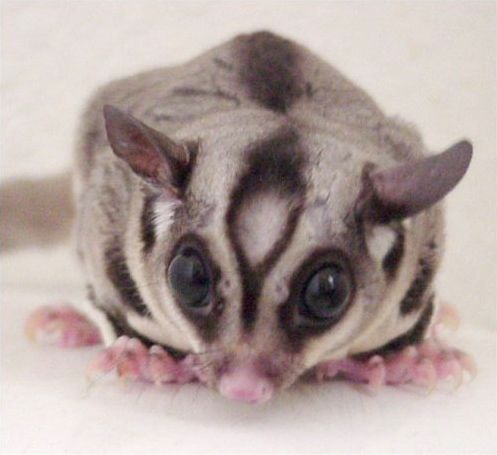
Photo: The original uploader was Dawson at English Wikipedia . · CC BY-SA 2.5
Sugar gliders are small nocturnal marsupials native to Australia and New Guinea that glide between trees using a patagium. They are highly social, demand specialized diets, and are restricted or banned in several U.S. jurisdictions.
ℹ️
Educational only. KinStation content is reviewed by licensed veterinarians but cannot replace an in-person exam. Always consult a licensed veterinarian or board-certified specialist for diagnosis, treatment, or any decision affecting your pet's health.
🩺 Need expert help with your sugar glider?
Connect with a specialist near you or ask a licensed vet — never substitute online guidance for hands-on care in an emergency.
Adults 5–6 inches body plus tail of similar length, 90–160 g.
Lifespan
10–15 years
Social needs
pair
Native region
Australasia (Australia, New Guinea, Indonesia)
Climate
🌍 Varied
Family
Petauridae
Genus
Petaurus
Part of the Sugar Gliders
Small nocturnal gliding marsupials that live in bonded colonies and are kept as highly social, pair- or group-housed exotic pets.
More sugar gliders coming soon.
Habitat & space requirements
From the minimum an animal needs to be kept humanely, up to the ideal setup. Bigger is almost always better — minimums are floors, not targets.
Photo coming soon
Minimum
Tall flight cage (pair)
≈ 24 × 24 × 36 in, ½ in bar spacing
Sugar gliders must never be kept alone, so the welfare floor is a pair (or more) in a tall flight cage of at least roughly 24 × 24 × 36 in with horizontal-friendly bars spaced no more than ½ in apart, plus pouches, branches, and a solid exercise wheel. Height matters more than footprint for this gliding marsupial; keep them warm at 24–27 °C with a varied diet and a bonded companion to prevent self-mutilation and depression.
Photo coming soon
Recommended
Large vertical aviary cage
≈ 36 × 24 × 48+ in tall, ½ in bars
A responsible keeper provides a tall vertical cage around 36 × 24 in footprint and 48 in or more high with ½ in bar spacing, filled with branches and ropes for climbing, multiple fleece pouches, a safe wheel, and rotating foraging toys. Keep a bonded pair or colony at 24–27 °C, offering nightly out-of-cage bonding time, as these highly social, intelligent marsupials need both companionship and vertical space to glide and forage.
Photo coming soon
Ideal
Walk-in aviary / glider room
Walk-in aviary or dedicated glider room
The best welfare outcome is a walk-in aviary or dedicated glider-proofed room with tall branching, ropes, foraging stations, nest boxes, and real space to glide between perches. A bonded colony thrives here at 24–27 °C with enrichment that mimics their arboreal, nocturnal life, providing the companionship and three-dimensional freedom that prevent stress behaviours and stereotypies.
Life & growth stages
How this animal changes through its life — each stage often has its own care, diet and space needs.
Photo coming soon
Newborn
Newborn mammals are nursed on their mother's milk. Many are born helpless — blind, deaf, and sparsely furred (altricial, as in dogs, cats, and rodents) — while others stand and follow within hours (precocial, as in hoofed livestock).
Photo coming soon
Juvenile
After weaning, juveniles grow quickly and become increasingly active, playful, and independent. Adult coat, proportions, and (in many species) the permanent teeth come in as they approach full size.
Photo coming soon
Adult
Adults reach full body size and sexual maturity, with the species' mature coat and build. Sexual dimorphism — differences in size, mane, horns, or markings — is pronounced in some mammals and subtle in others.
Senior
Senior animals show aging signs such as graying fur, reduced activity, and a greater need for veterinary monitoring of joints, teeth, and organ function. Lifespan and the onset of old age vary widely by species and size.
Color & pattern variants
Natural variants occur in the wild; selectively bred (man-made) variants were developed in captivity.
Sugar gliders are arboreal, gliding marsupials, so vertical space is the priority: a tall enclosure with safe bar spacing, multiple branches and perches at varied heights, and fleece sleeping pouches near the top. A large solid-surface wheel sized to avoid back or tail curvature gives them an outlet for their immense nightly energy. They glide rather than fly, and they need height to launch from.
Daily out-of-cage time in a fully glider-proofed room is widely considered part of meeting their needs — these are intensely active animals that do poorly with too little space or stimulation. Keep the room warm and draught-free, remove hazards (open water, gaps, other pets, toxic plants), and provide foraging toys and rotating enrichment.
Legality varies considerably in the United States; ownership is prohibited or restricted in several states and some cities. Check your local and state laws — and any applicable licensing — before acquiring gliders.
Substrate
Sugar gliders live arboreally and rarely touch the floor, so use an easy-clean tray liner of newspaper, paper towel or fleece beneath the cage rather than loose bedding. Provide cloth pouches and nest boxes for sleeping rather than substrate-style bedding. Keep liners dry and changed frequently, as their high-moisture diet makes the cage tray soil quickly.
Equipment & setup
House in a tall cage at least 90 cm high with narrow bar spacing, kept warm at 24-27 C (a low-watt ceramic heat emitter or under-tank/side heat panel is often needed in cooler homes, with no UVB strictly required if diet is correct). Fill the vertical space with branches, ropes, a solid running wheel (12 in+, no exposed axle) and hanging sleep pouches. Always keep gliders in same-species pairs or groups, as solitary housing causes severe stress and self-mutilation.
Diet
Sugar glider nutrition is genuinely complex and a frequent source of disease when done casually. Experienced keepers follow one of several established, documented diet plans that combine a balanced protein source, fresh fruits and vegetables, and a calcium-appropriate nectar or supplement component. The recurring theme across credible plans is keeping the calcium-to-phosphorus balance correct.
Getting that balance wrong is the classic, serious mistake: chronically low calcium relative to phosphorus drives nutritional metabolic bone disease, which can present as hind-limb weakness or paralysis. Because the safe approach depends on the specific diet plan you follow, supplementation should be guided by that plan and an exotics veterinarian rather than improvised. Avoid chocolate, onion, garlic, and most processed human foods, and provide fresh water nightly.
A common pitfall is drifting toward an all-fruit or treat-heavy diet because gliders love sweet foods — this unbalances the diet and contributes to both obesity and calcium problems.
Behavior & temperament
Sugar gliders are highly social colony animals, and keeping a single glider in isolation is widely regarded as poor welfare; bonded same-sex or neutered pairs (or small groups) are recommended. They are strictly nocturnal and vocal, with a distinctive 'crabbing' alarm call, plus barks and chirps that carry at night.
Bonding with people takes patience and consistency — carrying a glider in a bonding pouch and offering calm, scent-based familiarity over weeks to months is the usual route. A well-bonded glider may ride in a pocket and seek out its person; a stressed or lonely one may become withdrawn or, in chronic cases, self-mutilate, which is a red flag for a veterinary and husbandry review.
Their athleticism is the headline trait: they launch, glide, and cling with startling agility, and they need an environment and companionship that lets them express it.
Health
Care should be anchored to an exotics veterinarian familiar with marsupials, ideally identified before you bring gliders home. Because gliders are small, social, and nocturnal, owner observation — appetite, activity at night, droppings, and especially hind-limb strength — is central to catching problems early.
Hind-limb weakness or paralysis from calcium imbalance (nutritional metabolic bone disease) is a hallmark diet-related emergency. Other documented concerns include dental disease, obesity, stress-related self-mutilation, and parasites. None of these should be self-treated; lethargy, hind-end weakness, or a sudden behaviour change all warrant prompt evaluation.
The strongest preventive levers are a correct, balanced diet, appropriate companionship, and an enriched enclosure with enough space to move — most common problems trace back to one of those three.
Tips, DIY & hacks
Bond by carrying a glider in a fleece pouch against your body for several hours a day so it imprints on your scent. Feed a properly balanced diet (e.g. a recognized BML/HPW-style plan with calcium supplementation) to prevent metabolic bone disease, never just fruit and insects. DIY foraging by hiding mealworms and nectar treats in cork tubes and pouches, and rotate branches and toys to prevent boredom.
Origin & history
Sugar gliders are native to Australia, New Guinea, and nearby islands, where they live in tree hollows in social groups and glide between trees using the patagium, a membrane stretched between fore and hind limbs. They entered the exotic-pet trade comparatively recently and are bred in captivity in the United States.
Their care requirements — colony social needs, a specialised diet, and a tall enclosure with nightly activity — mean they are often acquired with under-appreciated commitments. Legal status is among the more restrictive of common exotic mammals, with several U.S. jurisdictions banning or regulating ownership, so prospective owners should verify local laws first.
Anecdotes & owner lore
Community experience and cultural notes — not veterinary advice. Every animal is an individual; treat these as colour, not care instructions.
The name comes from their fondness for sweet, sappy foods and their gliding habit, and devotees call them 'suggies.' The first thing new owners learn is 'crabbing' — a loud, buzzy alarm call that sounds far bigger than a 100-gram animal and usually means 'I am not ready to be picked up yet.'
Bonded gliders famously hitch rides in pouches, hoodies, and shirt pockets, peeking out during the day, and owners swap stories about the soft 'purring' chirps a content glider makes. The trade-off for that charm is their nocturnal schedule: a glider colony coming alive at midnight, gliding from curtain to bookshelf, has converted many a quiet bedroom into a tiny nightly trapeze act.
Common ailments
Dental disease — common
Obesity — common — Often driven by sweet, fatty, or fruit-heavy diets that gliders favour.
Metabolic bone disease (MBD) — common — In gliders this is the classic consequence of a low-calcium or unbalanced diet; hind-limb weakness or paralysis can be an early sign and is treated as an emergency.
Stress-related self-mutilation — rare — Frequently linked to loneliness or boredom; companionship and enrichment are central to prevention.
Reviewed and signed off by: KinStation Editorial - pre-launch draft (pending DVM review)