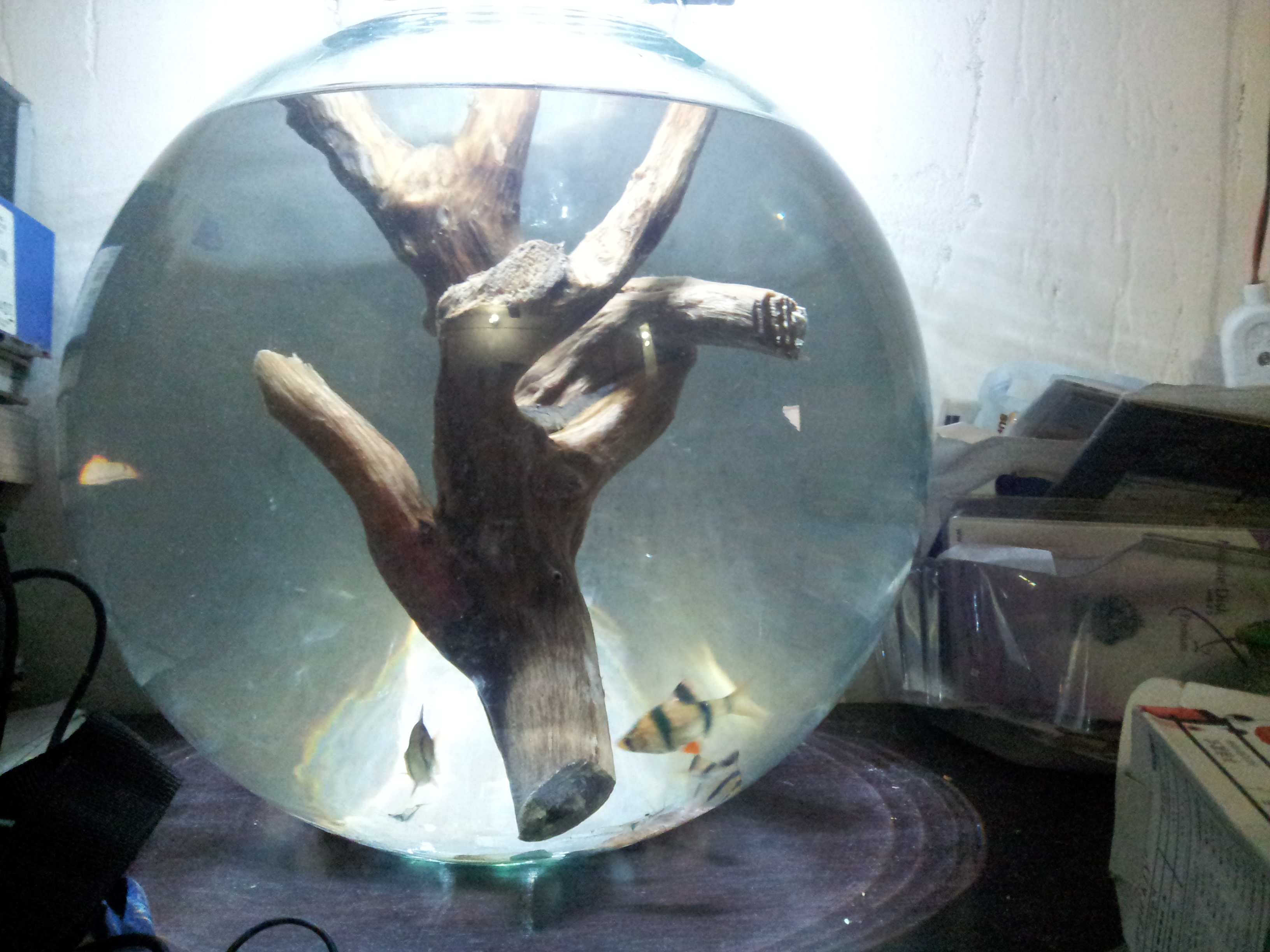
A bold, energetic golden-orange barb with four black vertical bars, famous as much for its activity as for its notorious fin-nipping. Best kept in a large group to spread out its boisterous behavior.
ℹ️
Educational only. KinStation content is reviewed by licensed veterinarians but cannot replace an in-person exam. Always consult a licensed veterinarian or board-certified specialist for diagnosis, treatment, or any decision affecting your pet's health.
🩺 Need expert help with your tiger barb?
Connect with a specialist near you or ask a licensed vet — never substitute online guidance for hands-on care in an emergency.
Small to medium; about 5-7 cm (2-2.8 in) total length.
Lifespan
5–7 years
Social needs
group
Native region
Southeast Asia (Sumatra and Borneo, Indonesia; widely introduced)
Origin
Old World
Climate
🌴 Tropical
Water type
💧 Freshwater
Family
Cyprinidae
Genus
Puntigrus
Part of the Barbs
Active, social cyprinids that thrive in schools and bring constant motion to a planted community tank. Most are hardy and beginner-friendly but appreciate swimming room and the security of a proper group.
From the minimum an animal needs to be kept humanely, up to the ideal setup. Bigger is almost always better — minimums are floors, not targets.
Minimum
Schooling tank
29 gal / 110 L (school of 6+)
Puntigrus tetrazona is a notorious fin-nipper — school of 6+ ESSENTIAL to disperse aggression. Active swimmers, warm water (24–28 °C), 3-ft+ length, no long-finned tankmates.
Rijans007 / CC BY-SA 3.0 (Wikimedia Commons)
Recommended
Long planted community
40–55 gal / 150–200 L
Larger school of 8–10 further reduces nipping. Pair with similarly active species. Driftwood and dense planting. Cherry/green barb morphs same care.
Debivort / CC BY-SA 3.0 (Wikimedia Commons)
Photo coming soon
Ideal
Asian biotope
75 gal+ / 280 L+ biotope
Long biotope with strong flow, robust plants, and a large school. Natural schooling formation and reduced aggression at scale.
Life & growth stages
How this animal changes through its life — each stage often has its own care, diet and space needs.
Photo coming soon
Egg
Fish eggs are small, translucent spheres, often laid in clutches on plants, substrate, or in a nest — or carried/brooded by a parent in livebearing and mouth-brooding species. A dark eye spot and the curled embryo become visible inside as development progresses.
Photo coming soon
Fry
Newly hatched fry are tiny and semi-transparent, frequently still carrying a yolk sac that fuels them before they feed freely. They lack full fin structure and adult coloration, staying near cover until they can swim and forage on their own.
Photo coming soon
Juvenile
Juveniles look like miniature adults but with developing fins and muted or different markings; many species shift pattern and color as they mature. Growth is rapid at this stage given clean water and steady feeding.
Adult
Adults show the species' full size, finnage, and mature coloration, and are sexually mature. Many fish develop sex-specific differences in size, color, or fin shape, which can intensify during breeding.
Color & pattern variants
Natural variants occur in the wild; selectively bred (man-made) variants were developed in captivity.
Tiger barbs are highly active and need swimming room; provide an aquarium of at least 90-110 L (around 25-30 gallons) so a proper group of 8 or more can be kept. A dark substrate, driftwood, and planting around the edges with open central swimming space suit them, along with moderate, well-oxygenated flow.
They accept a pH of about 6.0-7.5, soft to moderately hard water, and a temperature of roughly 23-27 C (73-81 F). They are hardy but should only go into a mature, fully cycled tank; their activity demands stable, clean conditions.
Substrate
Dark gravel or sand sets off their bold stripes; either works fine as they are not substrate-dwellers. A planted, well-aquascaped floor with open swimming lanes suits their active nature.
Equipment & setup
A moderately strong filter to provide gentle current and good oxygenation, a heater at 75-82F, and standard lighting. They prefer slightly soft to neutral water (pH 6.0-7.5) but adapt well to most stable community parameters.
Diet
Tiger barbs are omnivores and greedy, eager feeders. Provide quality flakes and pellets as a staple, supplemented with live and frozen foods such as bloodworms, brine shrimp, and daphnia, plus some vegetable matter or algae-based food.
Feed small amounts once or twice daily and avoid overfeeding, as they will eat enthusiastically. A varied diet keeps their coloration bright and their behavior settled.
Behavior & temperament
This is a lively, semi-aggressive, hierarchical shoaling fish. Kept in too-small numbers it becomes a persistent fin-nipper; keeping a group of at least 8-10 helps direct its chasing and squabbling within the shoal rather than at tankmates. Even so, it should never be housed with slow or long-finned fish such as bettas, angelfish, or guppies.
Good tankmates are robust, fast, similarly sized fish. Their constant activity and intra-group sparring are natural; ample swimming space and a large group are the best ways to channel that energy and reduce nipping.
Health
Tiger barbs are generally hardy but susceptible to ich, fin rot, and bacterial infections when stressed or kept in poor water. Stress from being kept in too small a group can also depress their immunity and worsen aggression.
Quarantine new fish, keep them in adequate numbers, and maintain clean, stable, well-oxygenated water. Choosing appropriate, non-vulnerable tankmates is itself a welfare and health measure, preventing injury to both the barbs and their neighbors.
Tips, DIY & hacks
Keep them in a school of at least 6-8 (ideally 10+) to curb their notorious fin-nipping, which intensifies in small groups. Avoid housing them with slow, long-finned tankmates like bettas or angelfish; pair instead with fast, robust species.