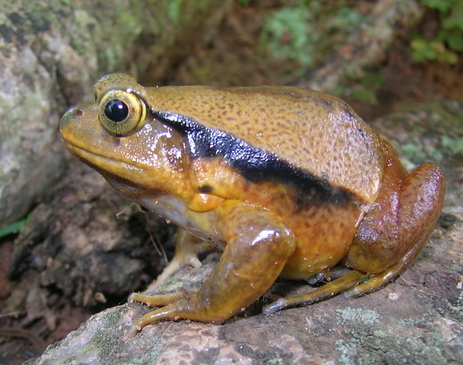
Photo: Franco Andreone - see authorization · CC BY-SA 2.5
A plump, brightly red-orange burrowing frog from Madagascar; hardy and beginner-friendly, kept mainly as a striking display animal.
ℹ️
Educational only. KinStation content is reviewed by licensed veterinarians but cannot replace an in-person exam. Always consult a licensed veterinarian or board-certified specialist for diagnosis, treatment, or any decision affecting your pet's health.
🩺 Need expert help with your tomato frog?
Connect with a specialist near you or ask a licensed vet — never substitute online guidance for hands-on care in an emergency.
Females are large and round at about 3.5-4 in (9-10 cm); males smaller at roughly 2.5 in (6 cm).
Lifespan
6–10 years
Social needs
solo
Native region
Madagascar
Origin
Old World
Climate
🌴 Tropical
Family
Microhylidae
Genus
Dyscophus
Part of the Tomato Frogs
Round, brightly colored burrowing frogs from Madagascar kept in humid, deep-substrate terrariums. Hardy and beginner-friendly, they are display animals best handled rarely.
More tomato frogs coming soon.
Habitat & space requirements
From the minimum an animal needs to be kept humanely, up to the ideal setup. Bigger is almost always better — minimums are floors, not targets.
Photo coming soon
Minimum
Floor terrarium
18 × 18 × 12 in for one adult
Dyscophus antongilii / guineti is a large stocky burrowing toad-like frog. 18×18×12 floor terrarium with deep coco fibre / leaf mix for burrowing, hides, shallow water dish, 65–80% humidity at 72–80 °F. Tomato frogs sit-and-wait — width matters more than height.
Photo coming soon
Recommended
Wider floor terrarium
24 × 18 × 12 in for a pair
Wider floor space for a pair (sex-and-size-matched), deep substrate for burrowing, multiple hides, shallow water area. Mist 1× daily — humidity should peak then dry slightly.
Photo coming soon
Ideal
Bioactive floor terrarium
24 × 18 × 18 in bioactive
Planted bioactive floor terrarium with drainage, deep substrate, leaf litter, hides, and shallow water. Supports natural burrowing and the bright crimson coloration that gives the species its name.
Life & growth stages
How this animal changes through its life — each stage often has its own care, diet and space needs.
Photo coming soon
Egg
Amphibian eggs are soft, jelly-coated spheres laid in or near water — in floating clutches, strings, or foam nests depending on the species. The dark embryo is visible within the clear gel as it develops.
Photo coming soon
Tadpole / Larva
The aquatic larva (a tadpole in frogs/toads, a gilled larva in salamanders and newts) breathes through gills and feeds and grows in water. Frog/toad tadpoles are limbless at first, then sprout hind then front legs as metamorphosis nears.
Photo coming soon
Juvenile (froglet / eft)
At metamorphosis the animal develops legs and lungs and typically leaves the water as a froglet or, in many newts, a terrestrial eft. It resembles a small adult but is not yet sexually mature and its coloration may still be changing.
Adult
Adults reach full size and breeding condition, with the species' mature skin coloration and pattern. Many amphibians return to water to breed and can show seasonal or sex-specific changes such as nuptial coloration or crests.
Habitat & enclosure
Tomato frogs are terrestrial, sedentary burrowers that do well in a horizontally oriented terrarium of at least 18 x 18 x 12 in (45 x 45 x 30 cm) for one adult, with more floor space being better than height. Provide several inches of soft, moisture-holding substrate such as coconut fiber or a soil-and-leaf-litter bioactive mix so they can dig in, plus cork bark, leaf litter, and hides. A shallow, easily exited water dish with dechlorinated water is essential and should be cleaned daily.
Keep temperatures moderate at around 70-80 F (21-27 C), avoiding hot spots, and maintain humidity around 60-80 percent by misting and using a damp substrate while still allowing some airflow to prevent stagnation. They do not require high UVB, though low-level UVB and a normal light cycle can be beneficial. Note that the genus Dyscophus includes the protected, CITES Appendix I-listed D. antongilii; D. guineti is the species available in the pet trade.
Substrate
Provide several inches of soft, moist burrowing substrate like coconut fiber or a coir-and-sphagnum mix, since these frogs bury themselves much of the day. Keep it damp but not waterlogged, and avoid coarse materials that could be ingested with prey.
Equipment & setup
House these terrestrial frogs at 75-82F with 65-80% humidity, using a low-wattage heat source only if the room is cool and misting to maintain dampness. They need no strict UVB (low-level is beneficial), a secure lid, gentle low lighting, and a shallow dechlorinated-water dish since they are not strong swimmers.
Diet
Tomato frogs are sit-and-wait insectivores with hearty appetites. Offer appropriately sized live crickets, dubia roaches, earthworms, and other gut-loaded insects, dusted with calcium plus D3 at most feedings and a multivitamin about weekly. Large females may occasionally take an earthworm or larger prey item, but oversized or hard prey should be avoided.
Feed adults every few days and juveniles more often, watching body condition closely because this species readily becomes obese. Provide constant access to clean, dechlorinated water for skin hydration.
Behavior & temperament
Tomato frogs are slow-moving, mostly nocturnal ambush predators that spend much of the day buried with only the eyes exposed. They are best kept singly or in carefully matched same-size pairs, as size mismatches can lead to one frog attempting to eat another. When threatened, they puff up to look larger and can secrete a sticky, mildly irritating white skin defense, so handling should be minimal and always followed by hand-washing.
Because of that skin secretion and their sensitivity, they are a look-don't-touch pet; handle only with clean, wet hands when relocation is necessary. Enrichment comes from a deep diggable substrate, leaf litter to forage through, hides, and varied live prey.
Health
Common problems include obesity from overfeeding, metabolic bone disease from inadequate calcium or D3, and bacterial skin infections (including red-leg-type infections) tied to poor hygiene or chronically dirty water. As with all amphibians, chytrid and ranavirus are concerns, particularly in imported animals.
Prevention focuses on portion control, a varied dusted diet, clean fresh water, appropriate humidity with airflow, and quarantine of new arrivals. Skin discoloration or sores, bloating, lethargy, or appetite loss should prompt a visit to an amphibian-experienced veterinarian. This content is informational only and not a substitute for professional veterinary care.
Tips, DIY & hacks
Feed gut-loaded crickets, roaches, and worms dusted with calcium and a multivitamin, and avoid overfeeding to prevent obesity in this stocky species. Their skin exudes a sticky, irritating secretion when stressed, so minimize handling and use wet hands; keep them solitary or in same-species pairs, and a cool winter rest with reduced feeding can help condition them for breeding.