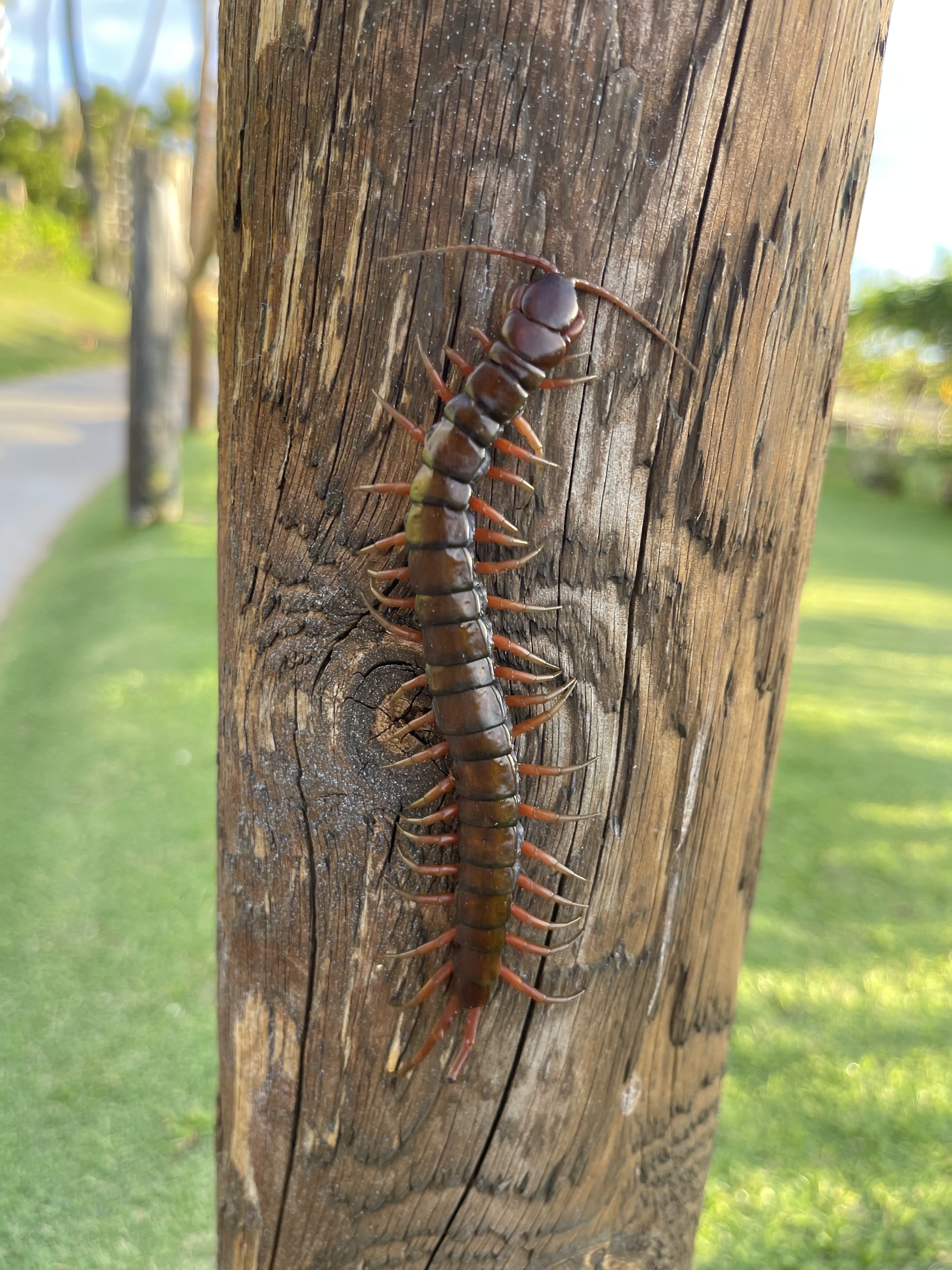
The Vietnamese centipede is a large, fast, and notably defensive tropical centipede with a medically significant venomous bite. It is a striking but strictly hands-off display animal recommended only for experienced keepers who respect its speed, defensiveness, and ability to escape. Note that 'Vietnamese giant centipede' in the hobby often refers to the closely related Scolopendra dehaani, and the 'Chinese red-headed' centipede is the separate Scolopendra mutilans.
ℹ️
Educational only. KinStation content is reviewed by licensed veterinarians but cannot replace an in-person exam. Always consult a licensed veterinarian or board-certified specialist for diagnosis, treatment, or any decision affecting your pet's health.
🩺 Need expert help with your vietnamese centipede?
Connect with a specialist near you or ask a licensed vet — never substitute online guidance for hands-on care in an emergency.
Large, commonly 15-20 cm (6-8 in), with robust forcipules; the very large 25 cm 'Vietnamese giant' animals in the hobby are usually the closely related Scolopen
Lifespan
5–10 years
Social needs
solo
Native region
Southeast and East Asia (including Vietnam, China, and surrounding tropical regions); the broader S. subspinipes complex
Origin
Old World
Climate
🌴 Tropical
Family
Scolopendridae
Genus
Scolopendra
Part of the Centipedes
Centipedes are fast, predatory many-legged arthropods kept as hands-off display invertebrates. The larger Scolopendra species are venomous and defensive, requiring secure escape-proof enclosures, deep humid substrate, and experienced, cautious keepers.
More centipedes coming soon.
Habitat & space requirements
From the minimum an animal needs to be kept humanely, up to the ideal setup. Bigger is almost always better — minimums are floors, not targets.
Photo coming soon
Minimum
Juvenile escape-proof centipede
5–10 gal with 4 in substrate
Vietnamese centipedes (Scolopendra subspinipes) are large, fast, and have medically significant venom — escape-proof lid with vaseline rim, deep packed humid substrate, cork bark hide, and water dish. Expert keepers only.
Photo coming soon
Recommended
Adult escape-proof enclosure
10–20 gal long, 6 in substrate, 75% RH
Long footprint, deep packed coco-fibre/topsoil substrate so they can burrow, multiple hides, leaf litter, and a heavy water dish. Always handle with long tongs; never bare-hand — this is one of the most dangerous keeper-injuries.
Photo coming soon
Ideal
Bioactive tropical vivarium
20 gal long+ bioactive, 75–80% RH
Bioactive tropical vivarium with isopods, leaf litter, deep packed substrate, and a sealed escape-proof front-opening lid. Maintain humidity but with cross-ventilation; never house with anything else.
Life & growth stages
How this animal changes through its life — each stage often has its own care, diet and space needs.
Photo coming soon
Egg
These invertebrates lay eggs — often in a guarded clutch, a silk sac (spiders), or a brood (carried by female isopods). The eggs are small and soft and develop without a true larval or pupal transformation.
Photo coming soon
Juvenile
Juveniles hatch as miniature versions of the adult and grow by molting their exoskeleton (or, in snails, by enlarging the shell). They gain size, segments, or leg pairs and gradually take on adult coloration with each molt.
Adult
Adults reach full size and reproductive maturity with the species' mature form and coloration. Many arachnids and myriapods continue to molt as adults, and sexes can differ in size or in specialized appendages.
Habitat & enclosure
Keep one centipede alone in a secure, escape-proof enclosure — these animals are powerful escape artists that can climb silicone and squeeze through tiny gaps, so a tight-fitting locked lid is essential. A floor footprint of roughly 2-3x the centipede's length works well (a 30 x 30 cm or larger terrarium for an adult). Provide deep substrate for burrowing. Maintain warm tropical conditions of 24-28°C (75-82°F) and high humidity around 70-85%, with a humidity gradient and at least one moist hide. Ventilation must balance humidity against stagnant, moldy air.
Substrate
Use a deep, moisture-retaining substrate (at least the centipede's length in depth, often 10-15 cm) such as coconut coir, a coir/topsoil mix, or coir with sphagnum moss to support burrowing and hold humidity. Keep one side more moist than the other to create a gradient. Add cork bark, hides, and leaf litter for cover and security.
Equipment & setup
Priorities are a locking, gap-free, escape-proof enclosure, deep substrate, secure hides, and a water dish. Maintain heat with a thermostat-controlled heat mat on the side of the enclosure (never directly under deep burrowing substrate) or a warm ambient room; avoid hot surfaces the animal can contact. A hygrometer and thermometer help track the warm, humid target range. No UVB is required. Keep a pair of long forceps/tongs and a catch cup on hand for safe maintenance, and consider keeping the enclosure inside a secondary container as backup containment.
Diet
A voracious nocturnal predator. Feed appropriately sized live or pre-killed insects and invertebrates — crickets, roaches (e.g. dubia), mealworms/superworms, and the occasional larger prey for big adults. Some keepers offer pre-killed pinky mice rarely, but an insect-based diet is healthier and cleaner. Feed an adult roughly once a week or less; centipedes can fast for long periods, especially before a molt. Always remove uneaten live prey, which can injure a molting centipede. Provide a shallow water dish or keep substrate moist enough for hydration.
Behavior & temperament
Highly defensive, fast, and quick to bite — this is one of the most defensive commonly kept centipedes and must NEVER be handled. Its venomous bite, delivered by modified front legs (forcipules), is medically significant: extremely painful and capable of causing intense local swelling, and serious systemic reactions or rare severe complications (including a documented human fatality) have been reported, so a bite warrants medical attention. It is nocturnal, secretive, and spends much of its time burrowed. Treat it purely as an observation animal and use long tools to perform any maintenance from a safe distance.
Health
Molting is the most vulnerable time — the centipede seals itself away and should not be disturbed, fed, or handled; live prey left in the enclosure can attack and kill a softened, molting animal. Mites and fungal growth result from overly wet, poorly ventilated, or dirty enclosures, so spot-clean and remove leftover food and waste. Dehydration and desiccation are risks if humidity drops too low; a constantly available water source and damp substrate prevent this. Avoid wild-caught feeder insects that may carry pesticides. Falls and rough handling can cause fatal internal injury, another reason to keep it hands-off.
Tips, DIY & hacks
Treat this species as advanced and dangerous: assume it is faster than you expect and plan every enclosure opening before you start, ideally over a tub so an escapee is contained. Maintain humidity by moistening substrate rather than heavy surface misting to reduce mold. Disturb the centipede as little as possible. Note this is a tropical species and in some places large/venomous centipedes face import or keeping restrictions — check local and state regulations before acquiring one. Never free-handle it, even briefly; the bite is no joke.