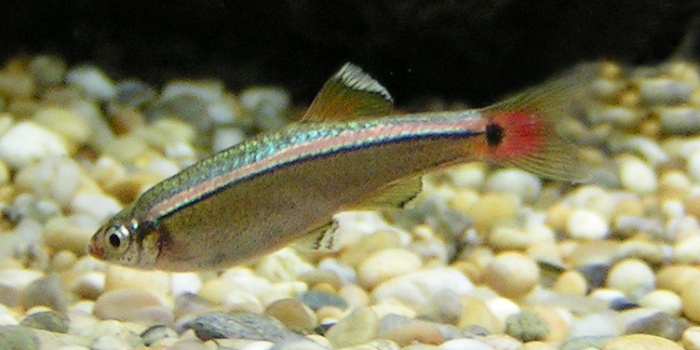
A hardy, coolwater shoaling minnow with a glowing lateral stripe and red-tipped fins, often called the 'poor man's neon tetra.' One of the few popular aquarium fish that thrives without a heater.
ℹ️
Educational only. KinStation content is reviewed by licensed veterinarians but cannot replace an in-person exam. Always consult a licensed veterinarian or board-certified specialist for diagnosis, treatment, or any decision affecting your pet's health.
🩺 Need expert help with your white cloud mountain minnow?
Connect with a specialist near you or ask a licensed vet — never substitute online guidance for hands-on care in an emergency.
East Asia (southern China, Guangdong; historically the White Cloud Mountain near Guangzhou, plus Vietnam)
Origin
Old World
Climate
⛅ Subtropical
Water type
💧 Freshwater
Family
Cyprinidae
Genus
Tanichthys
Part of the Danios
Lively, hardy cyprinids — from tiny nano jewels to fast mid-water shoalers — that do best in active groups and tolerate a range of temperatures, including cooler subtropical setups.
From the minimum an animal needs to be kept humanely, up to the ideal setup. Bigger is almost always better — minimums are floors, not targets.
Photo coming soon
Minimum
Cool school tank
10 gal / 38 L (school of 6+)
Tanichthys albonubes is a cool-water (14–22 °C) minnow — unheated tanks ideal. School of 6+, gentle flow, planted nano. Hardy and ideal for unheated rooms.
Photo coming soon
Recommended
Long unheated community
20 gal long / 75 L
Larger school of 10+ in a long planted unheated tank. Pair with similarly cool-tolerant species (rosy barbs, paradise fish). Outdoor seasonal tubs work in mild climates.
Photo coming soon
Ideal
Cool biotope / outdoor tub
40 gal+ / 150 L+ biotope
Cool planted biotope or outdoor mini-pond with native plants and microfauna. Self-sustaining colonies and full courtship colour displays.
Life & growth stages
How this animal changes through its life — each stage often has its own care, diet and space needs.
Photo coming soon
Egg
Fish eggs are small, translucent spheres, often laid in clutches on plants, substrate, or in a nest — or carried/brooded by a parent in livebearing and mouth-brooding species. A dark eye spot and the curled embryo become visible inside as development progresses.
Photo coming soon
Fry
Newly hatched fry are tiny and semi-transparent, frequently still carrying a yolk sac that fuels them before they feed freely. They lack full fin structure and adult coloration, staying near cover until they can swim and forage on their own.
Photo coming soon
Juvenile
Juveniles look like miniature adults but with developing fins and muted or different markings; many species shift pattern and color as they mature. Growth is rapid at this stage given clean water and steady feeding.
Adult
Adults show the species' full size, finnage, and mature coloration, and are sexually mature. Many fish develop sex-specific differences in size, color, or fin shape, which can intensify during breeding.
Color & pattern variants
Natural variants occur in the wild; selectively bred (man-made) variants were developed in captivity.
A group is well suited to a planted aquarium of at least 40-60 L (around 10-15 gallons), with length for swimming. Provide a dark substrate, plants, and some current to mimic their cool, fast-flowing hill-stream origins; a secure lid is wise as they can jump. They tolerate and even prefer cooler temperatures, so a heater is usually unnecessary in a normal room.
Unlike most tropical aquarium fish, white clouds are a subtropical, coolwater species that thrives at about 18-22 C (64-72 F) and tolerates a broad range down to the mid-teens C; sustained tropical warmth above roughly 24 C shortens their lifespan and fades their color. They accept a wide pH (about 6.0-8.0) and are very forgiving of hardness, making them ideal for unheated tanks and seasonal outdoor ponds in temperate climates.
Substrate
Fine gravel or sand works well, and a dark substrate enhances their red-and-iridescent coloration. A planted layout mimics their cool mountain-stream origins.
Equipment & setup
A gentle sponge or hang-on-back filter providing light current; notably, no heater is needed, as they thrive at cooler 60-72F room temperatures and can even tolerate down near 50F. Standard lighting and a lid are sufficient.
Diet
White clouds are omnivorous micro-predators and undemanding feeders. Offer quality flakes and micro-pellets as a staple, with live and frozen foods such as daphnia, baby brine shrimp, cyclops, and mosquito larvae.
Feed small amounts once or twice daily. They feed mainly at the surface and mid-water; a varied diet brings out the red in their fins and the iridescence of their stripe.
Behavior & temperament
This is a peaceful, active shoaling fish best kept in groups of at least 8-10, where males display vivid color while sparring harmlessly for attention. In adequate numbers they are bold and constantly on the move in the open water.
Their coolwater needs make them excellent companions for other subtropical species such as hillstream loaches, certain shrimp, and small gobies, rather than warm-water tropicals. A current to swim against and a planted, open layout provide natural enrichment.
Health
White clouds are exceptionally hardy and among the most forgiving aquarium fish, which is why they are recommended for beginners. The main welfare error is keeping them too warm long-term, which stresses them, dulls their color, and reduces lifespan; chilling is rarely a problem.
They can still suffer ich, fin rot, and bacterial infections if stressed or kept in poor water, so maintain clean, stable conditions and an adequate group. Quarantine new fish and avoid prolonged tropical temperatures to keep them healthy and long-lived.
Tips, DIY & hacks
These are excellent unheated or subtropical-tank fish and make a great choice for cooler rooms where tropical species would struggle. Keep a school of 8+ to encourage males to display their best breeding colors, and they will readily spawn in a densely planted tank with no special intervention.