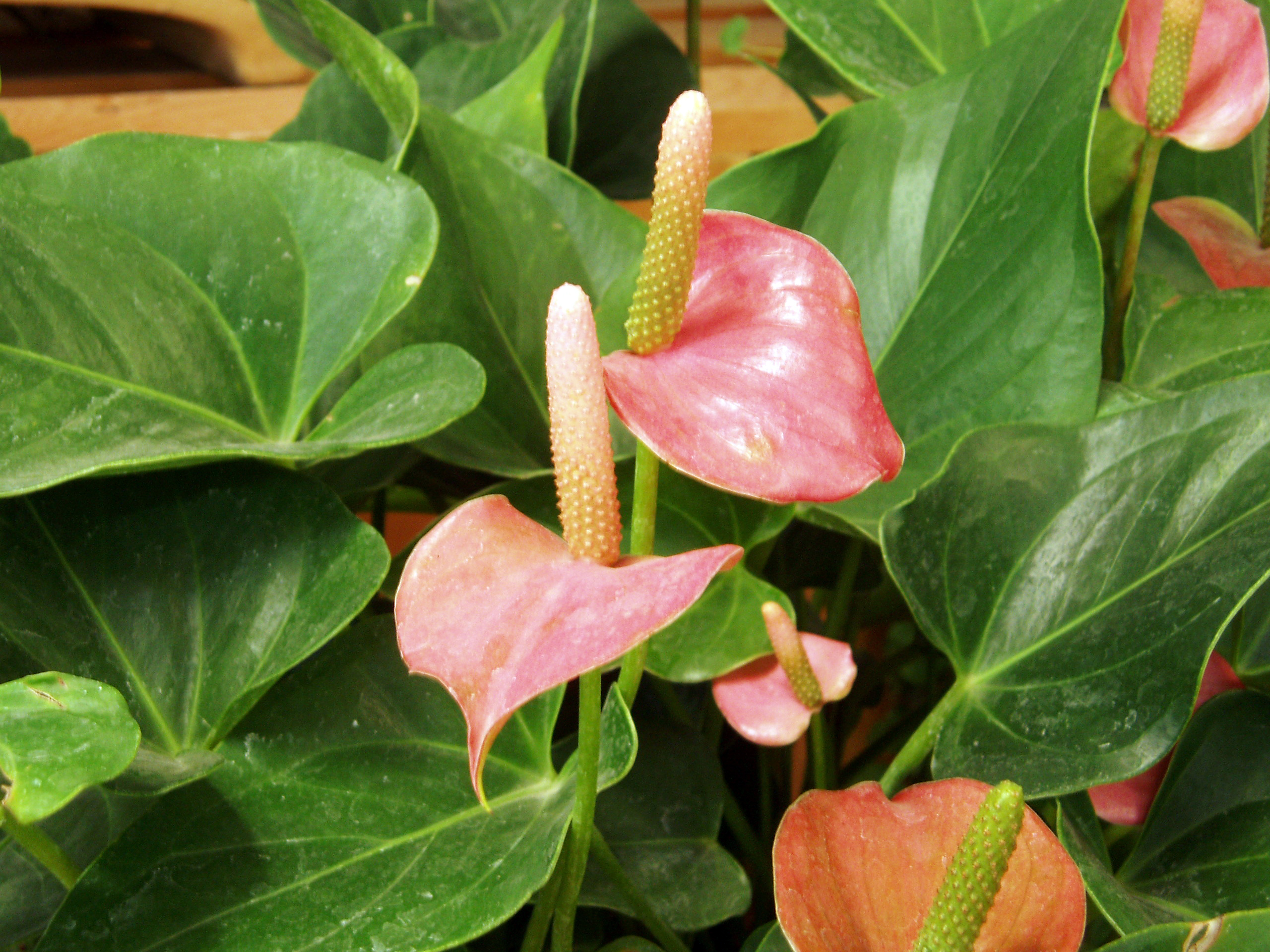
Anthurium andraeanum · also called Flamingo flower, Flamingo lily, Painter's palette, Laceleaf
Photo: Taken by Fanghong · CC BY 2.5
Toxic to pets
Toxic to cats and/or dogs — keep out of reach.
Grown for its glossy, heart-shaped, lacquer-red (or pink/white) spathes that can last for weeks, the anthurium is a long-blooming tropical aroid. Its 'flower' is a colorful bract around a slender spadix.
ℹ️
Educational only. KinStation content is reviewed by licensed veterinarians but cannot replace an in-person exam. Always consult a licensed veterinarian or board-certified specialist for diagnosis, treatment, or any decision affecting your pet's health.
Quick facts
Category
Flowering
Family
Araceae
Native origin
Tropical rainforests of Colombia and Ecuador
Care difficulty
Intermediate
Light
Bright indirect
Pet toxicity
Toxic to pets
Light
Anthuriums bloom best in bright indirect light; too little light and they grow leaves but few spathes. Keep them out of direct midday sun, which scorches both leaves and flowers. A spot near an east window, or set back from a brighter one, hits the right balance.
Water
Water when the top inch or so of mix dries, soaking thoroughly and letting it drain — the thick roots rot if kept waterlogged, but the plant also dislikes drying out completely. Consistency matters: erratic watering causes brown leaf tips and stalled blooming. Use water low in salts and let chlorinated tap water stand if leaf tips brown.
Soil & potting
As epiphytic aroids, anthuriums need a coarse, very airy mix — a blend of orchid bark, perlite, and peat or coir, rather than dense potting soil. Excellent drainage is essential. Repot every couple of years; if aerial roots climb out, you can top-dress or move up one pot size.
Environment — humidity, temperature, placement
Warmth and humidity drive continuous flowering: keep them above about 60F (15C) and ideally in a humid room, as dry air suppresses blooms and browns the leaves. Avoid cold drafts and sudden temperature drops. A bright, warm bathroom or kitchen often suits them well.
Propagation
Propagate by division — separate offsets or clumps with their own roots at repotting and pot them individually. Stem cuttings with a node and an aerial root will also root in a moist, airy medium. Seed is slow and rarely used at home; most plants are divisions or tissue-cultured stock.
Toxicity detail
Toxic to cats and dogs. The ASPCA lists Anthurium (flamingo flower) as toxic because of insoluble calcium oxalate crystals, the same irritants found in many aroids. Chewing releases the crystals, causing oral pain and burning, drooling, pawing at the mouth, and difficulty swallowing; vomiting is possible. Keep it out of reach of pets and contact a veterinarian if it is chewed. Source: ASPCA Animal Poison Control toxic-plant database.
Origin & history
Anthurium andraeanum was introduced to cultivation in the late 19th century after collection in the South American tropics and was named in honor of the French botanist Edouard Andre. Intensive breeding, especially in Hawaii and the Netherlands, expanded the wild red form into a palette of pinks, whites, oranges, and greens with ever-glossier spathes. It is now a major commercial cut flower and potted plant, valued for blooms that last extraordinarily long.
Growth stages
How this plant changes through its life — each stage often has its own care, diet and space needs.
Photo coming soon
Seed
Most plants begin as a seed (or spore in ferns) — a dormant package holding the embryo and a food reserve within a protective coat. Given moisture, warmth, and sometimes light, the seed breaks dormancy and germinates.
Photo coming soon
Seedling
The seedling emerges with a root and its first leaves (cotyledons), then true leaves. It is tender and shallow-rooted, dependent on steady moisture and light as it establishes the beginnings of stem and root systems.
Photo coming soon
Vegetative growth
In the vegetative phase the plant focuses on growing roots, stems, and foliage, building the size and structure it needs before flowering. This is the main period of leafing out and, for many houseplants, the stage at which they are grown and propagated.
Mature / Flowering
A mature plant reaches its full habit and, when conditions and age allow, flowers and sets seed (or, for foliage plants, simply attains its full adult size and form). This is the stage shown in most reference photos.
Varieties & cultivars
Natural forms are the wild species; cultivars are selectively-bred colour or variegation forms of the same plant.
Cultivars3
Red Flamingo Flower
The classic anthurium with glossy heart-shaped leaves and waxy, lacquered bright-red spathes around a yellow spadix.
Bright indirect light drives continuous flowering; too dim and blooms stop.
Pink
Same waxy flowering habit with soft to hot-pink spathes instead of red. A popular colour selection.
Bright indirect light keeps the pink saturated and flowering steady.
White
Clean white spathes with a pale spadix, giving a crisp, modern look against the dark foliage.
Bright indirect light; white spathes can show stress marks, so avoid cold drafts.
Problems & solutions
Each problem lists a proven fix (horticulture / extension-backed) and, where useful, an anecdotal remedy from the grower community — clearly labeled so you can judge for yourself.
Few or no flowers
mild
Symptoms:The plant grows healthy leaves but produces few colorful spathes.
Likely cause:Insufficient light is the leading cause; low humidity, cool temperatures, and lack of feeding during the growing season also reduce blooming.
✓ Proven fix
Give bright indirect light, keep the plant warm and humid, and feed with a dilute balanced (or phosphorus-leaning) fertilizer in spring and summer. Improved light usually restores blooming within a few weeks.
◇ Anecdotal remedy — grower lore, unverified
Some hobbyists report better flowering after moving plants to a steamy bathroom window, crediting the higher humidity as much as the light.
Brown leaf tips and edges
mild
Symptoms:Leaf tips and margins dry out and turn brown while the leaf center stays green.
Likely cause:Low humidity, salt or mineral buildup from fertilizer or tap water, or inconsistent watering that lets the mix swing between bone-dry and soggy.
✓ Proven fix
Raise humidity, flush the pot periodically to leach out salts, water consistently when the top inch dries, and use low-salt or filtered water. Trim damaged tips for appearance; they will not regreen.
◇ Anecdotal remedy — grower lore, unverified
Grouping anthuriums with other tropicals to create a humid microclimate is a popular grower fix for chronic tip browning.
Yellowing lower leaves / root rot
moderate
Symptoms:Older leaves yellow and the plant looks tired; roots may be brown and mushy.
Likely cause:Overwatering or a dense, poorly draining mix that suffocates the thick epiphytic roots. A little lower-leaf yellowing with age is normal, but widespread yellowing signals soggy roots.
✓ Proven fix
Repot into a coarse, airy aroid mix with excellent drainage, trim away soft rotted roots, and let the top inch dry before watering. Ensure the pot drains freely and never leave it standing in water.
◇ Anecdotal remedy — grower lore, unverified
Many growers add a generous scoop of orchid bark or chunky perlite to a standard mix specifically to keep anthurium roots from staying wet.
Anecdotes & grower lore
Community experience and cultural notes — not horticultural guarantees. Conditions vary by home; treat these as colour, not prescriptions.
Owners delight in the anthurium's almost artificial-looking sheen — newcomers routinely poke the spathe to check whether it is plastic, and the running joke is that it looks 'too perfect to be real.' Cut anthuriums are prized in tropical floristry precisely because a single bloom can hold for weeks in a vase, and growers in Hawaii treat them as a point of regional pride.
Reviewed and signed off by: KinStation Editorial — pre-launch draft (pending horticulture review) on 2026-05-28