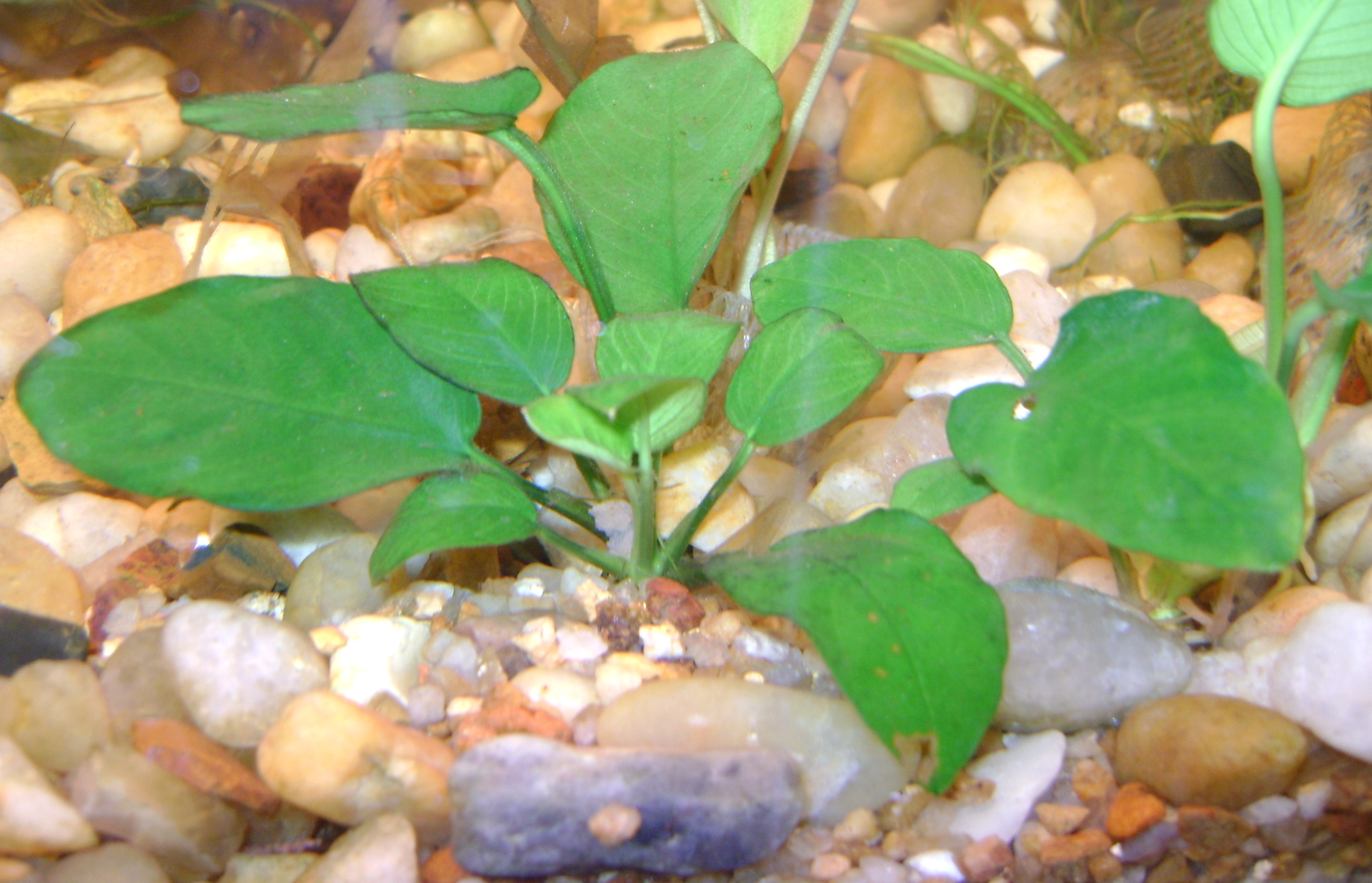
Anubias barteri var. nana · also called Dwarf anubias, Anubias nana, Nana
Photo: Carlosar · CC BY-SA 3.0
Pet-safe
Generally non-toxic to cats and dogs.
Anubias nana is a compact dwarf variety of Anubias barteri, prized for its small, rounded dark-green leaves and tiny footprint. It attaches to hardscape, tolerates very low light, and is one of the easiest aquarium plants to grow.
ℹ️
Educational only. KinStation content is reviewed by licensed veterinarians but cannot replace an in-person exam. Always consult a licensed veterinarian or board-certified specialist for diagnosis, treatment, or any decision affecting your pet's health.
Quick facts
Category
Aquatic Plants
Family
Araceae
Native origin
West Africa (Cameroon)
Care difficulty
Beginner
Light
Low light
Pet toxicity
Pet-safe
Light
Grows well in **low to medium light** (about 10-50 PAR). Because of its slow growth, bright light tends to coat the leaves with green spot algae; shaded or low-light placement keeps foliage clean.
Water
Very tolerant. Temperature **22-28 C (72-82 F)**, pH **6.0-7.5**, soft to moderately hard. Appreciates light **water-column fertilisation** with a complete liquid fertiliser; iron and a balanced micro/macro mix keep leaves deep green.
Soil & potting
An **epiphyte — do NOT bury the rhizome**. Tie or glue it to small rocks, driftwood, or wedge into hardscape crevices; its compact size makes it perfect for nano tanks and foreground accents. Feeds primarily from the water column.
Environment — humidity, temperature, placement
**CO2 not required** but speeds growth. Tolerant of low to moderate flow. Excellent **foreground to midground** plant and for attaching to nano hardscape. Grows both submersed and emersed.
Propagation
Propagated by **rhizome division** — split the rhizome into segments each retaining several leaves and roots, then re-attach. Develops side shoots from the rhizome that can be separated.
Toxicity detail
Safe for fish, shrimp, snails, and pets; leaves are rarely grazed. Contains calcium oxalate in its sap (typical of Araceae) but poses no practical risk submersed. Not a regulated or invasive species in aquarium use; never release into natural waterways.
Growth stages
How this plant changes through its life — each stage often has its own care, diet and space needs.
Photo coming soon
Spore / recruit
Aquatic plants and macroalgae establish from spores, seeds, or drifting fragments that settle and attach to substrate or rock. Many freshwater aquarium plants and marine macroalgae also spread readily from a detached piece that takes root or holdfast.
Photo coming soon
Young growth
Young growth puts out its first blades, fronds, or leaves and anchors with roots or a holdfast. Submersed plants may look different from their emersed form, and growth speeds up as the plant adapts to the water's light and nutrients.
Mature
A mature aquatic plant or macroalga reaches its full size and characteristic shape, forming the dense growth, runners, or fronds typical of the species. Established plants spread to fill space and can be divided or trimmed to propagate.
Varieties & cultivars
Natural forms are the wild species; cultivars are selectively-bred colour or variegation forms of the same plant.
Natural forms1
Nana
The standard dwarf anubias with small, rounded, tough dark-green leaves. The workhorse foreground/midground epiphyte.
Low light only; bright light encourages nuisance algae on the slow leaves. Never bury the rhizome.
Cultivars3
Nana Petite
Nursery-selected miniature of nana with tiny leaves, perfect for nano tanks and detailed scaping.
Same care as nana; grows very slowly, so keep light modest to avoid algae.
Golden / Gold
Colour selection whose new leaves emerge bright yellow-gold before slowly ageing to green, giving a glowing fresh-growth look.
A little more light helps the golden new growth show, but keep it moderate to avoid algae on the slow leaves.
Pinto (variegated)
Rare variegated nana with leaves heavily marbled and splashed in white over green, sometimes almost fully white. Prized and pricey.
Needs a bit more light to feed the limited green tissue, but white leaves burn easily, so keep it gentle; extremely slow.