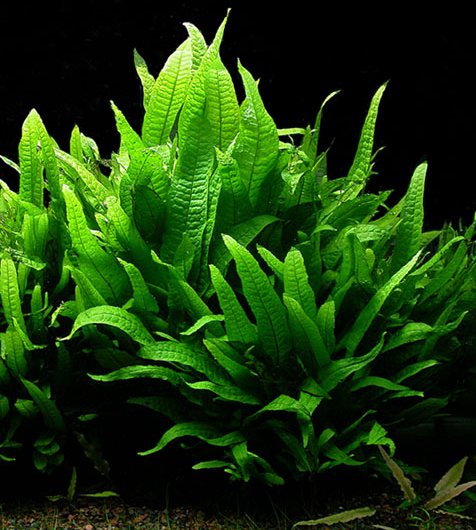
Microsorum pteropus · also called Leptochilus pteropus, Java water fern, Microsorum pteropus
Photo: Tsunamicarlos at English Wikipedia · Public domain
Pet-safe
Generally non-toxic to cats and dogs.
Java fern is one of the hardiest, most beginner-friendly aquarium plants, an epiphyte that attaches to wood and rock by its rhizome and tolerates a wide range of conditions. Its tough, leathery leaves are unpalatable to most fish, making it a staple of low-tech planted tanks. Note: the currently accepted botanical name is Leptochilus pteropus, though Microsorum pteropus remains the standard name in the aquarium trade.
ℹ️
Educational only. KinStation content is reviewed by licensed veterinarians but cannot replace an in-person exam. Always consult a licensed veterinarian or board-certified specialist for diagnosis, treatment, or any decision affecting your pet's health.
Quick facts
Category
Aquatic Plants
Family
Polypodiaceae
Native origin
Southeast Asia (Malaysia, Thailand, southern China, India, and surrounding regions)
Care difficulty
Beginner
Light
Low light
Pet toxicity
Pet-safe
Light
Thrives in **low to moderate light** (roughly 10-40 PAR). High light without CO2 can trigger nuisance algae on its slow-growing leaves and may cause translucent or browning patches. No special lighting is needed; standard low-tech LED fixtures are ideal.
Water
Very adaptable. Temperature **20-28 C (68-82 F)**, pH **5.5-8.0**, soft to moderately hard water. Tolerant of a broad GH/KH range. Benefits from modest water-column dosing of a complete liquid fertiliser, especially **potassium and iron**; black spots on leaves often indicate nutrient (often potassium) deficiency or simply old/transitioning leaves.
Soil & potting
An **epiphyte — do NOT bury the rhizome**, which will rot if planted in substrate. Tie or glue (cyanoacrylate gel) the rhizome to driftwood, lava rock, or other hardscape; roots will grip over time. It draws nutrients mainly from the water column, so substrate type is irrelevant to its survival.
Environment — humidity, temperature, placement
**CO2 not required** but injection noticeably speeds its slow growth. Prefers gentle to moderate flow. Typically used as a **midground to background** plant or to clothe hardscape. Grows both submersed and emersed; emersed culture is common in nurseries.
Propagation
Spreads by **rhizome division** — cut the rhizome into sections each bearing several leaves and roots. Also reproduces via **adventitious plantlets (daughter plants)** that form on mature leaves; once they develop a few leaves and roots they can be detached and attached elsewhere.
Toxicity detail
Non-toxic and safe for fish, shrimp, snails, and pets. Generally left alone by herbivorous and plant-nibbling fish due to its bitter, leathery leaves. Not a regulated or noxious-weed species in aquarium use — unlike floating restricted plants such as water lettuce (Pistia) or Salvinia, Java fern is not subject to bans — but as with any aquarium plant it should never be released into the wild.
Growth stages
How this plant changes through its life — each stage often has its own care, diet and space needs.
Photo coming soon
Spore / recruit
Aquatic plants and macroalgae establish from spores, seeds, or drifting fragments that settle and attach to substrate or rock. Many freshwater aquarium plants and marine macroalgae also spread readily from a detached piece that takes root or holdfast.
Photo coming soon
Young growth
Young growth puts out its first blades, fronds, or leaves and anchors with roots or a holdfast. Submersed plants may look different from their emersed form, and growth speeds up as the plant adapts to the water's light and nutrients.
Mature
A mature aquatic plant or macroalga reaches its full size and characteristic shape, forming the dense growth, runners, or fronds typical of the species. Established plants spread to fill space and can be divided or trimmed to propagate.
Varieties & cultivars
Natural forms are the wild species; cultivars are selectively-bred colour or variegation forms of the same plant.
Natural forms4
Java fern (standard)
The classic broad-leaf Microsorum pteropus with strappy green leaves. Attaches to wood and rock rather than rooting in substrate.
Low-light tolerant; do not bury the rhizome or it rots.
Narrow Leaf
Naturally narrower, more slender green leaves giving a finer, bushier look than the standard broad form.
Same easy care; tie the rhizome to hardscape and keep it exposed.
Needle Leaf
The thinnest-leaved form, with very narrow needle-like green blades for a delicate, feathery texture.
Low light is fine; grows slowly, so be patient establishing it.
Trident
Distinct form with leaves split into multiple finger-like lobes, giving a forked, bushy, fast-growing appearance.
Faster than other java ferns; keep the rhizome attached and exposed.