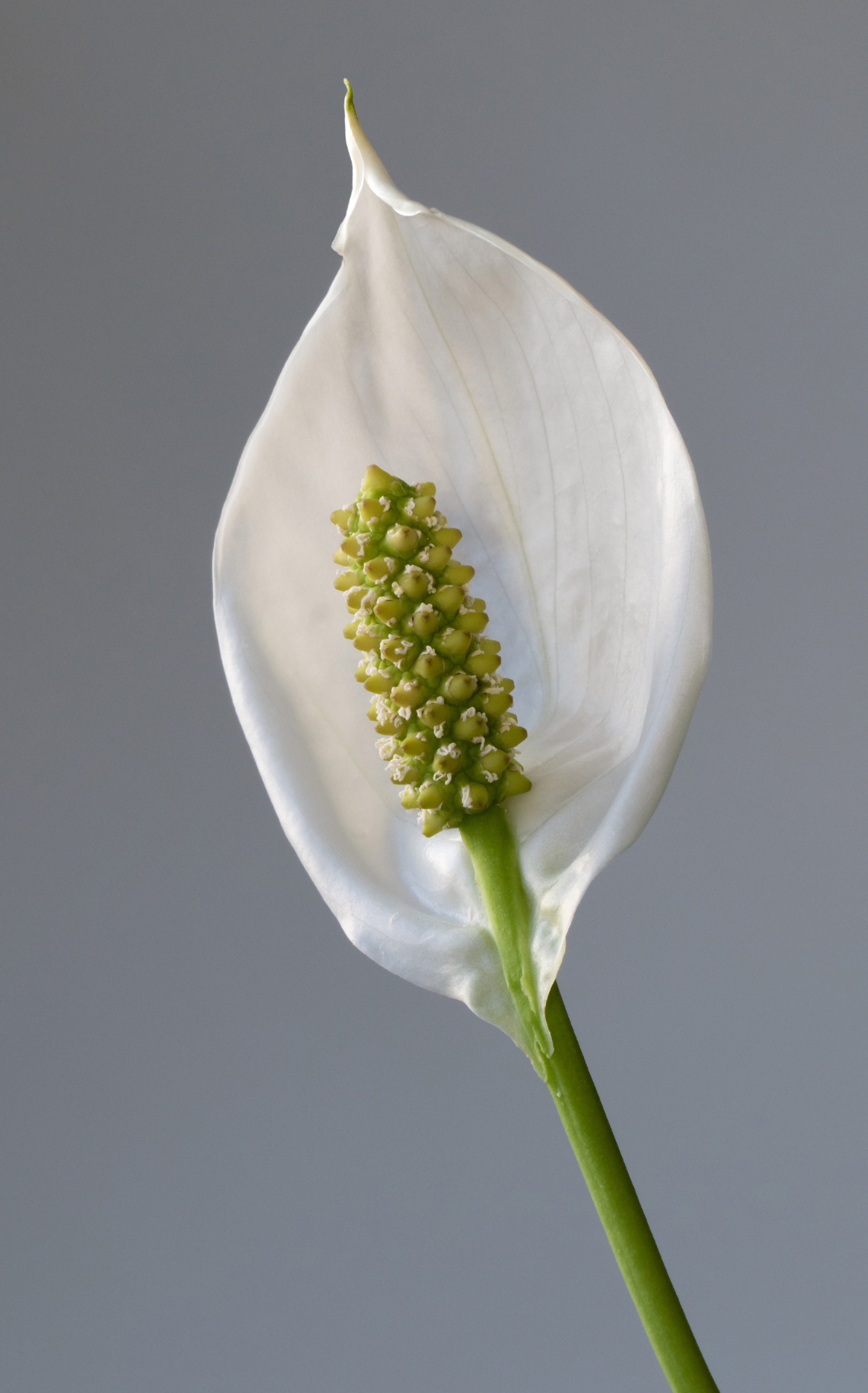
Spathiphyllum wallisii · also called Spathe flower, White sails, Mauna Loa
Toxic to pets
Toxic to cats and/or dogs — keep out of reach.
A forgiving aroid prized for glossy foliage and pure-white spathes, the peace lily blooms in modest light and famously droops dramatically when thirsty. Despite the name it is not a true lily.
ℹ️
Educational only. KinStation content is reviewed by licensed veterinarians but cannot replace an in-person exam. Always consult a licensed veterinarian or board-certified specialist for diagnosis, treatment, or any decision affecting your pet's health.
Quick facts
Category
Flowering
Family
Araceae
Native origin
Tropical rainforests of Central and South America
Care difficulty
Beginner
Light
Low light
Pet toxicity
Toxic to pets
Light
Peace lilies tolerate low light better than almost any flowering houseplant, which is why they thrive in offices and dim corners. For reliable blooming, however, give bright indirect light — the white spathes are produced far more freely there. Keep them out of harsh direct sun, which scorches the leaves and bleaches them yellow-green.
Water
Water when the top inch of mix dries; the plant signals thirst by wilting its whole canopy, then rebounds within hours of a soak. Avoid letting it sit in standing water, which rots the roots — empty the saucer after watering. They are sensitive to chlorine and fluoride, so let tap water stand overnight or use filtered water if leaf tips brown.
Soil & potting
Use a rich, well-draining, peat-based or coir-based potting mix that holds moisture without staying soggy. A handful of perlite or orchid bark improves aeration around the fleshy roots. Repot every year or two when roots fill the pot, stepping up only one pot size.
Environment — humidity, temperature, placement
As rainforest understory plants, peace lilies love warmth and humidity; keep them above 60F (15C) and away from cold drafts and heating vents. They appreciate a humid room, a pebble tray, or occasional misting, especially in dry winter air. Brown leaf tips are usually a sign of dry air, salt buildup, or fluoridated water.
Propagation
Propagate by division: at repotting, separate the clump into sections, each with several leaves and a portion of healthy roots, and pot them individually. Peace lilies cannot be reliably grown from leaf cuttings the way many houseplants are. Divisions establish quickly if kept warm, humid, and lightly watered.
Toxicity detail
Toxic to cats and dogs. The ASPCA classifies Spathiphyllum (peace lily) as toxic due to insoluble calcium oxalate crystals, which cause oral and esophageal irritation, intense burning of the mouth, drooling, and difficulty swallowing if chewed. Importantly, the peace lily is NOT a true lily (Lilium/Hemerocallis) and does not cause the acute kidney failure those genuine lilies cause in cats — but it should still be kept out of reach and a veterinarian contacted if ingested. Source: ASPCA Animal Poison Control toxic-plant database.
Origin & history
Spathiphyllum belongs to the arum family (Araceae) and was introduced to European horticulture in the 19th century after collection in the American tropics; the popular cultivar group 'Mauna Loa' helped make it a global houseplant staple. Its 'flower' is botanically an inflorescence: a central spadix of tiny true flowers wrapped by the showy white bract called a spathe. It earned lasting fame as one of the species highlighted in NASA's 1989 Clean Air Study of foliage plants.
Growth stages
How this plant changes through its life — each stage often has its own care, diet and space needs.
Photo coming soon
Seed
Most plants begin as a seed (or spore in ferns) — a dormant package holding the embryo and a food reserve within a protective coat. Given moisture, warmth, and sometimes light, the seed breaks dormancy and germinates.
Photo coming soon
Seedling
The seedling emerges with a root and its first leaves (cotyledons), then true leaves. It is tender and shallow-rooted, dependent on steady moisture and light as it establishes the beginnings of stem and root systems.
Photo coming soon
Vegetative growth
In the vegetative phase the plant focuses on growing roots, stems, and foliage, building the size and structure it needs before flowering. This is the main period of leafing out and, for many houseplants, the stage at which they are grown and propagated.
Mature / Flowering
A mature plant reaches its full habit and, when conditions and age allow, flowers and sets seed (or, for foliage plants, simply attains its full adult size and form). This is the stage shown in most reference photos.
Varieties & cultivars
Natural forms are the wild species; cultivars are selectively-bred colour or variegation forms of the same plant.
Cultivars3
Mauna Loa
The familiar mid-size peace lily with glossy dark-green leaves and tall white spathes. The standard houseplant form.
Tolerates low-to-medium light; flowers best in bright indirect light.
Sensation
Giant cultivar with broad, ribbed dark-green leaves reaching several feet tall and wide, with large white blooms. The biggest peace lily.
Handles lower light thanks to its size; give space to spread.
Domino
Variegated peace lily with dark-green leaves streaked and speckled in white, each leaf uniquely marbled. Adds colour to an otherwise green plant.
Needs brighter indirect light than green peace lilies to hold the white variegation and avoid reverting.
Problems & solutions
Each problem lists a proven fix (horticulture / extension-backed) and, where useful, an anecdotal remedy from the grower community — clearly labeled so you can judge for yourself.
Whole plant wilts and droops
mild
Symptoms:The entire canopy of leaves goes limp and sags over the pot edge, often quite suddenly.
Likely cause:Most commonly underwatering — the peace lily dramatizes drought more than almost any houseplant. Rarely, the same droop can signal the opposite problem (root rot from constant sogginess), so check whether the soil is bone-dry or waterlogged.
✓ Proven fix
If the mix is dry, water thoroughly until it drains from the bottom; the plant usually recovers turgor within a few hours. Going forward, water when the top inch dries rather than on a fixed calendar, and never let it sit in a saucer of water.
◇ Anecdotal remedy — grower lore, unverified
Some growers claim repeated dramatic wilts 'toughen up' the plant; there is no evidence for this, and chronic wilting stresses roots, so it is better to water consistently.
Brown, crispy leaf tips
mild
Symptoms:Leaf tips and margins turn brown and dry while the rest of the leaf stays green.
Likely cause:Usually low humidity, mineral or salt buildup in the soil, or sensitivity to chlorine and fluoride in tap water. Over-fertilizing concentrates salts and worsens it.
✓ Proven fix
Increase humidity (pebble tray or grouping plants), flush the pot periodically with plenty of water to leach out salts, and switch to filtered, distilled, or stood-overnight tap water. Trim dead tips to neaten the plant; they will not regrow green.
◇ Anecdotal remedy — grower lore, unverified
A common grower tip is to water with cooled rainwater collected outdoors, which avoids tap-water minerals entirely.
Refuses to flower
mild
Symptoms:Healthy green leaves but few or no white spathes for long stretches.
Likely cause:Too little light is the usual reason; peace lilies survive in deep shade but bloom only with brighter indirect light. Very young or recently divided plants also skip flowering while they re-establish.
✓ Proven fix
Move the plant to a bright spot with indirect light (an east window or a few feet back from a brighter one) and feed lightly during the growing season. Be patient after dividing — flowering resumes once the plant has rebuilt its root system.
◇ Anecdotal remedy — grower lore, unverified
Commercial growers sometimes induce uniform blooming with plant hormones; this is not something to attempt at home, and a brighter windowsill achieves the same end safely.
Anecdotes & grower lore
Community experience and cultural notes — not horticultural guarantees. Conditions vary by home; treat these as colour, not prescriptions.
Grower lore holds the peace lily up as the houseplant that 'tells you' when it is thirsty — owners trade stories of a totally collapsed plant springing back upright within an hour of watering, as though nothing happened. Many keepers swear by the trick of letting it wilt slightly on purpose to learn its rhythm, then never again. It is also passed around offices as a 'gift that survives anything,' a reputation it has largely earned.
Reviewed and signed off by: KinStation Editorial — pre-launch draft (pending horticulture review) on 2026-05-28