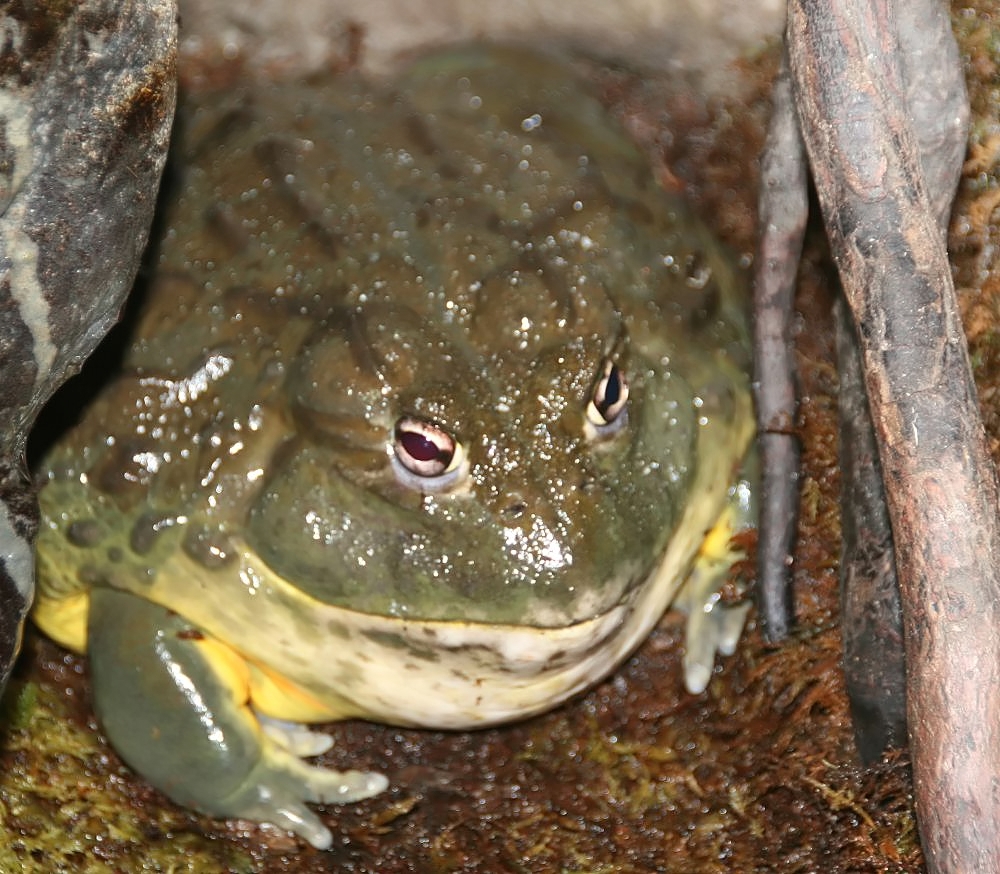
One of the largest frogs on Earth and a tank-like ambush predator with an enormous mouth, tooth-like odontoid projections, and a famously aggressive feeding response. Hardy and long-lived but powerful and bite-prone, the pixie is a rewarding display animal rather than a handling pet.
ℹ️
Educational only. KinStation content is reviewed by licensed veterinarians but cannot replace an in-person exam. Always consult a licensed veterinarian or board-certified specialist for diagnosis, treatment, or any decision affecting your pet's health.
🩺 Need expert help with your african bullfrog (pixie)?
Connect with a specialist near you or ask a licensed vet — never substitute online guidance for hands-on care in an emergency.
Large: males reach 8 to 9 in (20 to 23 cm) and over 2 lb (1 kg); females noticeably smaller at 4 to 5.5 in (10 to 14 cm)
Lifespan
15–35 years
Social needs
solo
Native region
Sub-Saharan Africa (savanna regions from Nigeria and Sudan south to South Africa)
Origin
Old World
Climate
⛅ Subtropical
Family
Pyxicephalidae
Genus
Pyxicephalus
Part of the Toads and burrowing frogs
Stout, terrestrial frogs and toads kept in humid, burrowable setups with a shallow water dish. Many are ambush predators with strong feeding responses and toxic or irritating skin secretions, so they are observation animals handled minimally and only with clean, wet hands.
From the minimum an animal needs to be kept humanely, up to the ideal setup. Bigger is almost always better — minimums are floors, not targets.
Photo coming soon
Minimum
Large floor terrarium
36 × 18 × 18 in for one adult male
Pyxicephalus adspersus (pixie frog) is one of the largest frogs in the world — males reach 9+ in. Solo housing only (cannibalistic). 36×18×18 floor terrarium with deep coco fibre for burrowing, large shallow water area, hides, 70–85% humidity at 75–85 °F.
Photo coming soon
Recommended
Wider floor terrarium
48 × 24 × 18 in
Adult males need substantial floor space — deep substrate for aestivation burrowing, large water bowl big enough to soak, multiple hides. Powerful — needs heavy fixtures and a locked lid.
Photo coming soon
Ideal
Bioactive floor terrarium
48 × 24 × 24 in+ bioactive
Large planted bioactive floor terrarium with drainage, deep substrate, leaf litter, hides, and a large water section. Pixies aestivate during dry season — bioactive substrate supports this natural cocoon-forming behaviour.
Life & growth stages
How this animal changes through its life — each stage often has its own care, diet and space needs.
Photo coming soon
Egg
Amphibian eggs are soft, jelly-coated spheres laid in or near water — in floating clutches, strings, or foam nests depending on the species. The dark embryo is visible within the clear gel as it develops.
Photo coming soon
Tadpole / Larva
The aquatic larva (a tadpole in frogs/toads, a gilled larva in salamanders and newts) breathes through gills and feeds and grows in water. Frog/toad tadpoles are limbless at first, then sprout hind then front legs as metamorphosis nears.
Photo coming soon
Juvenile (froglet / eft)
At metamorphosis the animal develops legs and lungs and typically leaves the water as a froglet or, in many newts, a terrestrial eft. It resembles a small adult but is not yet sexually mature and its coloration may still be changing.
Adult
Adults reach full size and breeding condition, with the species' mature skin coloration and pattern. Many amphibians return to water to breed and can show seasonal or sex-specific changes such as nuptial coloration or crests.
(c) jackietheunissen80, some rights reserved (CC BY-NC) via iNaturalist — https://www.inaturalist.org/observations/325304014
Color & pattern variants
Natural variants occur in the wild; selectively bred (man-made) variants were developed in captivity.
Natural
representative
Standard (wild-type) African bullfrog
The typical olive-green to grey-green form with ridged skin and a cream-to-yellow belly; males develop bright yellow-orange throats. This is the form almost always seen in the hobby.
Habitat & enclosure
House one frog alone in a 20 to 40 gallon (75 to 150 L) front-opening or terrestrial tank; bigger males need more floor space than height. Provide a deep moist substrate for burrowing and a large, shallow water dish the frog can sit in (no deep water, as they are poor swimmers). Maintain ambient temps of 75 to 82 F (24 to 28 C) with a gentle gradient and a basking-warm area near 84 F (29 C); never let it overheat. Keep humidity around 50 to 70 percent with daily light misting. UVB is not strictly required if the diet is well supplemented, but low-level UVB (2 to 5 percent) benefits long-term bone health.
Substrate
Use a deep (4 to 6 in / 10 to 15 cm) layer of loose, moist, burrowable substrate such as coconut fiber, organic topsoil, or a topsoil/coir mix. Avoid gravel, bark chips, or anything small enough to be swallowed during feeding, which causes impaction. Spot-clean waste daily and fully replace substrate periodically; these large frogs are heavy waste producers.
Equipment & setup
Provide a thermostat-controlled heat source (under-tank heater or low-watt overhead) to hold tropical temps, a reliable thermometer/hygrometer, and a large shallow water dish that is easy to clean daily. Optional low-percentage UVB supports bone health. A secure lid prevents escape, and a front-opening enclosure reduces stress from overhead movement. No filtration is needed since standing water should be changed frequently rather than filtered.
Diet
Voracious carnivore and opportunistic ambush feeder that will attempt to eat almost anything that moves and fits in its mouth. Staple feeders include nightcrawlers/earthworms, gut-loaded crickets, dubia roaches, and occasional pinky or fuzzy mice for large adults (sparingly, to avoid obesity). Dust insects with calcium plus D3 and a multivitamin. Feed juveniles every 1 to 2 days and adults every 4 to 7 days; these frogs gorge and become obese easily, so portion carefully. Never house two together, as cannibalism is common.
Behavior & temperament
A sit-and-wait ambush predator that spends most of its time buried with only the eyes exposed. Bold and notoriously aggressive at feeding time, with a wide gape, powerful jaws, and bony odontoids that can deliver a genuinely painful, blood-drawing bite; large males have been observed defending nests and lunging at intruders. This is not a handling animal. Move it with a cup or wet hands only when necessary, keep fingers clear during feeding (use tongs), and wash hands thoroughly before and after contact. During dry conditions it can estivate, forming a cocoon and burrowing for extended dormancy.
Health
Common problems stem from husbandry: obesity from overfeeding, metabolic bone disease from poor calcium/UVB, prolapse and impaction from oversized prey or loose substrate, and bacterial skin infections (red-leg) from dirty water. Keep the water dish and substrate scrupulously clean since frogs absorb toxins through their skin; use only dechlorinated water. Watch for bloat, cloudy eyes, lethargy, and refusal to feed. A frog that buries and stops eating for long periods may be estivating, but rule out illness first.
Tips, DIY & hacks
Always feed with long tongs, never fingers, due to the strong feeding strike and bite. Sex by size and throat color: mature males are far larger with yellow-orange throats. Soak a new or dehydrated frog in shallow dechlorinated water to rehydrate. Change the water dish daily because frogs often defecate in it. Keep this species solo for life, and plan for a multi-decade commitment given their long lifespan.