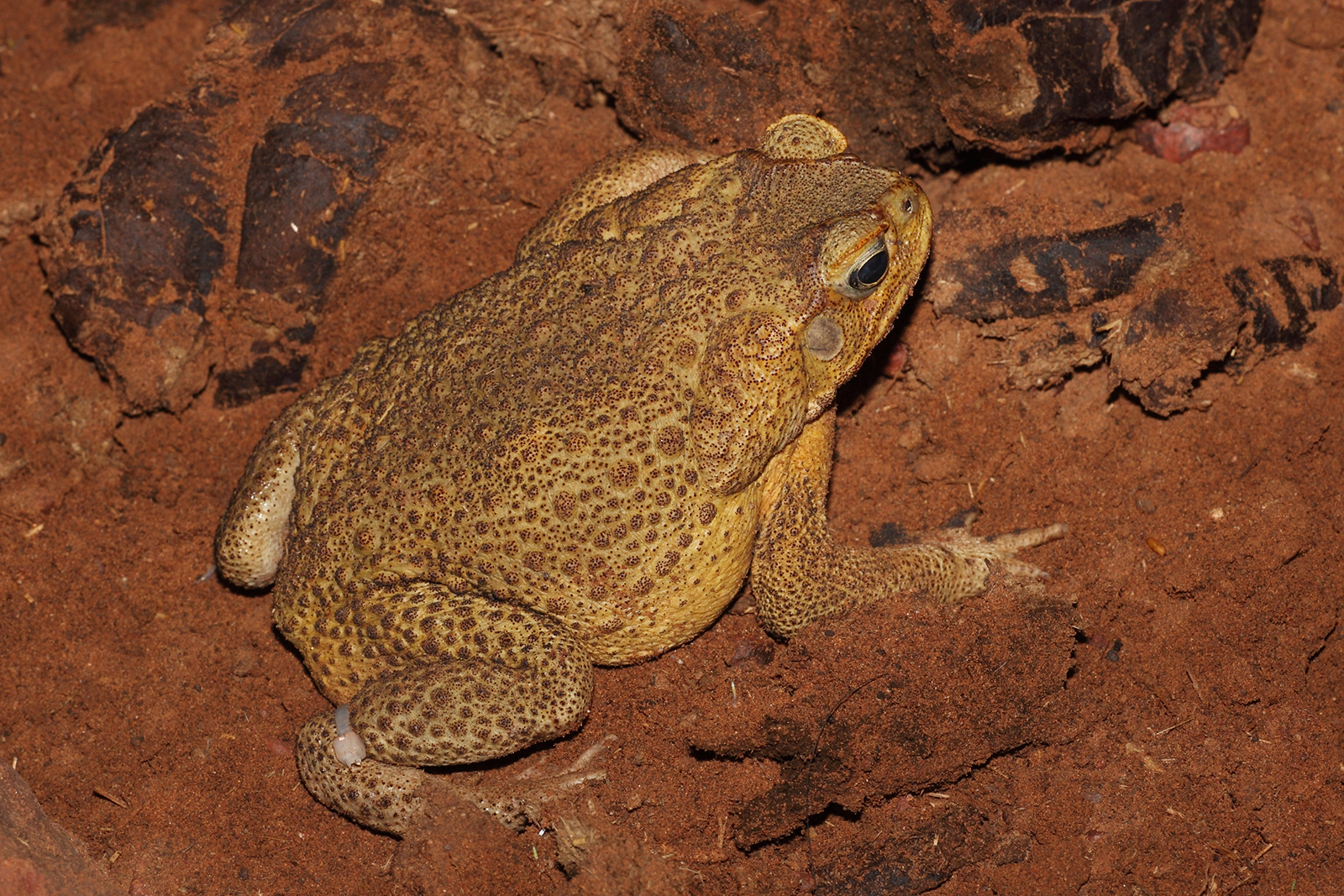
One of the world's largest toads and a notorious invasive species, the cane toad is hardy and long-lived but carries potent bufotoxins and is heavily regulated or banned in many places. It is an undemanding captive but a serious ecological and legal liability that demands a responsible, escape-proof setup.
ℹ️
Educational only. KinStation content is reviewed by licensed veterinarians but cannot replace an in-person exam. Always consult a licensed veterinarian or board-certified specialist for diagnosis, treatment, or any decision affecting your pet's health.
🩺 Need expert help with your cane toad?
Connect with a specialist near you or ask a licensed vet — never substitute online guidance for hands-on care in an emergency.
Large terrestrial toad: commonly 4–6 in (10–15 cm) snout-to-vent; large females exceed 7 in (18 cm) and can top 1 kg.
Lifespan
10–15 years
Social needs
solo
Native region
Native to South and Central America and extreme southern North America (Amazon basin north to the Rio Grande Valley of T
Origin
New World
Climate
🌴 Tropical
Family
Bufonidae
Genus
Rhinella
Part of the Toads and burrowing frogs
Stout, terrestrial frogs and toads kept in humid, burrowable setups with a shallow water dish. Many are ambush predators with strong feeding responses and toxic or irritating skin secretions, so they are observation animals handled minimally and only with clean, wet hands.
From the minimum an animal needs to be kept humanely, up to the ideal setup. Bigger is almost always better — minimums are floors, not targets.
Photo coming soon
Minimum
Large terrestrial enclosure
36 × 18 × 18 in floor terrarium
Rhinella marina is a giant terrestrial toad. LEGAL WARNING: invasive and illegal to keep in Australia, Hawaii, Florida (outside South FL native range), and many other regions — check local law before acquiring. Where legal: 36×18×18 floor terrarium with deep coco fibre, hides, shallow water dish, 50–70% humidity at 72–82 °F.
Photo coming soon
Recommended
Wider floor terrarium
48 × 24 × 18 in
Cane toads grow huge (up to 6 in / 1.5 kg) and need substantial floor space. Deep substrate for burrowing, multiple hides, large shallow water area. Wear gloves when handling — bufotoxin from parotid glands is dangerous to pets.
Photo coming soon
Ideal
Bioactive floor terrarium
48 × 24 × 18 in+ bioactive
Large planted bioactive floor terrarium with drainage, deep substrate, leaf litter, multiple hides, and a large shallow water section. Only consider where legal — captive-bred animals are scarce and rehoming an unwanted cane toad is difficult.
Life & growth stages
How this animal changes through its life — each stage often has its own care, diet and space needs.
Photo coming soon
Egg
Amphibian eggs are soft, jelly-coated spheres laid in or near water — in floating clutches, strings, or foam nests depending on the species. The dark embryo is visible within the clear gel as it develops.
Photo coming soon
Tadpole / Larva
The aquatic larva (a tadpole in frogs/toads, a gilled larva in salamanders and newts) breathes through gills and feeds and grows in water. Frog/toad tadpoles are limbless at first, then sprout hind then front legs as metamorphosis nears.
Photo coming soon
Juvenile (froglet / eft)
At metamorphosis the animal develops legs and lungs and typically leaves the water as a froglet or, in many newts, a terrestrial eft. It resembles a small adult but is not yet sexually mature and its coloration may still be changing.
Adult
Adults reach full size and breeding condition, with the species' mature skin coloration and pattern. Many amphibians return to water to breed and can show seasonal or sex-specific changes such as nuptial coloration or crests.
(c) mandymandossa, some rights reserved (CC BY-NC) via iNaturalist — https://www.inaturalist.org/observations/192148340
Habitat & enclosure
An adult needs a large terrestrial enclosure — a 40-gallon breeder (36×18 in floor) is a sensible minimum for one, larger for big females, since floor space matters more than height. Maintain temperatures around 75–82°F (24–28°C) with a gentle gradient and a nighttime drop, plus moderate-to-high humidity (50–80%). Provide a shallow, easily exited water dish big enough to soak in (toads drink and hydrate through the skin) with dechlorinated water changed daily. Include hides and sturdy plants. A secure lid is required.
Substrate
Use a deep, moisture-retentive, burrow-friendly substrate such as coconut fiber, organic topsoil, or a soil/sand loam mix, kept damp but not waterlogged; cypress mulch works as a topper. Avoid gravel, bark chips, and other loose materials that can be ingested during feeding and cause impaction. A bioactive setup with springtails/isopods and a drainage layer helps manage waste and humidity.
Equipment & setup
Provide a heat source (overhead heat lamp or a ceramic heat emitter for night) controlled by a thermostat to hold the warm gradient, plus thermometers and a hygrometer to monitor temperature and humidity. Low-level UVB is beneficial for long-term bone health. A large, low water dish and a secure, escape-proof lid complete the setup. Filtration isn't needed for the dish — just change the water daily.
Diet
Voracious generalist carnivores that will eat almost anything they can swallow. Offer a varied diet of appropriately sized insects — crickets, dubia roaches, earthworms, nightcrawlers — plus occasional pinky mice for very large adults. Gut-load feeders and dust with calcium (plus periodic D3) and a multivitamin. Adults are easily overfed and become obese; feed 2–3 times weekly to maintain a rounded but not bloated body. Never feed wild-caught insects that may carry pesticides.
Behavior & temperament
Calm, slow-moving, and nocturnal, with a strong feeding response — keep fingers clear at feeding time. Handling should be minimized and always done with clean, wet, gloved hands: the large parotoid glands behind the eyes secrete bufotoxins that are dangerously toxic if they contact the mouth, eyes, or a wound, and have killed pets that mouthed wild toads. Always wash thoroughly after contact and never touch your face. Not an interactive or handleable pet — keep as a display animal.
Health
Hardy and disease-resistant overall. The main captive problems are obesity from overfeeding, metabolic bone disease from poor calcium/D3, impaction from loose substrate or oversized prey, and skin/eye infections from dirty water. Provide clean water, correct supplementation, and proper temperatures. Their toxic secretions are a hazard to other pets and children in the home, which must factor into housing decisions.
Tips, DIY & hacks
Legal status is the critical issue: Rhinella marina is a prohibited or restricted invasive species in many jurisdictions. It is banned/prohibited in California, Hawaii, and as a pest in much of Australia, and is regulated as a nonnative invasive elsewhere; always verify federal, state, and local law before acquiring one. (In Florida, where it is established and invasive, it is currently regulated as Class III wildlife and may be kept as a personal pet without a permit, but importation and commercial use are permit-controlled.) Never release a cane toad — they are devastating invasives. Keep well away from dogs, cats, and children due to bufotoxins, and source only captive-bred animals. Provide floor space over height, keep water scrupulously clean, and resist overfeeding.