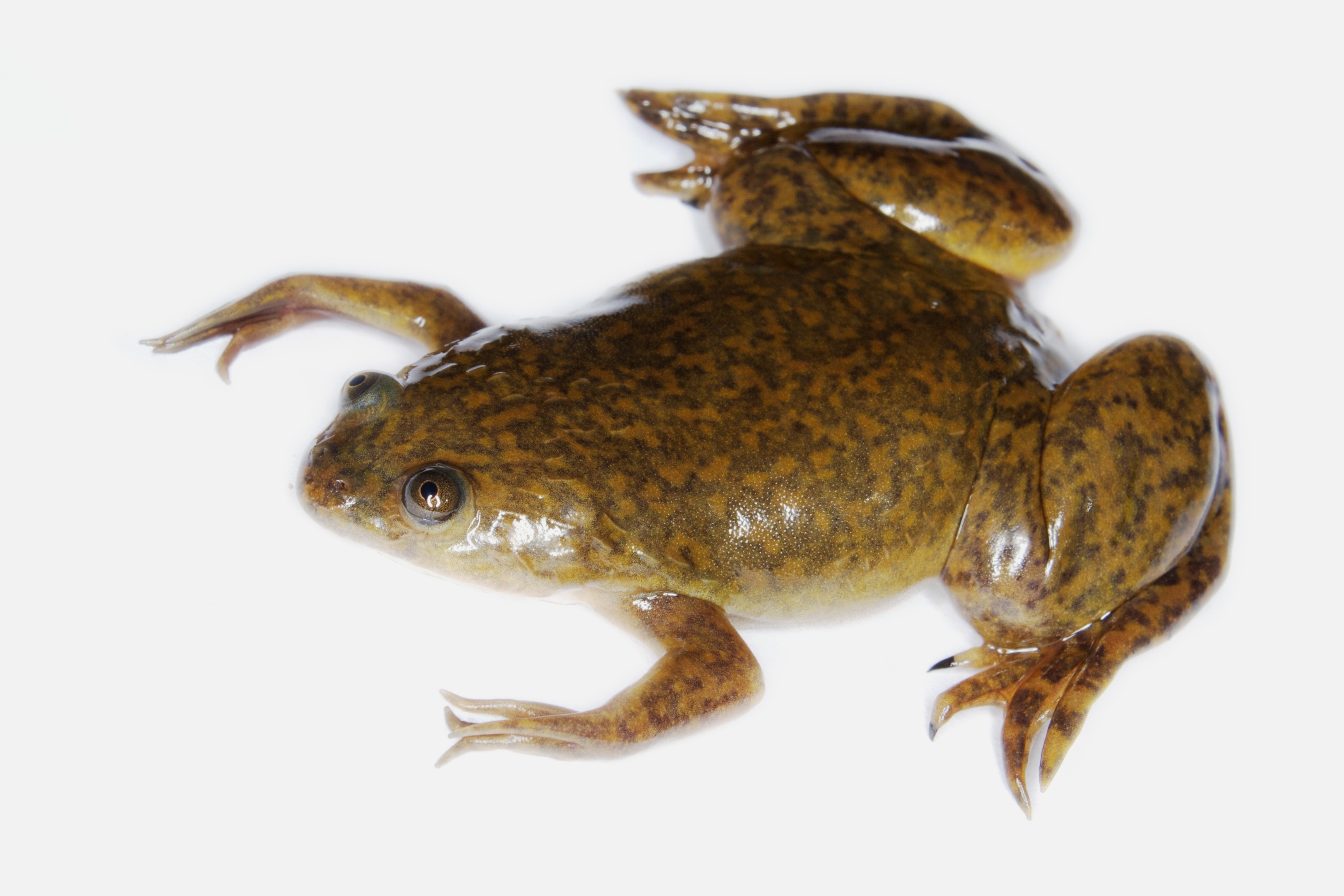
A fully aquatic, flat-bodied frog with clawed hind toes, long used in biology research and easy to keep in a simple freshwater aquarium. It is hardy and long-lived but is an invasive species and legally restricted or banned in many US states, so prospective keepers must check the law and never release it. Do not confuse it with the smaller African dwarf frog (Hymenochirus), which is a different, fully aquatic pet.
ℹ️
Educational only. KinStation content is reviewed by licensed veterinarians but cannot replace an in-person exam. Always consult a licensed veterinarian or board-certified specialist for diagnosis, treatment, or any decision affecting your pet's health.
🩺 Need expert help with your african clawed frog?
Connect with a specialist near you or ask a licensed vet — never substitute online guidance for hands-on care in an emergency.
Medium aquatic frog: 2.5 to 5 in (6 to 13 cm), females larger
Lifespan
10–20 years
Social needs
group
Native region
Sub-Saharan Africa (native to southern Africa); widely introduced and invasive elsewhere
Origin
Old World
Climate
🍂 Temperate
Water type
💧 Freshwater
Family
Pipidae
Genus
Xenopus
Part of the Aquatic amphibians
Fully or largely aquatic amphibians kept in cycled, well-filtered freshwater aquariums. They surface to breathe, prefer gentle current and hiding spots, and are not handling animals.
From the minimum an animal needs to be kept humanely, up to the ideal setup. Bigger is almost always better — minimums are floors, not targets.
Photo coming soon
Minimum
Aquatic tank
20-gal long (30 × 12 × 12 in) for one adult
Xenopus laevis is a fully aquatic large clawed frog (4–5 in). 20-gal long minimum with gentle filter, sand or smooth substrate, hides, hardy plants (or none — they uproot plants), 65–75 °F. Solitary or kept with similar-size Xenopus only. NEVER mix with dwarf clawed frogs (different species; clawed will eat them).
Photo coming soon
Recommended
Larger aquatic tank
29 gal for a pair / trio
Wider tank with gentle filtration, sand or bare-bottom, multiple hides, hardy plants. Xenopus are voracious — co-house only with sex-matched conspecifics, never with fish. Invasive outside native range — illegal to release.
Photo coming soon
Ideal
Planted aquatic
40-gal breeder planted
Larger planted aquatic tank with gentle filter, soft substrate, robust plants tied to wood, and dense hides. Albino Xenopus are the typical pet — easy beginner amphibian but messy. Lifespan 15+ years.
Life & growth stages
How this animal changes through its life — each stage often has its own care, diet and space needs.
Photo coming soon
Egg
Amphibian eggs are soft, jelly-coated spheres laid in or near water — in floating clutches, strings, or foam nests depending on the species. The dark embryo is visible within the clear gel as it develops.
Tadpole / Larva
The aquatic larva (a tadpole in frogs/toads, a gilled larva in salamanders and newts) breathes through gills and feeds and grows in water. Frog/toad tadpoles are limbless at first, then sprout hind then front legs as metamorphosis nears.
California Department of Fish and Wildlife, CC BY 2.0, via Wikimedia Commons
Photo coming soon
Juvenile (froglet / eft)
At metamorphosis the animal develops legs and lungs and typically leaves the water as a froglet or, in many newts, a terrestrial eft. It resembles a small adult but is not yet sexually mature and its coloration may still be changing.
Adult
Adults reach full size and breeding condition, with the species' mature skin coloration and pattern. Many amphibians return to water to breed and can show seasonal or sex-specific changes such as nuptial coloration or crests.
(c) Oliver Angus, some rights reserved (CC BY-NC) via iNaturalist — https://www.inaturalist.org/observations/109852472
Color & pattern variants
Natural variants occur in the wild; selectively bred (man-made) variants were developed in captivity.
Natural
representative
Wild-type
The natural olive-to-gray mottled form with a pale, marbled underside.
Selectively bred (man-made)
representative
Albino
A widely available pink-to-white captive strain with red eyes, popular in the pet and research trades.
Habitat & enclosure
Keep in a fully aquatic freshwater setup. A single adult needs at least a 10 to 20 gallon (40 to 75 L) aquarium; allow about 10 gallons per additional frog. Water depth of 8 to 12 in (20 to 30 cm) or more is fine since they surface to breathe. Maintain water at 65 to 75 F (18 to 24 C); they tolerate room temperature and do not need a heater in most homes. Use a secure, tight-fitting lid as they can jump and climb out. Provide caves and plants for cover and a gentle current.
Substrate
Use either a bare bottom for easy cleaning or large, smooth river stones too big to swallow; avoid gravel and small substrate, which they ingest accidentally and which can cause impaction. Hardy or artificial plants and caves provide enrichment and cover.
Equipment & setup
Provide a gentle filter (sponge or a baffled hang-on-back) sized to the tank, since strong current stresses them. A secure lid is essential to prevent escape. A heater is usually unnecessary at room temperature. Standard aquarium lighting suffices; no UVB is required. Keep a thermometer and a water-test kit for the nitrogen cycle.
Diet
Carnivorous and voracious. Feed sinking carnivore pellets, frog and turtle pellets, earthworms, bloodworms, blackworms, and occasional thawed fish or shrimp. They locate food by smell and by sensing vibrations with their lateral line. Feed adults every two to three days and juveniles more often; avoid overfeeding, which fouls water and causes obesity.
Behavior & temperament
Aquatic, active, and gregarious, often best kept in small groups. They are strong, opportunistic predators and will eat any tankmate small enough to swallow, including fish and smaller frogs, so house them only with similarly sized clawed frogs. They lack a tongue and use their forelimbs to stuff food into the mouth. Avoid handling; their skin is slippery and delicate, and they are stressed out of water.
Health
Hardy if water quality is maintained. Common issues include bloat or dropsy, bacterial and fungal skin infections (often water-quality related), red-leg, and nutritional problems from poor diet. Keep ammonia and nitrite at zero with regular water changes and filtration. They can carry and spread chytrid fungus, a major reason releasing them is dangerous to wild amphibians.
Tips, DIY & hacks
CRITICAL: Check your local and state laws before acquiring one. Xenopus laevis is classified as invasive and is restricted, prohibited, or requires a permit in numerous US states including California, Washington, Oregon, Arizona, Nevada, Florida, Louisiana, New Jersey, North Carolina, Kentucky, and Virginia, among others. Never release one into the wild; rehome unwanted frogs responsibly. Keep the tank tightly covered, keep water clean, and house only with same-size conspecifics.