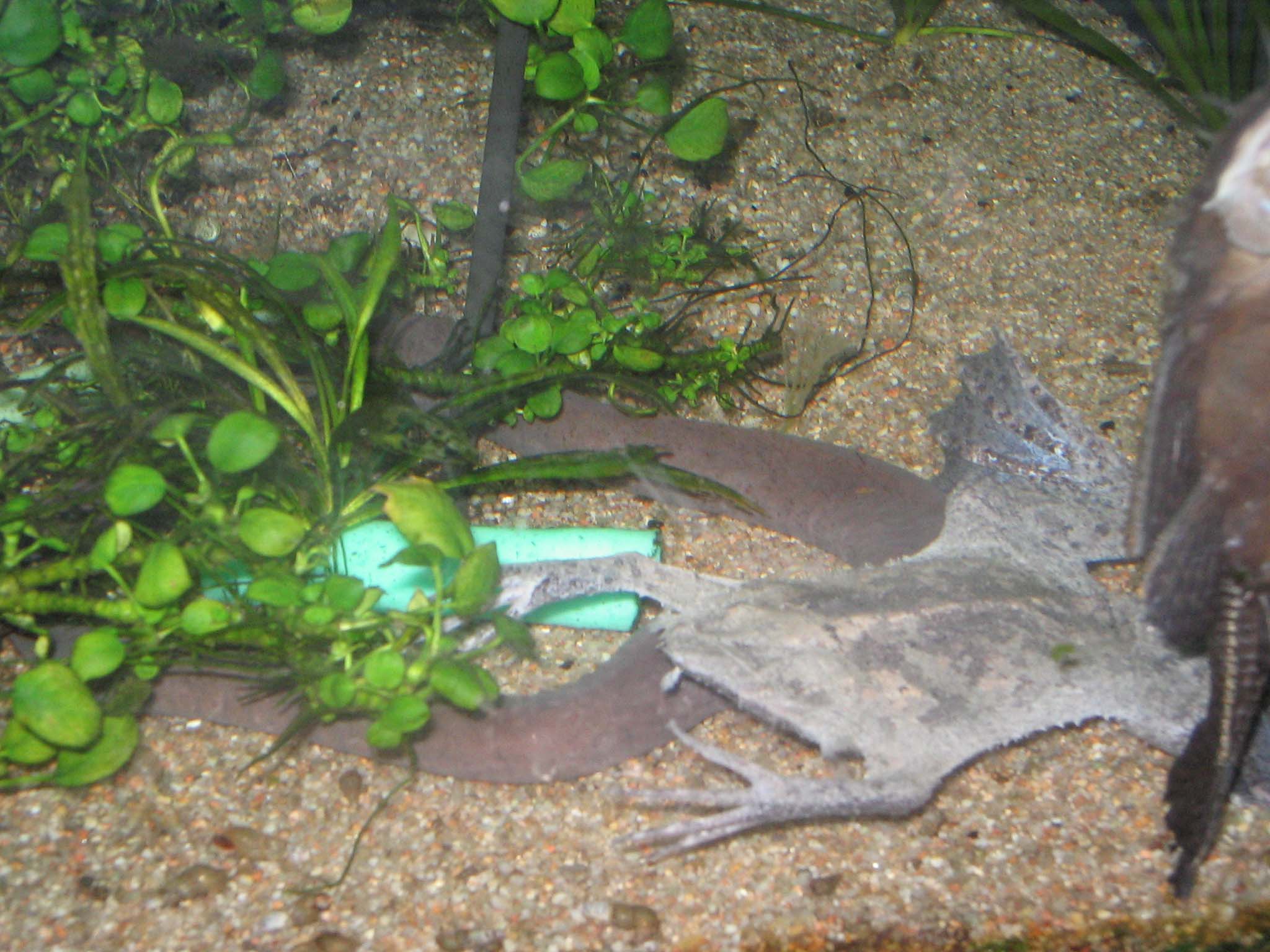
The Surinam toad is a bizarre, flattened, fully aquatic frog famous for the females brooding eggs in pockets of skin on their back until fully formed toadlets emerge. It is a fascinating display species but demanding to feed and not handleable.
ℹ️
Educational only. KinStation content is reviewed by licensed veterinarians but cannot replace an in-person exam. Always consult a licensed veterinarian or board-certified specialist for diagnosis, treatment, or any decision affecting your pet's health.
🩺 Need expert help with your surinam toad?
Connect with a specialist near you or ask a licensed vet — never substitute online guidance for hands-on care in an emergency.
Females reach 10-20 cm (4-8 in); males somewhat smaller. One of the largest fully aquatic frogs.
Lifespan
6–15 years
Social needs
solo
Native region
Amazon Basin of northern South America (Suriname, Guyana, Brazil, Peru, Ecuador, Bolivia, Colombia, Venezuela, Trinidad)
Origin
New World
Climate
🌴 Tropical
Water type
💧 Freshwater
Family
Pipidae
Genus
Pipa
Part of the Aquatic amphibians
Fully or largely aquatic amphibians kept in cycled, well-filtered freshwater aquariums. They surface to breathe, prefer gentle current and hiding spots, and are not handling animals.
From the minimum an animal needs to be kept humanely, up to the ideal setup. Bigger is almost always better — minimums are floors, not targets.
Photo coming soon
Minimum
Fully aquatic tank
30 gal (36 × 12 × 16 in)
Pipa pipa is a fully aquatic flat ambush predator. 30-gal tank with soft water (low pH, low TDS), gentle filter, sand substrate, dim light, lots of leaf litter and bogwood for cover, 75–82 °F. Famous for back-brooding eggs — females embed eggs in dorsal skin.
Photo coming soon
Recommended
Larger soft-water tank
55 gal (48 × 12 × 21 in)
Wider tank with soft, tannin-stained water, dim lighting, dense leaf litter, bogwood, gentle filtration. Surinam toads are wild-caught more often than captive-bred — quarantine and parasite treatment essential.
Ideal
Blackwater paludarium
75+ gal planted blackwater
Heavily planted blackwater tank with leaf litter, bogwood, soft acidic water, gentle filtration, dim light. A breeding pair will display the species' famous back-brooding reproductive cycle when conditions cycle wet/dry.
Christophe Cagé / CC BY-SA 3.0 (Wikimedia Commons)
Life & growth stages
How this animal changes through its life — each stage often has its own care, diet and space needs.
Photo coming soon
Egg
Amphibian eggs are soft, jelly-coated spheres laid in or near water — in floating clutches, strings, or foam nests depending on the species. The dark embryo is visible within the clear gel as it develops.
Photo coming soon
Tadpole / Larva
The aquatic larva (a tadpole in frogs/toads, a gilled larva in salamanders and newts) breathes through gills and feeds and grows in water. Frog/toad tadpoles are limbless at first, then sprout hind then front legs as metamorphosis nears.
Photo coming soon
Juvenile (froglet / eft)
At metamorphosis the animal develops legs and lungs and typically leaves the water as a froglet or, in many newts, a terrestrial eft. It resembles a small adult but is not yet sexually mature and its coloration may still be changing.
Adult
Adults reach full size and breeding condition, with the species' mature skin coloration and pattern. Many amphibians return to water to breed and can show seasonal or sex-specific changes such as nuptial coloration or crests.
Habitat & enclosure
Keep singly or in compatible groups in a large, well-filtered aquarium of at least 90-120 L (24-30+ gal) for a single adult; bigger is far better for these large frogs. They are entirely aquatic and rarely leave the water, only surfacing to breathe. Provide water depth of 25-40 cm with plenty of horizontal swimming room rather than height. Soft, slightly acidic to neutral water suits them best (pH ~6.5-7.5, soft to moderately hard, temperature 22-26 C / 72-79 F). Use a secure lid; they can be surprisingly capable of wedging out. Dim, tannin-stained "blackwater" conditions and plenty of cover (driftwood, leaf litter, broad plants) reduce stress in this shy, ambush-style species.
Substrate
Use fine sand or a bare bottom; large gravel can be accidentally swallowed during suction feeding and cause impaction. A thin sand layer with leaf litter (Indian almond/oak leaves) mimics their tannin-rich natural habitat and helps them feel secure.
Equipment & setup
Strong but gentle filtration (canister or sponge-buffered flow), a heater to hold 22-26 C, a secure lid, and a water-testing kit are core. Subdued lighting is preferred; no UVB is required for this fully aquatic species. Dechlorinator and regular partial water changes keep nitrogenous waste low.
Diet
Carnivorous suction-feeders and scavengers. They lack tongues and instead lunge and vacuum prey into the mouth, using sensitive star-tipped front fingers to detect food. Offer earthworms, blackworms, bloodworms, small fish, cut fish/shrimp, and prepared frozen meaty foods. Many learn to take tong-fed or sinking foods. Feed juveniles several times weekly; adults 2-3 times weekly. Tank mates small enough to fit in the mouth will be eaten, so house only with fish too large to swallow or keep them species-only.
Behavior & temperament
Slow, secretive ambush predators that spend most of the day motionless on the bottom blending in. They are not aggressive toward people but are not a handling species; like all amphibians their skin is sensitive and they should be netted or cup-transferred, not picked up. The legendary reproductive behavior, where eggs become embedded in the female's spongy back and develop in individual pockets before fully formed toadlets emerge, is one of the most remarkable sights in amphibian keeping.
Health
Sensitive to poor water quality, ammonia/nitrite spikes, and chlorine/chloramine, so robust filtration and dechlorinated water are essential. Watch for bloating, skin lesions/redness (bacterial infection), fungal patches, and cloudy eyes. Obesity from overfeeding fatty foods is common in captivity. As with all amphibians, never use copper-based medications or handle with bare, lotioned, or unwashed hands.
Tips, DIY & hacks
Reduce flow rate, as they dislike strong currents. Tannins from botanicals (leaves, alder cones) calm them and may encourage natural behavior. Feed in low light when they are most active. Quarantine new wild-caught specimens (most are wild-collected) and treat for parasites under a vet's guidance. Avoid mixing with nippy or fin-eating fish.