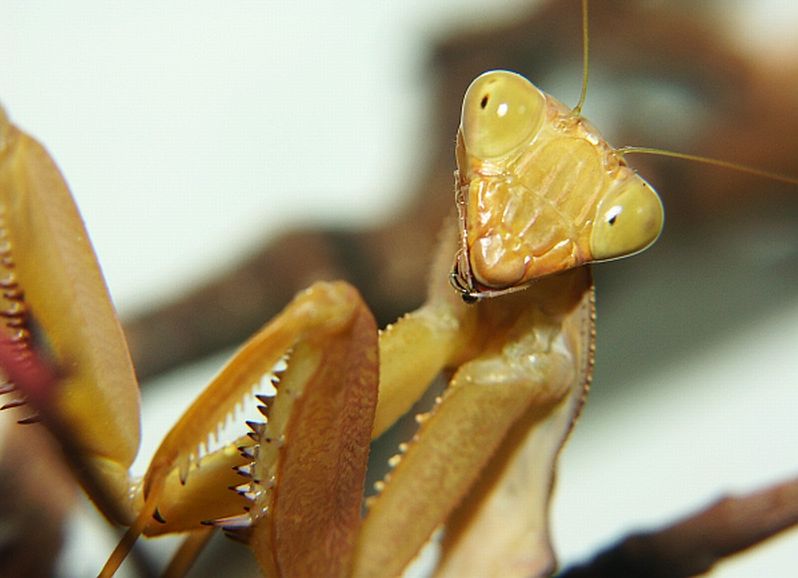
A large, hardy, forgiving African mantis widely regarded as one of the best beginner species. Bold and confident, it readily takes prey and tolerates gentle handling.
ℹ️
Educational only. KinStation content is reviewed by licensed veterinarians but cannot replace an in-person exam. Always consult a licensed veterinarian or board-certified specialist for diagnosis, treatment, or any decision affecting your pet's health.
🩺 Need expert help with your african mantis?
Connect with a specialist near you or ask a licensed vet — never substitute online guidance for hands-on care in an emergency.
Adults roughly 7-9 cm (females larger and bulkier than males); a robust, stocky green-to-brown mantis.
Lifespan
1 years
Social needs
solo
Native region
Africa (widespread across sub-Saharan and northern Africa), with related populations around the Mediterranean
Origin
Old World
Climate
🌴 Tropical
Family
Mantidae
Genus
Sphodromantis
Part of the Mantises
Praying mantises — solitary, cannibalistic ambush predators kept individually in tall, well-ventilated enclosures with climbing decor. They need vertical headroom for safe molting, live insect prey, and gentle misting; most are harmless and many tolerate light handling.
From the minimum an animal needs to be kept humanely, up to the ideal setup. Bigger is almost always better — minimums are floors, not targets.
Photo coming soon
Minimum
Juvenile mantis enclosure
3× body length tall (≈ 6 × 6 × 12 in)
African mantis (Sphodromantis spp.) needs an enclosure at least 3× its body length tall — they hang upside-down to moult. Mesh-front for ventilation, twigs/silk plants, daily mist.
Photo coming soon
Recommended
Adult arboreal enclosure
8 × 8 × 12 in mesh-fronted
Tall ventilated enclosure with climbing branches, foliage, and a daily mister. Feed live insects every 2–3 days. Single-housed (cannibalistic).
Photo coming soon
Ideal
Planted bioactive tall enclosure
12 × 12 × 18 in planted bioactive
Tall planted bioactive enclosure with live plants, springtails, and isopods. Beautiful display for one of the larger common pet mantids.
Life & growth stages
How this animal changes through its life — each stage often has its own care, diet and space needs.
Photo coming soon
Egg
Insects begin as eggs, laid singly or in clusters on or near a food source. Egg size, shape, and incubation time vary widely; some are glued to surfaces, others inserted into plant tissue or soil.
Photo coming soon
Larva / Nymph
The immature stage either looks grub- or caterpillar-like and very different from the adult (a larva, in beetles, flies, and butterflies) or like a wingless miniature adult (a nymph, in roaches, mantises, and stick insects). It eats and molts repeatedly as it grows.
Photo coming soon
Pupa
In insects with complete metamorphosis, the larva pupates — often in a cocoon, chrysalis, or sealed cell — and its body is reorganized into the adult form. Nymph-developing insects skip a true pupa and molt straight to the adult.
Adult
The adult is the sexually mature, usually winged stage with the species' full coloration and form. Adults are typically the dispersing and reproducing stage, and in many insects do not grow further once mature.
Habitat & enclosure
House individually (mantises are cannibalistic) in a vertical enclosure at least 3x the mantis's body length tall to allow safe molting — roughly a 20-30 cm tall terrarium for an adult. Provide plenty of branches, fake plants, or mesh to hang from upside down. Keep 24-30C (75-86F) by day with a slight night drop, and moderate humidity around 50-60%, achieved by light misting every day or two and good ventilation. No UVB required.
Substrate
A simple, moisture-retaining substrate such as coconut fiber, a paper towel, or a thin soil layer to help hold humidity — substrate is for the keeper's humidity management, not for the arboreal mantis itself. Spot-clean frass and uneaten prey regularly.
Equipment & setup
A vertical mesh or glass enclosure with secure ventilation, climbing decor, and a spray bottle for misting. A heat mat or low-watt lamp only if the room is cool; aim for gentle warmth, not a hotspot. A thermometer/hygrometer helps dial in conditions. No UVB and no special lighting needed.
Diet
A voracious generalist predator of live insects. Feed appropriately sized prey — fruit flies for tiny nymphs, graduating to houseflies, blue-bottle flies, crickets, roach nymphs, and the occasional moth or locust for adults. Prey should be no longer than the mantis's body and ideally smaller. Feed nymphs daily-ish and adults every 2-3 days; a well-fed female's abdomen rounds out. Provide hydration through misting droplets, which they drink.
Behavior & temperament
Bold, alert, and one of the more handleable mantises — adults often sit calmly on a hand and track movement with their swiveling heads. Harmless to humans (no venom of concern; at most a startling grab from the spined forelegs). Strictly solitary and cannibalistic, so never house two together except briefly and carefully for breeding, where the female may eat the male. Adult males can fly, so handle and house with a secure lid. A reliable, confident feeder that rarely refuses food.
Health
Hardy if molting conditions are right. The biggest killers are mismolts from too-low humidity or insufficient vertical height/grip — provide ample headroom and a textured surface to hang from. Never disturb a mantis preparing to molt (it hangs upside down and stops eating). Avoid oversized or hard-bodied prey that can injure the mantis. Overfeeding can shorten adult lifespan; impaction and gut issues are rare with proper feeders.
Tips, DIY & hacks
Ideal first mantis: forgiving of minor husbandry errors, large enough to handle and observe easily, and an enthusiastic eater. Confirm a molt is complete and the cuticle hardened before offering food or handling. To sex, count abdominal segments (males have more visible segments and slimmer bodies). Sphodromantis is non-native to the US and should never be released outdoors — keep escapes contained and dispose of surplus oothecae responsibly.