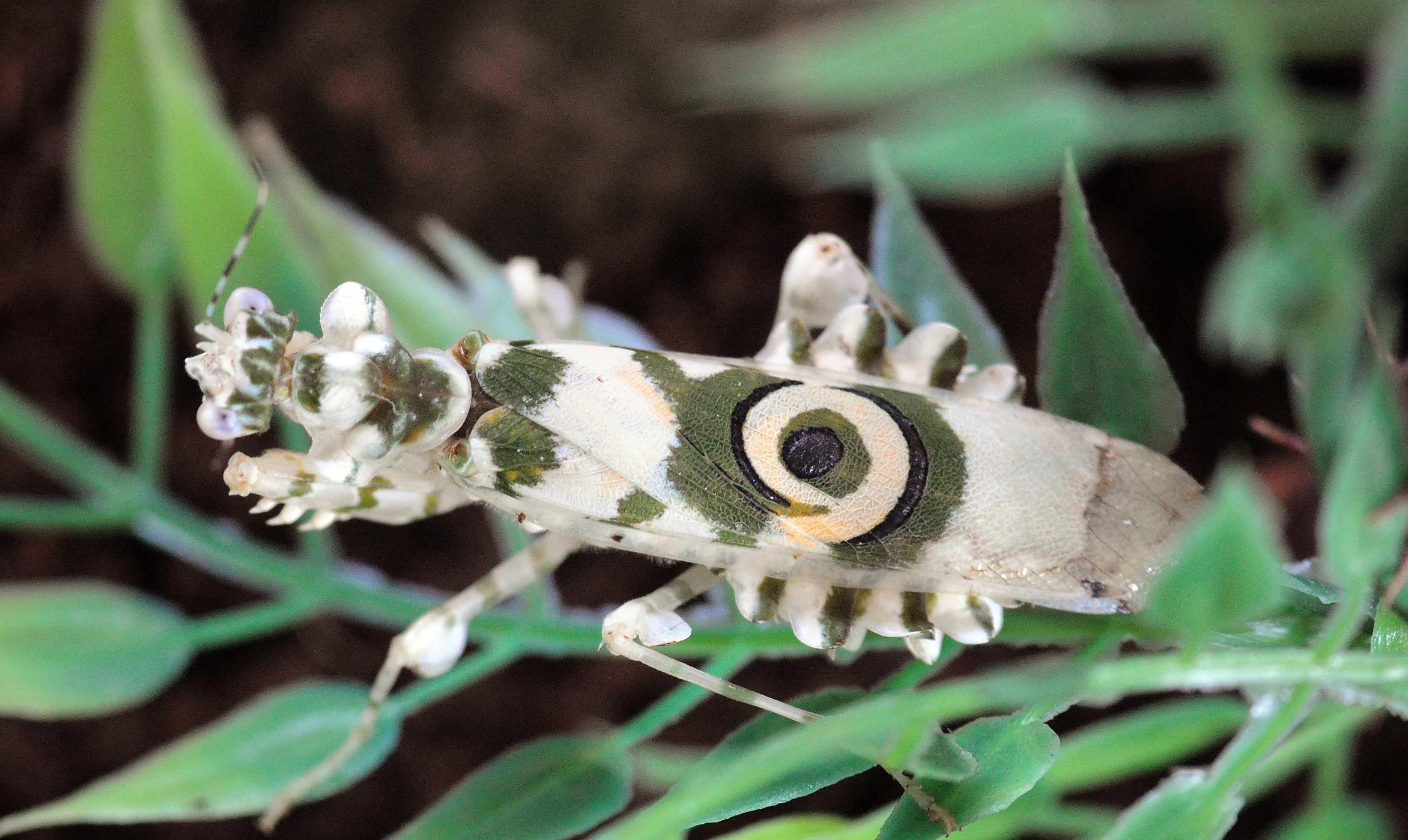
A small, spectacularly colored African flower mantis famous for the spiral 'target' eyespot on each forewing, which it flashes in a deimatic threat display. Striking and rewarding to keep, but its higher humidity needs and small size make it a step up from the hardiest beginner mantids. Harmless to humans.
ℹ️
Educational only. KinStation content is reviewed by licensed veterinarians but cannot replace an in-person exam. Always consult a licensed veterinarian or board-certified specialist for diagnosis, treatment, or any decision affecting your pet's health.
🩺 Need expert help with your spiny flower mantis?
Connect with a specialist near you or ask a licensed vet — never substitute online guidance for hands-on care in an emergency.
A small, showy mantis; adult females reach about 4-5 cm (1.6-2 in) and males are slightly smaller, slimmer, and lighter-bodied.
Lifespan
1 years
Social needs
solo
Native region
Sub-Saharan Africa (eastern and southern Africa)
Origin
Old World
Climate
🌴 Tropical
Family
Hymenopodidae
Genus
Pseudocreobotra
Part of the Mantises
Praying mantises — solitary, cannibalistic ambush predators kept individually in tall, well-ventilated enclosures with climbing decor. They need vertical headroom for safe molting, live insect prey, and gentle misting; most are harmless and many tolerate light handling.
From the minimum an animal needs to be kept humanely, up to the ideal setup. Bigger is almost always better — minimums are floors, not targets.
Photo coming soon
Minimum
Adult mesh-top enclosure
≈ 6 × 6 × 9 in (≥ 3× body length tall)
Pseudocreobotra wahlbergii is small and bold but still strictly solitary. Height at least three times body length with a mesh ceiling for moult-hanging. Mist lightly daily.
Photo coming soon
Recommended
Warm planted terrarium
8 × 8 × 12 in, 25–30 °C, 60–70% RH
A front-opening terrarium with mesh top, silk flowers and branches, and gentle warmth. Spiny flowers display their startle 'eyespot' wings when disturbed — give them room to flare.
Photo coming soon
Ideal
Planted display enclosure
10 × 10 × 16 in, planted, warm
A taller planted display with live flowering plants, branches, and lighting that highlights the wing pattern. Generous height supports clean moults.
Life & growth stages
How this animal changes through its life — each stage often has its own care, diet and space needs.
Photo coming soon
Egg
Insects begin as eggs, laid singly or in clusters on or near a food source. Egg size, shape, and incubation time vary widely; some are glued to surfaces, others inserted into plant tissue or soil.
Photo coming soon
Larva / Nymph
The immature stage either looks grub- or caterpillar-like and very different from the adult (a larva, in beetles, flies, and butterflies) or like a wingless miniature adult (a nymph, in roaches, mantises, and stick insects). It eats and molts repeatedly as it grows.
Photo coming soon
Pupa
In insects with complete metamorphosis, the larva pupates — often in a cocoon, chrysalis, or sealed cell — and its body is reorganized into the adult form. Nymph-developing insects skip a true pupa and molt straight to the adult.
Adult
The adult is the sexually mature, usually winged stage with the species' full coloration and form. Adults are typically the dispersing and reproducing stage, and in many insects do not grow further once mature.
Habitat & enclosure
House singly in a small, tall enclosure at least 3x the mantis's body length in height and roughly 2x in width (about 15x15x20-25 cm / 6x6x10 in for an adult) so it has vertical space to hang and molt. Furnish with twigs, fine branches, and artificial flowers or foliage to perch on and ambush from. Keep warm at 25-30 C (77-86 F) by day, dropping to room temperature at night, with moderate humidity (~50-60%) rising higher overnight, achieved by light evening misting balanced against good ventilation. As with all mantises, ample clear vertical space below a secure perch is critical for safe molting.
Substrate
A thin layer of coco fiber, damp paper towel, or a shallow soil base that holds light humidity and is easy to keep clean; depth is unimportant since the mantis lives on vertical surfaces and foliage rather than burrowing.
Equipment & setup
A tall, well-ventilated enclosure with mesh or netting on the ceiling and at least one side for grip and as a molting anchor, plenty of twigs and leafy or floral decor for perching, a spray bottle for misting, and a thermometer/hygrometer. A thermostatted low-wattage heat source helps maintain its preferred warmth in cooler homes. No UVB is required.
Diet
A sit-and-wait flower mimic that actively prefers flying prey. Feed flightless fruit flies to small nymphs, progressing to houseflies, blue-bottle flies, small moths, and small crickets or roaches for larger nymphs and adults; flying prey suits its ambush style best. Feed nymphs every 1-2 days and adults every 3-4 days, removing uneaten prey. Mist surfaces lightly so the mantis can drink droplets.
Behavior & temperament
A beautiful ambush predator that perches motionless to mimic a flower and lunges with its raptorial forelegs. Its signature defense is a startling deimatic display: when threatened it rears up and spreads its wings to flash the bold spiral eyespots, making itself look larger and discouraging predators. Generally calm and can be handled gently, but it is small, delicate, and quick to take flight, so handle low over a soft surface. Strictly solitary and cannibalistic, so house individually except for brief, supervised, well-fed breeding attempts.
Health
Reasonably hardy but bound by the typical roughly one-year mantis lifespan (about 10-14 months total), with adults living only a few months past the final molt. The most common keeper-caused losses are mismolts from insufficient vertical space, low humidity, or disturbance while molting — never feed or handle a mantis that is in pre-molt or hanging upside down. Watch also for dehydration (mist regularly) and gut impaction from oversized or contaminated prey; offer cleanly raised feeders. This species prefers warmer, slightly more humid conditions than many temperate mantids.
Tips, DIY & hacks
Decorate with branches and artificial flowers to echo its natural flower-mimicry and give it ambush perches and molting anchors. Keep it warm by day and lightly humid (mist in the evening) while preserving airflow to prevent mold and mismolts. Always leave at least twice the body length of clear space beneath a secure perch for molting, and never disturb a mantis hanging upside down. Match feeder size to the mantis (no larger than roughly its head) and favor flying prey.