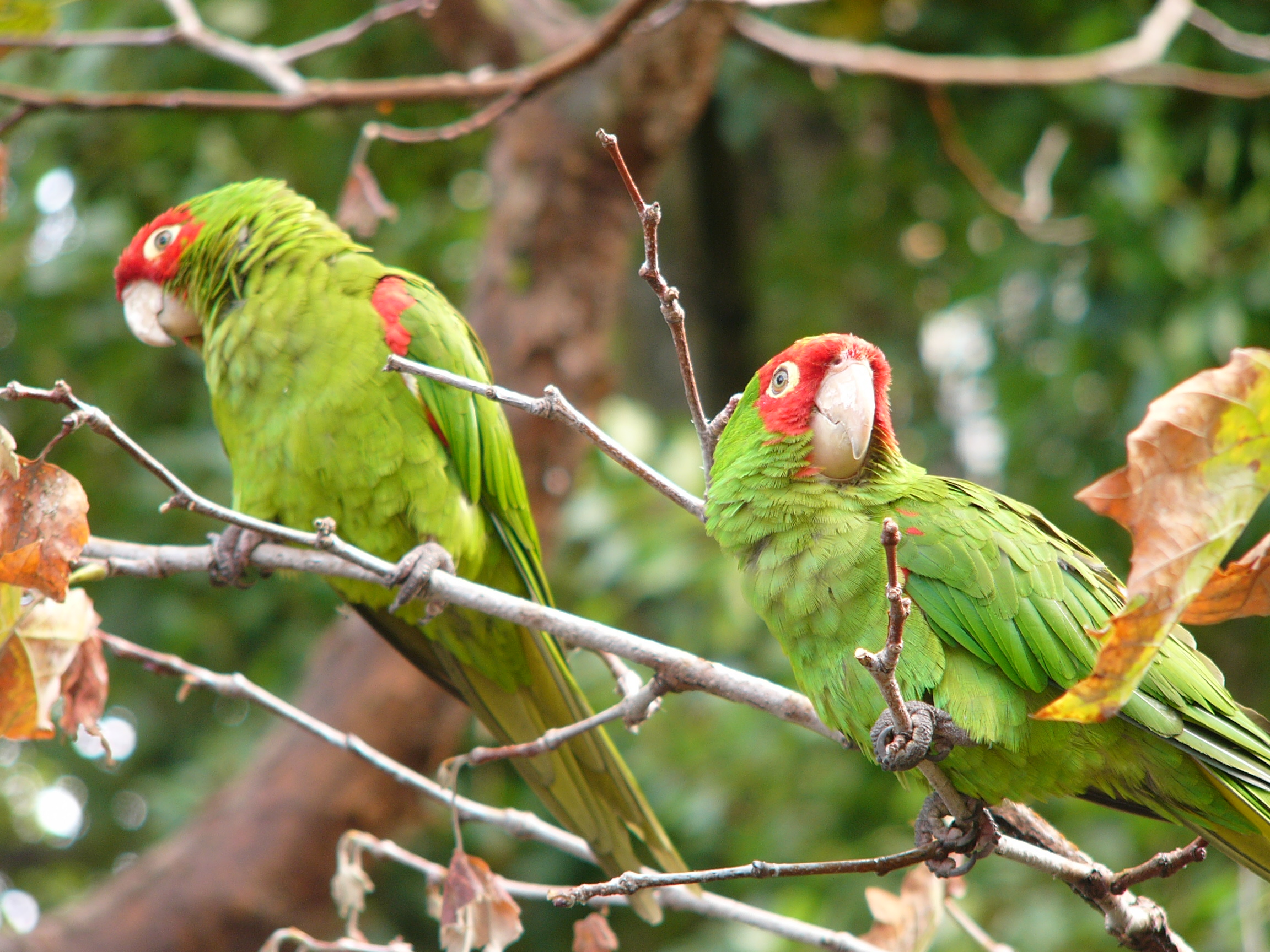
A large, green conure with a vivid red mask and head, famous from the feral flocks of San Francisco's Telegraph Hill. Intelligent and capable talkers, they are affectionate but loud and need committed owners.
ℹ️
Educational only. KinStation content is reviewed by licensed veterinarians but cannot replace an in-person exam. Always consult a licensed veterinarian or board-certified specialist for diagnosis, treatment, or any decision affecting your pet's health.
🩺 Need expert help with your red-masked conure?
Connect with a specialist near you or ask a licensed vet — never substitute online guidance for hands-on care in an emergency.
Larger conure, about 33 cm (13 in) long, roughly 165-200 g.
Lifespan
20–30 years
Social needs
pair
Native region
South America (western Ecuador and northwestern Peru); feral populations in the United States
Origin
New World
Climate
🌴 Tropical
Family
Psittacidae
Genus
Psittacara
Part of the Conures
Conures are small to medium New-World parrots from Central and South America, prized as companion birds for their bold personalities, vivid colors, and strong human bonds. They are active, playful, and social, needing roomy cages, daily interaction, and plenty of enrichment.
From the minimum an animal needs to be kept humanely, up to the ideal setup. Bigger is almost always better — minimums are floors, not targets.
Photo coming soon
Minimum
Flight cage + daily out-of-cage time
30 × 24 × 36 in, bar spacing 5/8–3/4 in
Red-masked (cherry-headed) conures are loud, highly social flock birds — a cage is base, not the world. Provide several hours of supervised out-of-cage time, abundant chew toys, and a quiet sleep zone. Keep with avian or human company most of the day.
Photo coming soon
Recommended
Large flight cage + bird-safe room
40 × 30 × 48 in flight cage + bird room access
A wider flight cage and access to a bird-safe room with playstands, rotating foraging toys, and bathing. Cherry-heads bond intensely and benefit from a compatible mate or daily multi-hour socialisation.
Photo coming soon
Ideal
Walk-in aviary or bird room
Walk-in aviary or dedicated bird room
Aviary or bird room with real flight, foraging substrate, branches, and pair/flock life. Best welfare for this loud, intelligent species — solo apartment life often ends in plucking or screaming.
Life & growth stages
How this animal changes through its life — each stage often has its own care, diet and space needs.
Photo coming soon
Egg
Birds develop inside a hard-shelled egg incubated by the parent(s). Egg size, shell color, and clutch size vary by species; the embryo develops over days to weeks before hatching.
Photo coming soon
Hatchling / Chick
Hatchlings are either altricial — naked, blind, and dependent on parents (typical of parrots and songbirds) — or precocial — downy, mobile, and self-feeding soon after hatching (typical of poultry and waterfowl). Down gives way to the first feathers.
Photo coming soon
Juvenile / Fledgling
Fledglings grow in their juvenile plumage and begin to fly and feed themselves, though they may still beg from parents at first. Juvenile feathering is often duller than the adult and is replaced as the bird matures.
Adult
Adults attain full body size and mature plumage, and are capable of breeding. Many species show distinct adult coloration, and in sexually dimorphic birds males and females differ in plumage, size, or markings.
(c) Justyn Stahl, some rights reserved (CC BY-NC) via iNaturalist — https://www.inaturalist.org/observations/272585280
Color & pattern variants
Natural variants occur in the wild; selectively bred (man-made) variants were developed in captivity.
Given their size, Red-masked conures need a spacious cage of at least 24 x 24 x 36 inches (60 x 60 x 90 cm), and ideally a flight cage or aviary, with 5/8 to 3/4 inch (about 16-19 mm) bar spacing. Provide sturdy natural-branch perches, abundant chewing and foraging toys, and a roosting tent or box, and give them a minimum of 3-4 hours of supervised out-of-cage time daily for exercise.
They are comfortable at normal household temperatures of roughly 18-29 C (65-85 F) and should be protected from drafts and rapid temperature changes. Indoor birds on a complete diet do not require UVB lighting, but natural sunlight or full-spectrum lighting supports their health and plumage.
Substrate
Use newspaper, kraft paper, or paper towel on the tray for quick daily cleaning and droppings checks; avoid corncob, walnut shell, or wood chips, which grow mold and can be ingested. A wire grate keeps these messy, active birds off soiled paper.
Equipment & setup
Provide a large, strong cage (minimum roughly 24x24x36 in, larger is better) with stainless or powder-coated bars they cannot bend, plus an out-of-cage play stand for their high activity level. Include varied natural perches, a UVB/full-spectrum lamp on a 10-12 hour cycle, and lots of destructible and foraging toys; normal household temperatures suit them.
Diet
Base the diet on formulated pellets (about 60-70% of intake) with daily fresh vegetables, leafy greens, and limited fruit. Restrict fatty seeds and nuts to occasional treats or foraging rewards, since these large conures readily become overweight, and supply a cuttlebone or mineral block for calcium.
Avoid avocado, chocolate, caffeine, alcohol, and salty or sugary processed foods, which are toxic or harmful to parrots. Provide fresh water and change it daily.
Behavior & temperament
Red-masked conures are intelligent, bold, and affectionate, and they are among the better-talking conures, able to learn words, phrases, and tricks. They are highly active and playful, thriving on training, foraging challenges, and plenty of things to chew and shred.
They are loud, with harsh, screechy calls, and are best for homes that can tolerate noise. As strongly social birds they bond closely and need daily interaction; isolation or boredom can trigger excessive screaming or feather plucking. A compatible companion bird can help meet their social needs.
Health
Common health concerns include feather-destructive behavior, obesity and fatty liver disease, and respiratory infections, along with psittacine risks such as psittacosis (chlamydiosis) and proventricular dilatation disease (PDD). Quarantine new arrivals and consult an avian vet promptly for any signs of illness such as lethargy, fluffed posture, or appetite loss.
Prevention rests on a varied balanced diet, generous exercise and mental stimulation, clean housing, and routine avian veterinary care. Note: this is informational only and not a substitute for veterinary care.
Tips, DIY & hacks
These loud, intelligent conures need heavy enrichment, so rotate cheap DIY foraging toys (paper cups, cardboard, shreddable palm) to curb screaming and feather-plucking. Schedule daily out-of-cage time and a consistent sleep cover or quiet dark room for 10-12 hours to keep noise and stress down.