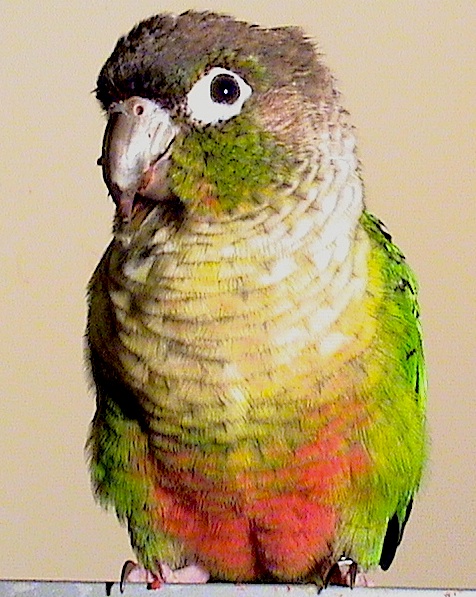
The green-cheeked conure is a small, playful South American parrot prized as one of the quieter, more apartment-friendly conures. Affectionate and clownish, it suits attentive first-time parrot keepers willing to commit for decades.
ℹ️
Educational only. KinStation content is reviewed by licensed veterinarians but cannot replace an in-person exam. Always consult a licensed veterinarian or board-certified specialist for diagnosis, treatment, or any decision affecting your pet's health.
🩺 Need expert help with your green-cheeked conure?
Connect with a specialist near you or ask a licensed vet — never substitute online guidance for hands-on care in an emergency.
Conures are small to medium New-World parrots from Central and South America, prized as companion birds for their bold personalities, vivid colors, and strong human bonds. They are active, playful, and social, needing roomy cages, daily interaction, and plenty of enrichment.
From the minimum an animal needs to be kept humanely, up to the ideal setup. Bigger is almost always better — minimums are floors, not targets.
Minimum
Flight cage (pair)
24 × 24 × 30 in, ½ in bar spacing
The smallest humane setup is a 24 × 24 × 30 in cage with ½-inch bar spacing, lined with paper or other safe substrate and packed with perches of varying diameter, foraging toys, shreddables, and a bath. Green-cheeks are flock birds, so a lone bird needs intensive daily interaction or a companion of its own kind; this is a floor, not a place to spend the whole day. Keep them in normal room temperatures (around 18–26 °C) and out of draughts.
Rob Speed / CC BY-SA 2.0 (Wikimedia Commons)
Photo coming soon
Recommended
Large flight cage + daily out-time
36 × 24 × 36 in, ½ in bar spacing
A responsible keeper should aim for a 36 × 24 × 36 in flight cage with ½-inch bars, rotating foraging toys, natural-branch perches, and several hours of supervised out-of-cage flight every day. A bonded pair or constant human companionship prevents boredom-driven plucking and screaming. Wider-than-tall designs matter more than height because these birds fly horizontally.
Photo coming soon
Ideal
Aviary / bird room
Walk-in aviary or dedicated bird room
The best outcome is a walk-in aviary or bird-safe room allowing genuine sustained flight, with live or natural branches, multiple foraging stations, and bathing opportunities. Green-cheeks are intelligent and intensely social, so housing a compatible pair or small group in this space supports natural foraging and flock behaviour. Provide year-round protection from frost and extreme heat.
Life & growth stages
How this animal changes through its life — each stage often has its own care, diet and space needs.
Photo coming soon
Egg
Birds develop inside a hard-shelled egg incubated by the parent(s). Egg size, shell color, and clutch size vary by species; the embryo develops over days to weeks before hatching.
Photo coming soon
Hatchling / Chick
Hatchlings are either altricial — naked, blind, and dependent on parents (typical of parrots and songbirds) — or precocial — downy, mobile, and self-feeding soon after hatching (typical of poultry and waterfowl). Down gives way to the first feathers.
Photo coming soon
Juvenile / Fledgling
Fledglings grow in their juvenile plumage and begin to fly and feed themselves, though they may still beg from parents at first. Juvenile feathering is often duller than the adult and is replaced as the bird matures.
Adult
Adults attain full body size and mature plumage, and are capable of breeding. Many species show distinct adult coloration, and in sexually dimorphic birds males and females differ in plumage, size, or markings.
(c) Marisel Morales, some rights reserved (CC BY-NC) via iNaturalist — https://www.inaturalist.org/observations/215577845
Color & pattern variants
Natural variants occur in the wild; selectively bred (man-made) variants were developed in captivity.
Even a small parrot needs room to climb, flap, and play. MINIMUM cage for a single green-cheek is roughly 24 in W × 24 in D × 24 in H with bar spacing no wider than about 1/2 to 5/8 inch so a small head cannot become trapped; bigger is always better and a narrow, tall cage is a poor substitute for width. RECOMMENDED is a cage around 30 × 24 × 36 in paired with at least 2–4 hours of supervised out-of-cage time daily in a bird-safe room. IDEAL is a walk-in flight cage or a dedicated bird room (several feet in each dimension) that allows true sustained flight.
Place the cage against a wall in a sociable but not chaotic part of the home, out of direct sun, kitchen fumes, and drafts, with one corner offering a sense of security. Provide perches of varied natural-wood diameters (not just dowels) to protect foot health, plus rope and platform perches. Keep a stable, comfortable household temperature; sudden chilling and overheating both stress small parrots.
Enrichment is not optional for an intelligent flock animal. Rotate foraging toys, shreddable wood and palm, puzzle feeders, and bells, and offer a shallow bath dish or gentle misting. Like all birds, green-cheeks are acutely vulnerable to fumes from PTFE/Teflon-coated cookware, self-cleaning ovens, scented candles, and aerosols, which can be rapidly fatal — keep the bird far from the kitchen and never use non-stick cookware in a home with birds.
Substrate
Line the tray with plain newspaper or paper towels for fast, hygienic cleanup and easy dropping checks. Skip loose substrates like corncob or walnut shell, which grow mold and pose ingestion and respiratory hazards.
Equipment & setup
Provide a cage at least 24x24 inches with 1/2-5/8 inch bar spacing and several natural-wood perches of mixed diameters to prevent pressure sores. They need no added heat at room temperature; a full-spectrum lamp supports vitamin-D synthesis, and a shallow bath or light misting keeps feathers in good condition.
Diet
A formulated pellet designed for small parrots or conures should make up roughly the bulk of the daily diet, because all-seed diets cause long-term malnutrition (notably vitamin-A deficiency and fatty liver disease). Supplement pellets with a daily variety of fresh vegetables and leafy greens (dark leafy greens, squash, peppers, carrot), limited fruit, and cooked legumes or whole grains for enrichment. A modest amount of seed can be used as a foraging treat rather than a staple.
Fresh, clean water must be available at all times and changed daily. Avoid the classic bird toxins entirely: avocado, chocolate, caffeine, alcohol, onion and garlic, and excess salt. Do not rely on seed mixes, fortified or not, as the foundation of the diet.
Behavior & temperament
Green-cheeked conures are among the quietest conures — they still chatter, alarm-call, and can be loud in bursts, but they lack the piercing scream volume of larger conures, which makes them more apartment-tolerant. Talking ability is limited and gravelly; they may learn a few words but are valued far more for personality than speech. Their temperament is bold, curious, acrobatic, and famously 'clownish,' often hanging upside-down and burrowing into pockets or sleeves.
They are flock birds that bond intensely with their people and need genuine daily interaction; a neglected green-cheek can become nippy, scream, or pluck. Many do well kept as a bonded pair, which provides companionship when humans are away, though a strongly pair-bonded duo may be less hand-tame. Watch body language — pinned eyes, raised neck feathers, and tail fanning signal excitement or overstimulation that can precede a bite.
Health
Find an avian veterinarian before you need one; most general-practice vets do not treat birds. A new-bird exam and routine annual wellness checks with weight tracking on a gram scale catch problems early, because parrots instinctively mask illness until they are seriously unwell.
Common concerns in small conures include feather-destructive (plucking) behavior, often rooted in boredom, stress, or hormonal and dietary factors; respiratory disease including the zoonotic infection psittacosis; and nutritional disease such as fatty liver and hypovitaminosis A from poor diets. Reproductively active hens can develop egg binding.
Seek prompt avian-veterinary care for any fluffed, quiet, bottom-of-cage bird, tail-bobbing or open-mouth breathing, discharge from eyes or nostrils, sudden weight loss, or a hen straining to pass an egg. When in doubt, a bird that 'looks a little off' warrants a same-day call to an avian vet.
Tips, DIY & hacks
Green-cheeks love to burrow and snuggle, but use fleece tents/huts only under supervision since loose threads cause toe entanglement and frayed fabric triggers chronic egg-laying. Channel their playful, mischievous energy with cheap DIY foraging toys—shreddable paper rolls, vegetable-tanned leather strips, and wrapped treats—and give daily out-of-cage time to keep this generally quiet conure content.
Origin & history
The green-cheeked conure is native to the forests and woodlands of central South America, ranging across parts of Brazil, Bolivia, Argentina, and Paraguay, where it lives in noisy flocks. It belongs to the genus Pyrrhura, the 'small conures,' a group distinct from the larger, louder Aratinga conures such as the sun conure. In aviculture it has become one of the most popular small companion parrots of the last few decades.
Captive breeding has produced a range of color mutations beyond the wild green-and-maroon type, including the popular yellow-sided, cinnamon, pineapple, and turquoise varieties, all the same species. Their manageable size, relatively modest noise, and engaging personality have made them a staple recommendation for people wanting a 'big parrot personality' in a small package.
Anecdotes & owner lore
Community experience and cultural notes — not veterinary advice. Every animal is an individual; treat these as colour, not care instructions.
Green-cheek keepers swap endless stories about the 'pocket parrot' habit — these little conures love to wedge themselves into shirt pockets, hoods, and sleeves, and will happily nap there while their human goes about the day. They are notorious upside-down hangers, dangling by one foot from the cage roof for the sheer fun of it, and many develop a goofy 'play-dead' flop on their backs in a trusted hand that startles first-time owners.
The breed is famous in bird circles for being a 'velcro bird' that wants to be on or near its person constantly, and for a stubborn, mischievous streak — they will methodically dismantle any toy with a clasp and let themselves out of poorly latched cages. Owners often note the irony that one of the smallest commonly kept conures has one of the biggest personalities, packing the confidence and antics of a macaw into a body that weighs less than a deck of cards.
Common ailments
Psittacosis (avian chlamydiosis) — rare — Zoonotic — handle a sick new bird carefully and tell your physician about bird contact.
Hypovitaminosis A (vitamin A deficiency) — common
Feather-destructive behavior (feather plucking) — common — Often linked to insufficient enrichment or social interaction in small conures.
Reviewed and signed off by: KinStation Editorial — pre-launch draft (pending DVM review)