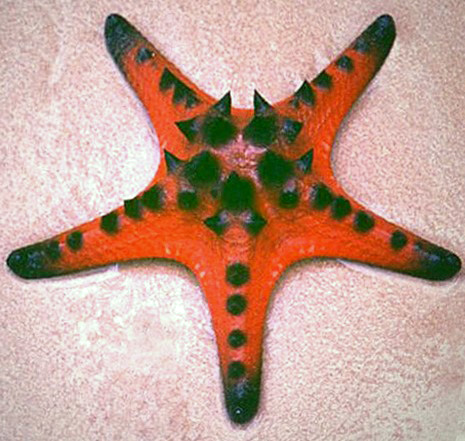
A striking tan-to-cream sea star studded with dark, cone-shaped 'chocolate chip' tubercles. Hardy and inexpensive, it is a popular display star for fish-only systems, but it is NOT reef-safe and will eat sessile invertebrates. It is an active scavenger that needs a mature tank with a steady food supply.
ℹ️
Educational only. KinStation content is reviewed by licensed veterinarians but cannot replace an in-person exam. Always consult a licensed veterinarian or board-certified specialist for diagnosis, treatment, or any decision affecting your pet's health.
🩺 Need expert help with your chocolate chip star?
Connect with a specialist near you or ask a licensed vet — never substitute online guidance for hands-on care in an emergency.
Typically 6-8 in (15-20 cm) across; can reach 12 in (30 cm)
Lifespan
5–10 years
Social needs
solo
Native region
Indo-Pacific (seagrass beds and sandy lagoons)
Origin
Old World
Climate
🌴 Tropical
Water type
🌊 Marine
Family
Oreasteridae
Genus
Protoreaster
Part of the Sea Stars & Brittle Stars
Echinoderm sea stars, serpent stars and brittle stars kept as reef clean-up crew. Most are detritivores or scavengers; a few are specialist feeders that need mature tanks and very stable, copper-free water.
From the minimum an animal needs to be kept humanely, up to the ideal setup. Bigger is almost always better — minimums are floors, not targets.
Photo coming soon
Minimum
Predatory sea star tank
50+ gal FOWLR (fish-only with live rock)
Chocolate chip stars (Protoreaster nodosus) are not reef-safe — they eat corals, clams, and slow inverts. House in a mature 50+ gal FOWLR system with stable salinity (1.025) and temperature (24–26 °C).
Photo coming soon
Recommended
Established FOWLR display
75–90 gal mature FOWLR
A larger mature FOWLR system gives the star room to scavenge and reduces competition with tank-mates. Drip-acclimate slowly (≥ 2 hours); sea stars are very sensitive to salinity/temperature shifts.
Photo coming soon
Ideal
Large invert-display tank
100+ gal mature, invert-display
Large mature invert-display with sand, live rock, and only fish/inverts the star won't eat. Pristine, stable parameters (no copper ever) and supplemental target-feeding of meaty seafood every few days.
Life & growth stages
How this animal changes through its life — each stage often has its own care, diet and space needs.
Photo coming soon
Larva
Most marine invertebrates hatch into microscopic planktonic larvae (such as the zoea of crustaceans or the bipinnaria/veliger of echinoderms and mollusks) that drift and feed in the water column. The larva looks nothing like the adult and undergoes major reorganization.
Photo coming soon
Juvenile
After settling out of the plankton, the juvenile takes on a recognizable miniature of the adult body plan — a tiny shell, a small star, or a translucent shrimp. Crustaceans grow by molting, shedding the exoskeleton to enlarge.
Adult
Adults reach full size and reproductive maturity with the species' mature shell, shape, or coloration. Many continue to molt or grow throughout life, and some show sex differences in size or claw/appendage shape.
Habitat & enclosure
House in a fish-only or fish-only-with-live-rock (FOWLR) system of at least 30-50 gallons, scaled up for larger specimens. Maintain tropical reef parameters: temperature 75-82F (24-28C), pH 8.1-8.4, salinity SG 1.024-1.026, alkalinity 8-11 dKH, and undetectable ammonia/nitrite with low nitrate. Moderate flow and standard lighting are fine; the star is unaffected by light intensity.
These stars naturally inhabit shallow seagrass beds and sandy lagoons, so a sizeable open sand area for foraging is more important than rockwork. A well-established tank with biofilm and detritus is needed to keep them fed.
Substrate
Provide a deep, open bed of fine to medium aragonite sand that mimics its lagoon habitat and lets it forage and bury slightly. Live rock can be included for biofilm, but leave ample uncluttered sand for movement.
Equipment & setup
Run a protein skimmer and live-rock biofiltration, a reliable heater, and a powerhead for moderate flow. No specialized lighting is required, so standard fish-only lighting is adequate.
Diet
Omnivorous scavenger and predator. In the wild it grazes biofilm, sponges, detritus and slow or sessile invertebrates. In captivity, supplement actively by target-feeding meaty foods such as chopped shrimp, clam, mussel, fish and sinking pellets several times a week; it everts its stomach onto food to digest it externally.
Behavior & temperament
Peaceful toward fish but emphatically NOT reef-safe: it preys on corals, clams, tube worms, snails, sponges, anemones and other sessile inverts. Keep it only in fish-only or robust FOWLR setups. It is generally slow and ornamental, though it will climb rock and glass while foraging.
Health
Sensitive to copper, rapid salinity or temperature swings, and poor water quality; long drip-acclimation is mandatory. Starvation is the leading captive killer, shown by a shrinking, sunkempt body and lesions. Watch for bacterial infection or 'melting' tissue and white patches where tubercles erode; remove an affected star to limit spread.
Tips, DIY & hacks
Drip-acclimate over 1-2 hours and never expose the star to air. Because it is not reef-safe, dedicate it to a fish-only display; if you want a star for a reef, choose a serpent or brittle star instead. Feed by placing food directly under the central disc.