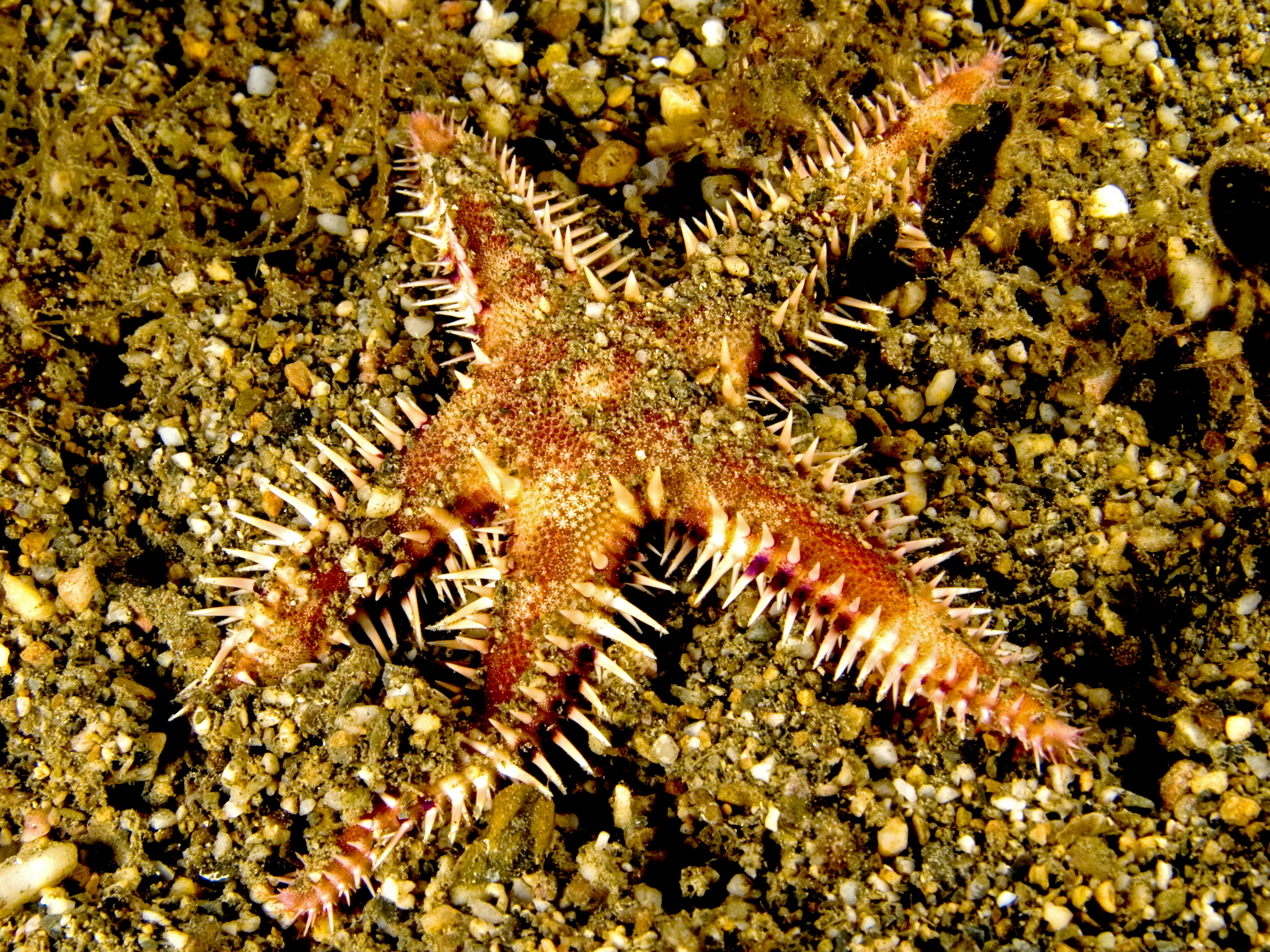
A flattened, sand-colored star with a comb of marginal spines that burrows through the substrate sifting for food. It keeps deep sand beds aerated and clean, but it is a voracious consumer of beneficial sand fauna and frequently starves in smaller tanks once that food runs out. Best reserved for large, mature systems.
ℹ️
Educational only. KinStation content is reviewed by licensed veterinarians but cannot replace an in-person exam. Always consult a licensed veterinarian or board-certified specialist for diagnosis, treatment, or any decision affecting your pet's health.
🩺 Need expert help with your sand sifting star?
Connect with a specialist near you or ask a licensed vet — never substitute online guidance for hands-on care in an emergency.
Usually 5-8 in (13-20 cm) across; can reach 12 in (30 cm)
Lifespan
3–7 years
Social needs
solo
Native region
Indo-Pacific (sandy substrates)
Origin
Old World
Climate
🌴 Tropical
Water type
🌊 Marine
Family
Astropectinidae
Genus
Astropecten
Part of the Sea Stars & Brittle Stars
Echinoderm sea stars, serpent stars and brittle stars kept as reef clean-up crew. Most are detritivores or scavengers; a few are specialist feeders that need mature tanks and very stable, copper-free water.
From the minimum an animal needs to be kept humanely, up to the ideal setup. Bigger is almost always better — minimums are floors, not targets.
Photo coming soon
Minimum
Mature reef with deep sand bed
75+ gal mature reef, 2–3 in sand
Sand sifting stars (Astropecten polyacanthus) deplete sand-bed microfauna fast — only viable in mature 75+ gal systems with established pod populations. Stable salinity (1.025) and 24–26 °C.
Photo coming soon
Recommended
Established large reef
100+ gal mature reef, deep sand bed
A larger mature reef with a deep sand bed (3–4 in) and ongoing pod production supports the star's foraging without crashing the substrate ecosystem. Drip-acclimate over hours.
Photo coming soon
Ideal
Refugium-fed display reef
125+ gal display with refugium
Display reef plumbed to a refugium that continuously seeds copepods, amphipods, and other microfauna into the sand bed. Best chance of long-term survival for this otherwise short-lived captive species.
Life & growth stages
How this animal changes through its life — each stage often has its own care, diet and space needs.
Photo coming soon
Larva
Most marine invertebrates hatch into microscopic planktonic larvae (such as the zoea of crustaceans or the bipinnaria/veliger of echinoderms and mollusks) that drift and feed in the water column. The larva looks nothing like the adult and undergoes major reorganization.
Photo coming soon
Juvenile
After settling out of the plankton, the juvenile takes on a recognizable miniature of the adult body plan — a tiny shell, a small star, or a translucent shrimp. Crustaceans grow by molting, shedding the exoskeleton to enlarge.
Adult
Adults reach full size and reproductive maturity with the species' mature shell, shape, or coloration. Many continue to molt or grow throughout life, and some show sex differences in size or claw/appendage shape.
Habitat & enclosure
Provide a large, established system of at least 75-100 gallons with a deep, mature sand bed; many keepers recommend roughly one star per 50+ gallons of sand surface. Maintain tropical reef parameters: temperature 75-82F (24-28C), pH 8.1-8.4, salinity SG 1.024-1.026, alkalinity 8-11 dKH, and low nitrate with zero ammonia/nitrite. Gentle to moderate flow over the sand suits its burrowing lifestyle; lighting is irrelevant to the star.
These stars spend almost all their time buried, plowing through sand for infauna, so substrate depth and a rich, mature sand bed matter far more than rockwork or light.
Substrate
A deep (3-4 in / 7-10 cm), fine-to-medium aragonite sand bed is essential; it cannot live on bare-bottom or coarse gravel. The sand bed must be mature and biologically rich to feed the star and let it burrow naturally.
Equipment & setup
Standard reef equipment applies: protein skimmer, live-rock biofiltration, heater, and a powerhead providing gentle flow across the sand. No special lighting is required for the star itself.
Diet
Detritivore and micro-predator that ingests sand and digests the organic film, leftover food, detritus, microfauna, small worms and mollusks within it. It can quickly deplete a sand bed's living fauna, so supplement by burying meaty foods such as mysis, chopped clam or sinking pellets in the substrate near it once it has cleared natural stock.
Behavior & temperament
Peaceful and reef-safe toward corals and fish, spending its life buried and largely out of sight. It is, however, hard on the sand bed's beneficial copepods, worms and snails. Keep only one per tank unless the system is very large, and avoid pairing it with other sand-bed scavengers competing for the same food.
Health
The number-one issue is slow starvation in tanks too small or too clean to sustain it, often visible only when the star wastes away under the sand. Like all echinoderms it is highly sensitive to salinity swings, copper and poor acclimation; drip slowly. Inspect for soft, disintegrating tissue or stuck-out, withered arms indicating decline.
Tips, DIY & hacks
Add this star only to a well-aged tank (6+ months) with an abundant sand bed, and be prepared to spot-feed buried food to prevent starvation. Drip-acclimate over 1-2 hours and never lift it into air. It is excellent for turning over and aerating a deep sand bed, but at the cost of much of the bed's fauna.