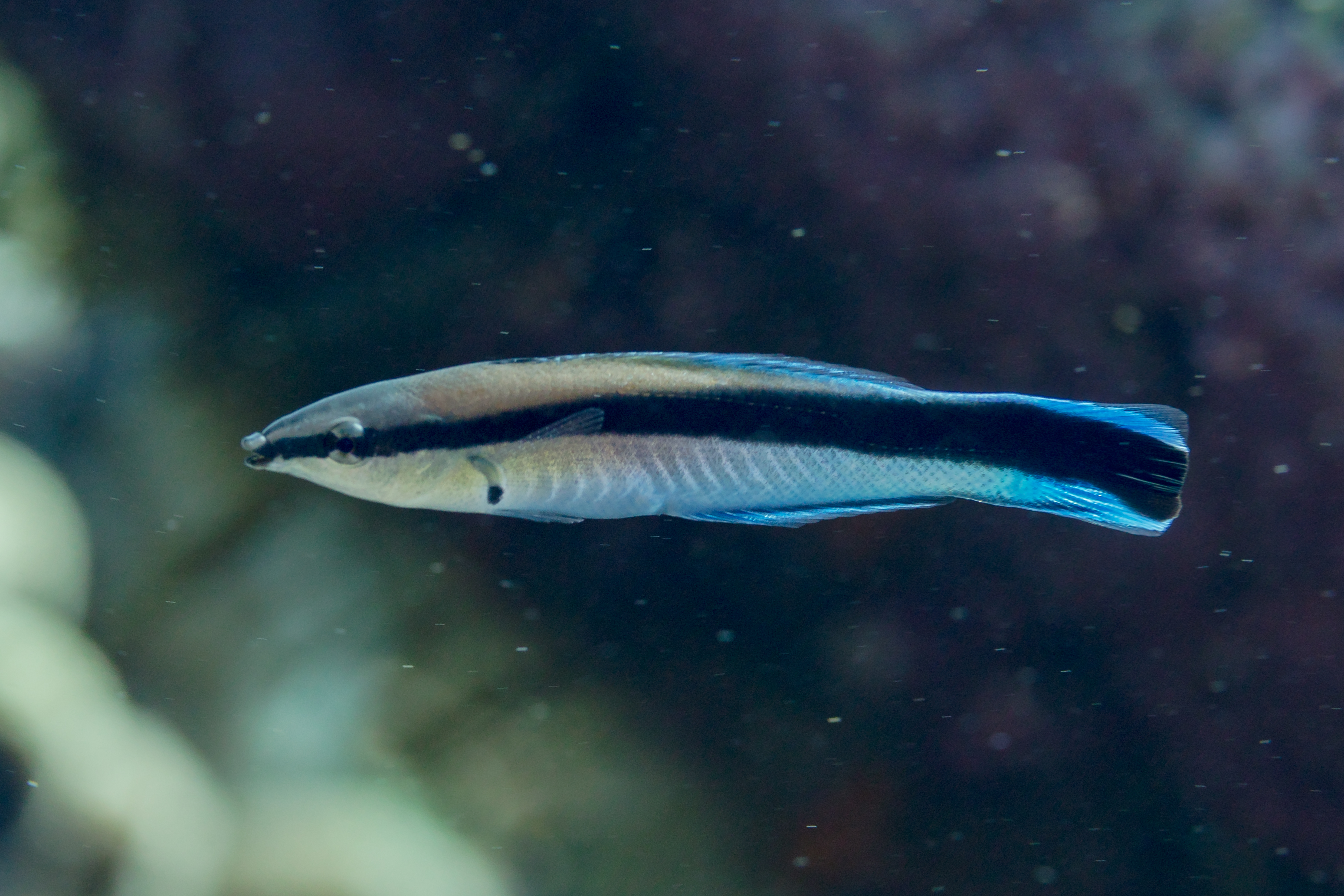
A slender, electric-blue-and-black striped reef fish that earns its living picking parasites and dead tissue off other fish at cleaning stations. Captivating to watch, but a specialist feeder that often starves in captivity, so it is best left on the reef unless you can meet its demanding diet.
ℹ️
Educational only. KinStation content is reviewed by licensed veterinarians but cannot replace an in-person exam. Always consult a licensed veterinarian or board-certified specialist for diagnosis, treatment, or any decision affecting your pet's health.
🩺 Need expert help with your bluestreak cleaner wrasse?
Connect with a specialist near you or ask a licensed vet — never substitute online guidance for hands-on care in an emergency.
Reaches about 4.5 in (11.5 cm), typically 3-4 in (7.5-10 cm) in aquaria.
Lifespan
4–7 years
Social needs
solo
Native region
Indo-Pacific, from the Red Sea and East Africa to the central Pacific
Origin
Old World
Climate
🌴 Tropical
Water type
🌊 Marine
Family
Labridae
Genus
Labroides
Part of the Wrasses
Wrasses (family Labridae) are an enormous, diverse group of active, colorful reef fish ranging from tiny fairy and flasher wrasses to large predators. Many sand-diving species sleep buried in the substrate, most are accomplished jumpers, and several are prized for controlling pest invertebrates in reef aquariums.
From the minimum an animal needs to be kept humanely, up to the ideal setup. Bigger is almost always better — minimums are floors, not targets.
Photo coming soon
Minimum
Discouraged in captivity
75 gal / 284 L mature reef
Labroides dimidiatus rarely survives long term — they depend on a steady supply of parasites and slime to graze. At minimum a 75-gallon mature reef with abundant tankmates to clean, but most ethical aquarists skip this species entirely.
Photo coming soon
Recommended
Large established reef
125 gal / 473 L mature reef
125-gal mature reef with a high tankmate fish count, varied diet supplementation, and quarantine experience. Even then, mortality rates are high. Consider neon goby as a hardier alternative.
Photo coming soon
Ideal
Public-aquarium-scale reef
180 gal+ / 681 L+ public-style reef
Realistically only public-aquarium-scale reefs sustain cleaner wrasses long-term. We list this for completeness, but recommend against home aquarium purchase.
Life & growth stages
How this animal changes through its life — each stage often has its own care, diet and space needs.
Photo coming soon
Egg
Fish eggs are small, translucent spheres, often laid in clutches on plants, substrate, or in a nest — or carried/brooded by a parent in livebearing and mouth-brooding species. A dark eye spot and the curled embryo become visible inside as development progresses.
Photo coming soon
Fry
Newly hatched fry are tiny and semi-transparent, frequently still carrying a yolk sac that fuels them before they feed freely. They lack full fin structure and adult coloration, staying near cover until they can swim and forage on their own.
Photo coming soon
Juvenile
Juveniles look like miniature adults but with developing fins and muted or different markings; many species shift pattern and color as they mature. Growth is rapid at this stage given clean water and steady feeding.
Adult
Adults show the species' full size, finnage, and mature coloration, and are sexually mature. Many fish develop sex-specific differences in size, color, or fin shape, which can intensify during breeding.
Habitat & enclosure
Provide a minimum of 50-75 gallons of well-established, fish-heavy reef aquarium, because a cleaner wrasse depends on a steady supply of host fish to clean and on natural microfauna to supplement its diet. Aquascape with abundant live rock to create cleaning-station perches, sightlines, and crevices; the fish does not bury in sand but wedges into rock nooks to sleep, sometimes in a mucus cocoon. A tightly fitting lid is essential, as wrasses jump.
Maintain stable tropical reef parameters: temperature 72-80 F (22-27 C), pH 8.1-8.4, salinity 1.023-1.026 specific gravity, and moderate flow. Stability matters greatly because this is a delicate, stress-prone species that tolerates little fluctuation in water quality.
Substrate
A fine sand bed is appropriate and natural for the display, though this wrasse rests in rock crevices rather than burrowing. Generous live rock is the most important aquascape element, providing cleaning perches and overnight shelter.
Equipment & setup
Run a marine system with strong biological filtration, a protein skimmer, and a reliable heater set to the tropical range; a chiller may be needed in warm climates. Provide moderate flow from powerheads and standard reef lighting, and fit a secure, gap-free lid to prevent jumping.
Diet
In the wild this is an obligate cleaner that feeds almost entirely on the mucus, dead skin, and ectoparasites it removes from other fish, supplemented by tiny crustaceans. That specialized diet is extremely hard to replicate, which is why many imported cleaner wrasses slowly starve in home tanks. To have any chance of success, keep it only in a large, heavily stocked system with many fish to service, and offer frequent small feedings of enriched frozen mysis, cyclops, finely chopped seafood, and prepared foods.
Feed three or more times daily and watch closely that the individual is actually eating prepared food, not just picking. Many ethical aquarists decline to keep this species at all because of its poor survival record.
Behavior & temperament
Peaceful and reef-safe, the bluestreak cleaner wrasse is famous for its swaying "dance" that advertises cleaning services; other fish, even predators, queue up and allow it to pick at their gills, mouth, and body. It is harmless to corals and invertebrates and ignores tankmates except to clean them. It can be kept singly or, with care, as a mated pair in a large system, but multiple unpaired individuals will squabble.
Its greatest value is behavioral interest rather than practical parasite control, and it should never be relied on to cure a sick tank. Provide a calm, established community with plenty of larger, docile fish for it to service.
Health
The overwhelming risk is starvation and stress-related decline within weeks to months of import, the main reason this species is rated advanced and often discouraged. Beyond nutrition, cleaner wrasses are susceptible to ich (Cryptocaryon) and marine velvet, especially after shipping, so a careful quarantine and a fully cycled, mature display are critical. Avoid copper-based treatments where possible, as wrasses can be sensitive.
Never buy a thin, sunken-bellied specimen, and observe it feeding on prepared food at the store before purchase. Wild collection of cleaner wrasses also harms reef health, since each fish services many others.
Tips, DIY & hacks
Strongly consider a captive-bred or aquacultured individual if available, as they accept prepared foods far better than wild imports. Drip-acclimate slowly, quarantine before adding to the display, and confirm the fish eats frozen and prepared foods at the store first. The neon goby (Elacatinus) is a hardier, more sustainable cleaning alternative.