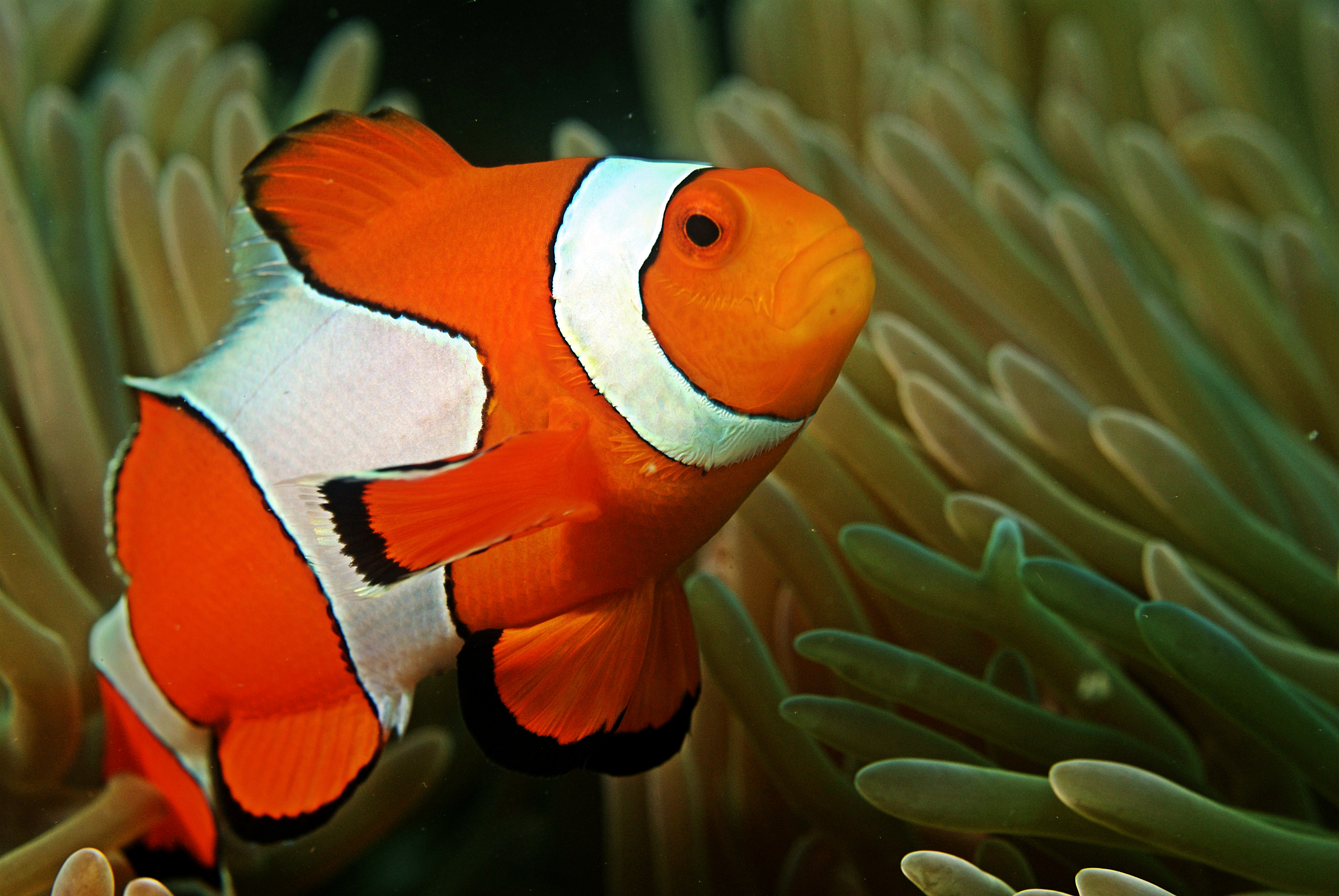
Ocellaris clownfish are small, hardy saltwater fish made famous by film. Captive-bred individuals are widely available, well-suited to nano reef tanks, and considered one of the best beginner marine fish — though saltwater husbandry itself is advanced.
ℹ️
Educational only. KinStation content is reviewed by licensed veterinarians but cannot replace an in-person exam. Always consult a licensed veterinarian or board-certified specialist for diagnosis, treatment, or any decision affecting your pet's health.
🩺 Need expert help with your clownfish (ocellaris)?
Connect with a specialist near you or ask a licensed vet — never substitute online guidance for hands-on care in an emergency.
Clownfish (anemonefish) are small, hardy, brightly banded reef fish of the genus Amphiprion in the family Pomacentridae, famous for sheltering among the tentacles of sea anemones. Peaceful, largely reef-safe, and widely captive-bred, they are the most popular beginner marine fish and the easiest saltwater species to breed at home.
From the minimum an animal needs to be kept humanely, up to the ideal setup. Bigger is almost always better — minimums are floors, not targets.
Photo coming soon
Minimum
Cycled nano reef
20 gal (≈ 76 L)
Despite their tiny captive size, ocellaris clowns need a fully cycled, stable saltwater tank of at least 20 gallons with live rock for shelter, stable salinity (≈ 1.024–1.026 SG) and tropical temperatures of 24–27 °C. Keep them as a bonded pair rather than alone, and avoid the marketed 'nano cube' tanks under 10 gallons that cannot hold stable parameters.
Photo coming soon
Recommended
Established reef tank
30 gal (≈ 114 L)
A 30-gallon or larger reef with plenty of live rock, gentle-to-moderate flow and good biological filtration gives a pair room to establish territory and natural swimming behaviour. Maintain 24–27 °C, low nitrate, and offer a host anemone or surrogate (leather coral or large polyp) so they can express their natural hosting instinct.
Photo coming soon
Ideal
Mature anemone reef
55+ gal (≈ 208+ L) reef
A mature 55-gallon-plus reef with strong lighting capable of supporting a healthy bubble-tip or other host anemone is the most natural setup, letting a bonded pair host as they would on the reef. Stable pristine water (24–27 °C, calcium and alkalinity balanced for corals), diverse rockwork, and a varied frozen and pellet diet support full lifelong wellbeing.
Life & growth stages
How this animal changes through its life — each stage often has its own care, diet and space needs.
Photo coming soon
Egg
Fish eggs are small, translucent spheres, often laid in clutches on plants, substrate, or in a nest — or carried/brooded by a parent in livebearing and mouth-brooding species. A dark eye spot and the curled embryo become visible inside as development progresses.
Photo coming soon
Fry
Newly hatched fry are tiny and semi-transparent, frequently still carrying a yolk sac that fuels them before they feed freely. They lack full fin structure and adult coloration, staying near cover until they can swim and forage on their own.
Photo coming soon
Juvenile
Juveniles look like miniature adults but with developing fins and muted or different markings; many species shift pattern and color as they mature. Growth is rapid at this stage given clean water and steady feeding.
Adult
Adults show the species' full size, finnage, and mature coloration, and are sexually mature. Many fish develop sex-specific differences in size, color, or fin shape, which can intensify during breeding.
Color & pattern variants
Natural variants occur in the wild; selectively bred (man-made) variants were developed in captivity.
Ocellaris clownfish are small, hardy marine fish well-suited to nano and mid-sized reef aquariums, though saltwater husbandry itself is an advanced undertaking. A bonded pair does well in a marine aquarium of at least roughly 20 gallons with stable salinity, a tropical temperature range, and a properly cycled biological filter — typically live rock or an equivalent that hosts the nitrifying bacteria that process waste.
Stability is the watchword for any reef system: salinity, temperature, and water chemistry are kept consistent, and saltwater is mixed and matched to the tank rather than changed abruptly. Live rock provides both filtration and the territory clownfish like to claim. A mature tank — one that has fully cycled and stabilized — is far more forgiving than a brand-new setup.
A host anemone is not required for captive-bred ocellaris clownfish, which often adopt a coral, a powerhead, or simply a corner of the tank instead. If an anemone is desired, compatible species (such as bubble-tip anemones) are added only once the system is well established, since anemones have their own demanding light and water requirements. The overall environment recreates a stable, warm, well-filtered reef niche.
Substrate
A shallow bed of fine aragonite sand (1-2 inches) suits a reef setup, or run bare-bottom for easier detritus export; clownfish are not substrate-dependent since they live in the water column near a host. Aragonite helps buffer pH and supports beneficial denitrifying bacteria.
Equipment & setup
Provide a 20+ gallon saltwater tank with live rock, a protein skimmer, a heater holding 75-82F, and stable salinity (1.024-1.026 SG); reef LED lighting is essential if you keep a host anemone (e.g., bubble-tip), which needs strong PAR. A gentle powerhead for flow and an established biofilter complete the setup.
Diet
Ocellaris clownfish are omnivores and are not fussy eaters, which is part of their beginner-friendly (for a marine fish) reputation. A quality marine flake and pellet diet forms the base, supplemented with frozen foods such as mysis shrimp and brine shrimp, and occasional marine algae (nori). A varied diet supports color and health.
Multiple small meals a day suit their metabolism better than one large feeding, and portions are sized to be eaten promptly so excess food doesn't degrade water quality — always a concern in the smaller volumes many clownfish tanks use. There are no supplement doses to administer; nutrition is about a varied, marine-appropriate menu.
The common pitfalls are overfeeding (which fouls reef water and feeds nuisance algae) and an overly monotonous diet. A varied rotation in modest portions keeps clownfish vigorous and brightly colored without overloading the system.
Behavior & temperament
Ocellaris clownfish are strongly site-attached and protective of whatever they adopt as a host — an anemone, a large-polyp coral, or even a powerhead. They are generally peaceful and make excellent reef-community fish, but they will defend their chosen spot with surprising boldness, including toward the keeper's hand at maintenance time.
Their most fascinating trait is their social and reproductive biology: clownfish are sequential hermaphrodites, specifically protandrous. A group forms a size-based hierarchy in which the largest fish is the breeding female, the second-largest is the breeding male, and the rest remain non-breeding. If the female dies, the breeding male changes sex to become the new female, and the largest non-breeder matures into the new male. Practically, this means a stable bonded pair is the goal, and a third adult should not be added.
Within a pair, clownfish are engaging and interactive, often "dancing" in their host and recognizing feeding routines. Their hardiness, personality, and famous looks make them one of the most rewarding entry points into reef keeping.
Health
Common ocellaris clownfish health concerns include marine ich (Cryptocaryon irritans), brooklynella ("clownfish disease," a protozoan that notably affects clownfish), and bacterial infections. These are general patterns to address with an aquatic veterinarian or via established reef disease-management practice, not casual guesswork.
Prevention centers on quarantine and stability: all new marine livestock is quarantined before joining the display, and salinity, temperature, and water chemistry are kept consistent. Many marine diseases enter on unquarantined fish, corals, or inverts, so biosecurity is the single most effective preventive measure. A mature, stable, well-filtered system resists outbreaks far better than a fluctuating one.
Signs that warrant attention include white spots (ich), excess mucus or sloughing skin (a brooklynella concern), rapid gilling, flashing, clamped fins, loss of appetite, and lethargy. For serious disease, an aquatic-experienced fish veterinarian provides diagnosis and a treatment plan.
Tips, DIY & hacks
Captive-bred ocellaris are hardy, disease-resistant, and adapt without an anemone, often hosting a frogspawn coral or even a powerhead instead. Buy a bonded pair or a group of juveniles and let the dominant one become female; quarantine all new saltwater fish to avoid introducing marine ich.
Origin & history
Amphiprion ocellaris is a clown anemonefish of the warm Indo-Pacific, living in association with sea anemones on coral reefs. It was already a popular marine aquarium fish before the 2003 film Finding Nemo (whose central characters are ocellaris clownfish), after which demand surged dramatically.
Clownfish were among the first marine ornamental fish to be reliably captive-bred at scale, and captive breeding has substantially reduced reliance on wild collection while producing a wide array of "designer" patterns and colors (snowflakes, picassos, black ocellaris, and more) beyond the standard orange-and-white. This combination of hardiness, captive-breeding success, and pop-culture fame has made the ocellaris clownfish the iconic gateway fish of the reef hobby.
Anecdotes & owner lore
Community experience and cultural notes — not veterinary advice. Every animal is an individual; treat these as colour, not care instructions.
No aquarium fish is more famous, and the fame is a double-edged sword. After Finding Nemo, clownfish demand exploded, and the film about a fish that should not be taken from the reef ironically drove a wave of people wanting one — a paradox the aquarium world still talks about. The happier footnote is that ocellaris clownfish were already captive-bred in large numbers, so much of that demand could be met without stripping reefs, and "tank-bred Nemo" became a conservation talking point.
The biology behind the cartoon is its own great story. Because clownfish are protandrous hermaphrodites, the real-life version of the film's premise would be startling: if Nemo's mother died, his father Marlin would have changed sex to become female, and Nemo would have grown up to be her mate. Keepers delight in this "the science says otherwise" twist. On a gentler note, owners adore their clownfish's bossy charm — the way a tiny pair will host a coral or a powerhead, "dance" in the current, and fearlessly defend their corner against a hand ten times their size makes them feel like the personable pets of the reef tank.
Common ailments
Bacterial infection — common
Marine ich (white spot) — common — A leading reason to quarantine all new marine livestock before adding to a display.
Brooklynella ('clownfish disease') — common — Especially associated with newly imported clownfish; quarantine is the main defense.
Reviewed and signed off by: KinStation Editorial - pre-launch draft (pending DVM review)