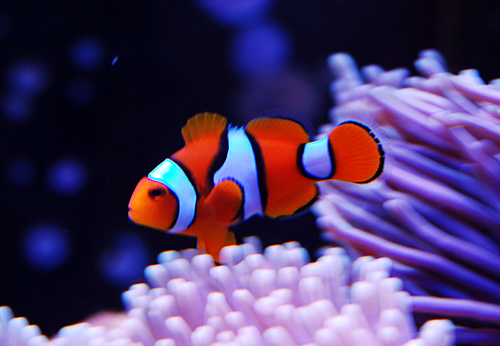
The classic orange-and-white anemonefish made famous by popular film, the percula is one of the hardiest and most beginner-friendly marine fish. Captive-bred stock is widely available, peaceful, reef-safe, and well suited to nano and community reef tanks. It is very similar to the ocellaris clownfish but typically shows thicker black margins around its three white bars.
ℹ️
Educational only. KinStation content is reviewed by licensed veterinarians but cannot replace an in-person exam. Always consult a licensed veterinarian or board-certified specialist for diagnosis, treatment, or any decision affecting your pet's health.
🩺 Need expert help with your percula clownfish?
Connect with a specialist near you or ask a licensed vet — never substitute online guidance for hands-on care in an emergency.
Small marine fish, about 7-8 cm (2.75-3 in); females larger than males.
Lifespan
6–20 years
Social needs
pair
Native region
Western Pacific: Great Barrier Reef, Melanesia, and the Coral Triangle
Origin
Old World
Climate
🌴 Tropical
Water type
🌊 Marine
Family
Pomacentridae
Genus
Amphiprion
Part of the Clownfish & Anemonefish
Clownfish (anemonefish) are small, hardy, brightly banded reef fish of the genus Amphiprion in the family Pomacentridae, famous for sheltering among the tentacles of sea anemones. Peaceful, largely reef-safe, and widely captive-bred, they are the most popular beginner marine fish and the easiest saltwater species to breed at home.
From the minimum an animal needs to be kept humanely, up to the ideal setup. Bigger is almost always better — minimums are floors, not targets.
Minimum
Pair-sized nano reef
20 gal / 75 L nano reef
Amphiprion percula is the classic peaceful clownfish — a captive-bred pair thrives in a nano reef with stable params (24–26 °C, sg 1.024), live rock, and gentle flow.
aquarist.me / CC BY 2.0 (Wikimedia Commons)
Photo coming soon
Recommended
Reef with hosting anemone
30–55 gal / 110–200 L reef
More volume stabilises params and supports a bubble-tip or carpet anemone (high lighting required). Pair forms a clear territory and breeds reliably.
Photo coming soon
Ideal
Mature mixed reef
75 gal+ / 280 L+ mixed reef
Spacious mixed reef with long-established BTA, diverse tankmates, and refugium support. Pair becomes a centrepiece display fish for 15+ years.
Life & growth stages
How this animal changes through its life — each stage often has its own care, diet and space needs.
Photo coming soon
Egg
Fish eggs are small, translucent spheres, often laid in clutches on plants, substrate, or in a nest — or carried/brooded by a parent in livebearing and mouth-brooding species. A dark eye spot and the curled embryo become visible inside as development progresses.
Photo coming soon
Fry
Newly hatched fry are tiny and semi-transparent, frequently still carrying a yolk sac that fuels them before they feed freely. They lack full fin structure and adult coloration, staying near cover until they can swim and forage on their own.
Photo coming soon
Juvenile
Juveniles look like miniature adults but with developing fins and muted or different markings; many species shift pattern and color as they mature. Growth is rapid at this stage given clean water and steady feeding.
Adult
Adults show the species' full size, finnage, and mature coloration, and are sexually mature. Many fish develop sex-specific differences in size, color, or fin shape, which can intensify during breeding.
Color & pattern variants
Natural variants occur in the wild; selectively bred (man-made) variants were developed in captivity.
A single fish or a bonded pair does well in 75 litres (20 gallons) or more of stable, mature saltwater; give a pair a bit more room. Keep temperature 24-27 C (75-80 F), pH 8.1-8.4, specific gravity 1.023-1.026 (salinity ~33-35 ppt), ammonia and nitrite zero, and nitrate low.
Provide gentle to moderate flow and plenty of live rock with caves and overhangs for shelter and to define a small territory. Standard reef lighting is fine. A host anemone is not required in captivity, though a healthy bubble-tip anemone (Entacmaea quadricolor) can be offered to experienced keepers; many perculas will instead host in soft corals or simply pick a rock.
Substrate
A shallow fine aragonite sand bed over plentiful live rock suits them best, providing biological filtration and the caves and ledges clownfish use as shelter. Bare-bottom works in dedicated breeding setups where a tile or pot is provided as a spawning surface.
Equipment & setup
Run a cycled marine system with live rock and/or a quality biological filter, a protein skimmer (recommended on tanks over ~75 litres), a reliable heater, and a powerhead or return for gentle-to-moderate flow. Standard reef LED lighting is sufficient; brighter reef lighting is only needed if keeping a host anemone or corals.
Diet
An omnivore that readily accepts a varied diet of high-quality marine flake and pellet, frozen mysis and enriched brine shrimp, and finely chopped meaty seafood, with occasional marine algae or nori for balance. Feed small amounts once or twice daily. In the wild they feed largely on zooplankton and algae picked from the water column near their host anemone.
Behavior & temperament
Peaceful, hardy, and fully reef-safe, the percula is a great community resident that will not harm corals or invertebrates. Clownfish are protandrous sequential hermaphrodites: all start as males and the dominant fish becomes female, so the reliable way to keep two is to add a small (male) juvenile to an established larger fish. They can be mildly territorial around their chosen host or rock, especially toward other clownfish, so house only one clownfish species per tank. They generally ignore unrelated tankmates such as gobies, blennies, and tangs.
Health
Hardy but still susceptible to marine ich (Cryptocaryon) and the more dangerous marine velvet (Amyloodinium), so quarantine new arrivals and watch for scratching, rapid breathing, or white spots. Captive-bred clownfish are also prone to Brooklynella (clownfish disease) and bacterial infections when stressed; tank-bred fish are generally hardier than wild-caught. Maintain stable salinity and temperature and avoid copper around any hosting invertebrates. (Health information is educational only and not a substitute for advice from an aquatic veterinarian.)
Tips, DIY & hacks
Buy captive-bred stock to get a hardier, sustainable fish that ships better and adapts to aquarium food immediately. Drip-acclimate over 30-60 minutes and quarantine for 2-4 weeks before adding to a display. To make a pair, add a clearly smaller juvenile to a larger established fish so the size hierarchy sets the sexes naturally; perculas are among the easiest marine fish to breed at home.