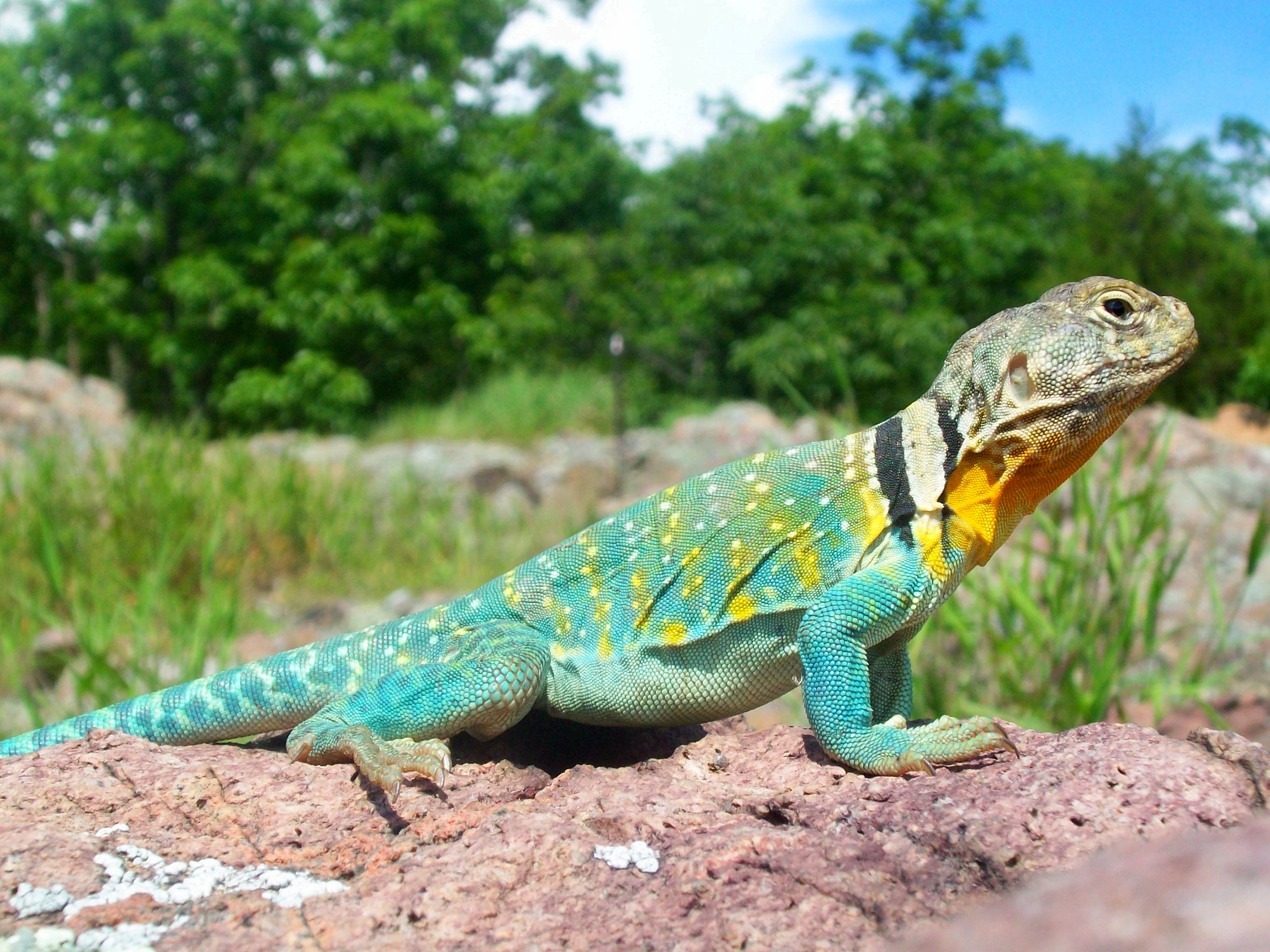
A vividly colored North American desert lizard (family Crotaphytidae) with a distinctive black-and-white collar, capable of sprinting bipedally across rocks. Hardy and bold but needs intense heat and UVB plus a dry, rocky terrestrial setup.
ℹ️
Educational only. KinStation content is reviewed by licensed veterinarians but cannot replace an in-person exam. Always consult a licensed veterinarian or board-certified specialist for diagnosis, treatment, or any decision affecting your pet's health.
🩺 Need expert help with your collared lizard?
Connect with a specialist near you or ask a licensed vet — never substitute online guidance for hands-on care in an emergency.
Total length 20-36 cm (8-14 in) including tail. Males are larger and far more brightly colored than females.
Lifespan
5–10 years
Social needs
solo
Native region
South-central and southwestern United States and northern Mexico
Origin
New World
Climate
🏜️ Arid
Family
Crotaphytidae
Genus
Crotaphytus
Part of the Iguanian lizards (New World)
New World iguanian lizards (families such as Corytophanidae and Crotaphytidae) are active, often crested or boldly colored display lizards. Despite superficially resembling Old World agamids, they belong to separate New World families. Most need strong UVB, hot basking spots, and a well-structured enclosure.
From the minimum an animal needs to be kept humanely, up to the ideal setup. Bigger is almost always better — minimums are floors, not targets.
Photo coming soon
Minimum
Desert terrarium
4 × 2 × 2 ft (≈ 75 gal)
Crotaphytus collaris is a fast active desert lizard. Minimum is a 4×2×2 with deep sand/clay substrate, large rocks for basking (basking surface 45–50 °C), cool 25 °C, and strong UVB (10–12%).
Photo coming soon
Recommended
Larger arid vivarium
5 × 2 × 2 ft, naturalistic
A 5×2×2 with massive rock structures, dig substrate, varied hardscape, and intense basking gradient. Collared lizards sprint and bask — open floor + high basking matter equally.
Photo coming soon
Ideal
Naturalistic American Southwest
6 × 3 × 2 ft, naturalistic
Large naturalistic enclosure with extensive rock structures, deep substrate, scattered plants, and full UVB/basking gradient. Mimics Oklahoma/Texas/New Mexico scrubland.
Life & growth stages
How this animal changes through its life — each stage often has its own care, diet and space needs.
Photo coming soon
Egg / Neonate
Most reptiles lay leathery- or hard-shelled eggs incubated by ambient warmth, though some snakes and lizards give live birth. Incubation temperature can influence sex and development in many species.
Photo coming soon
Hatchling
Hatchlings emerge as fully formed miniatures of the adult, often using an egg tooth to slit the shell. They are independent from birth but small and vulnerable, and may show brighter or different juvenile patterning.
Photo coming soon
Juvenile
Juveniles grow steadily, shedding their skin periodically as they enlarge. Coloration and proportions shift toward the adult form, and growth rate depends heavily on temperature, diet, and basking/UVB access.
Adult
Adults reach the species' full length and mass and become sexually mature. Many reptiles show sex differences in size, coloration, or features (such as larger heads, hemipenal bulges, or femoral pores), and continue to shed throughout life.
Habitat & enclosure
Provide a long, ground-oriented terrarium (minimum ~120 x 45 x 45 cm / 4 x 1.5 x 1.5 ft for an adult) furnished with stacked flat rocks, basking platforms, and hides. These are hot-climate baskers: offer a basking surface of 38-43 C (100-110 F), a cool side around 27 C (80 F), and a night drop into the low 20s C (low 70s F). Keep humidity low (around 30-40%) with a dry, arid setup and a water dish. Intense UVB is essential.
Substrate
Use a dry, diggable desert substrate such as a topsoil/sand mix that holds a burrow without being dusty. Add flat rocks and slate for basking and to wear down nails. Avoid pure fine silica sand. Provide a humid hide to aid shedding.
Equipment & setup
Use a high-output basking lamp (often halogen flood) on a thermostat to reach the high basking temperatures these lizards need, plus a strong UVB lamp. Add digital thermometers, a hygrometer, secure rock stacks (anchored so they cannot topple), and a shallow water dish.
Diet
Primarily insectivorous and a notable predator of other lizards in the wild. Feed crickets, dubia roaches, locusts, and other gut-loaded insects; large adults may take an occasional pink mouse. Dust with calcium and a multivitamin. Adults eat every 1-2 days; juveniles daily. Some individuals nibble flowers or greens.
Behavior & temperament
Diurnal, alert, and territorial. Males are aggressive toward other males and should be housed alone. They are active baskers and sprinters and can be skittish, though captive-bred animals often become confident and accept gentle handling over time. Their bold colors and personality make them rewarding display lizards. Provide ample basking and sight lines.
Health
Failure to thrive usually traces to insufficient heat or UVB, causing poor appetite, lethargy, or metabolic bone disease. Also watch for dehydration, retained shed, and parasites in wild-caught animals. A healthy collared lizard is plump-tailed, vividly colored, and basks vigorously. Provide a strong thermal gradient and proper photoperiod.
Tips, DIY & hacks
Do not skimp on basking heat or UVB; these are sun-loving desert specialists that need brighter, hotter conditions than many beginner lizards. Anchor rockwork on the enclosure floor (not on substrate) so digging cannot collapse it. Many keepers give wild-type animals a cooler winter rest period to support breeding and natural rhythms. Note that some US states require a permit to keep native wildlife, so check local collection and possession laws.