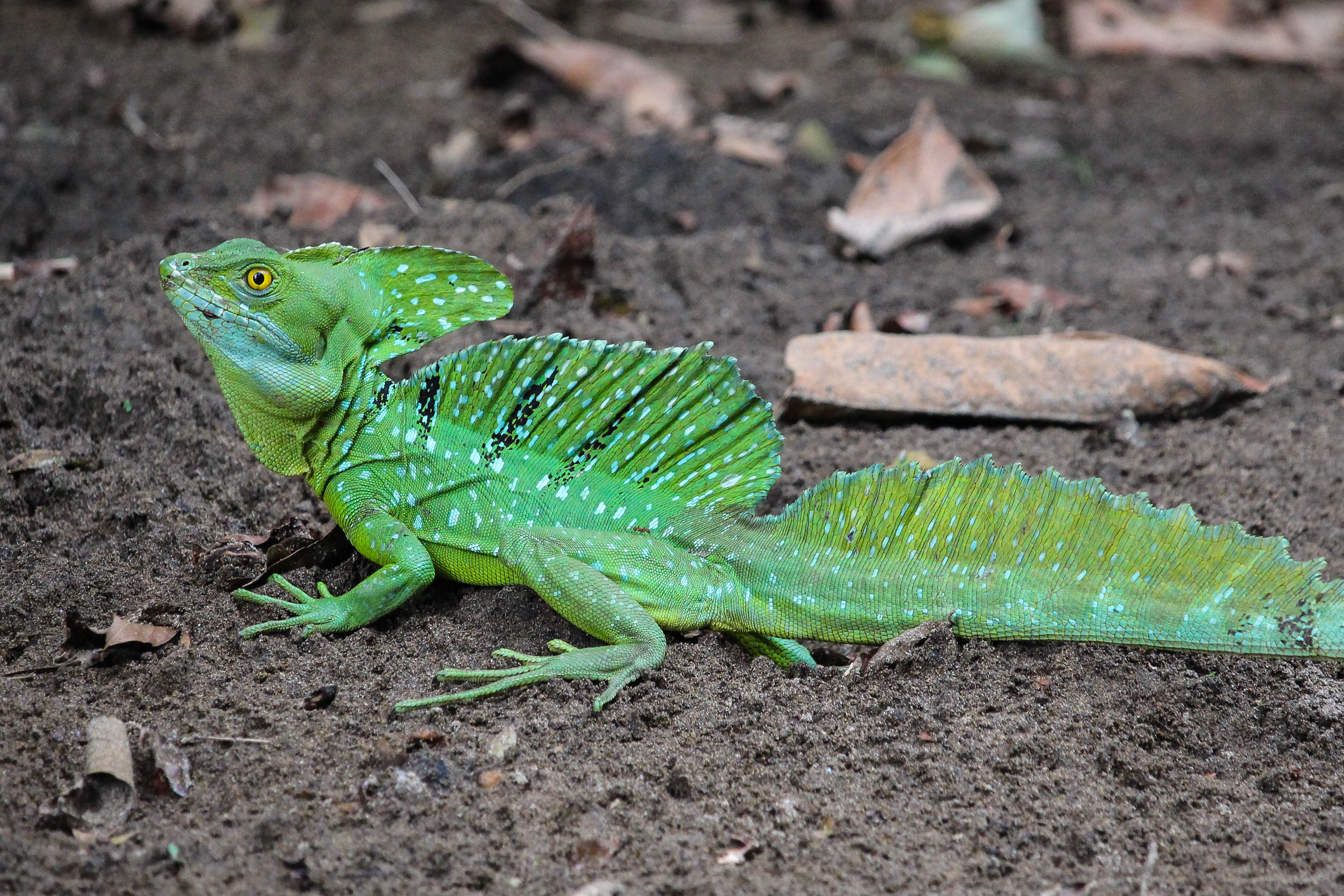
A brilliant green, semi-arboreal Central American lizard (family Corytophanidae, the casquehead lizards) famous for running across water on its hind legs (earning the Jesus Christ lizard nickname). Beautiful and active but nervous, needing a large, tall, humid enclosure.
ℹ️
Educational only. KinStation content is reviewed by licensed veterinarians but cannot replace an in-person exam. Always consult a licensed veterinarian or board-certified specialist for diagnosis, treatment, or any decision affecting your pet's health.
🩺 Need expert help with your green basilisk?
Connect with a specialist near you or ask a licensed vet — never substitute online guidance for hands-on care in an emergency.
Total length up to 75-90 cm (30-36 in) including the very long tail; males larger and more crested than females.
Lifespan
7–12 years
Social needs
solo
Native region
Central America (Honduras, Nicaragua, Costa Rica, Panama)
Origin
New World
Climate
🌴 Tropical
Family
Corytophanidae
Genus
Basiliscus
Part of the Iguanian lizards (New World)
New World iguanian lizards (families such as Corytophanidae and Crotaphytidae) are active, often crested or boldly colored display lizards. Despite superficially resembling Old World agamids, they belong to separate New World families. Most need strong UVB, hot basking spots, and a well-structured enclosure.
From the minimum an animal needs to be kept humanely, up to the ideal setup. Bigger is almost always better — minimums are floors, not targets.
Photo coming soon
Minimum
Tall arboreal enclosure
4 × 2 × 5 ft (≈ 150 gal)
Basiliscus plumifrons is large (2–3 ft) and arboreal/semi-aquatic. Minimum is a 4×2×5 with a large water section, massive climbing branches, basking 35 °C, 10–12% UVB, humidity 70–80%.
Photo coming soon
Recommended
Custom tall paludarium
6 × 2 × 6 ft with pool
A 6×2×6 with a deep pool (they sprint across water), extensive horizontal branches, live plants, and strong UVB. Skittish — provide visual barriers to reduce glass-strike injuries.
Photo coming soon
Ideal
Bioactive Neotropical paludarium
8 × 3 × 7 ft, bioactive paludarium
Large bioactive Central American rainforest paludarium with circulating pool, dense canopy, live tropical plants, and full UVB/humidity. Stunning display species when housed correctly.
Life & growth stages
How this animal changes through its life — each stage often has its own care, diet and space needs.
Photo coming soon
Egg / Neonate
Most reptiles lay leathery- or hard-shelled eggs incubated by ambient warmth, though some snakes and lizards give live birth. Incubation temperature can influence sex and development in many species.
Photo coming soon
Hatchling
Hatchlings emerge as fully formed miniatures of the adult, often using an egg tooth to slit the shell. They are independent from birth but small and vulnerable, and may show brighter or different juvenile patterning.
Photo coming soon
Juvenile
Juveniles grow steadily, shedding their skin periodically as they enlarge. Coloration and proportions shift toward the adult form, and growth rate depends heavily on temperature, diet, and basking/UVB access.
Adult
Adults reach the species' full length and mass and become sexually mature. Many reptiles show sex differences in size, coloration, or features (such as larger heads, hemipenal bulges, or femoral pores), and continue to shed throughout life.
Habitat & enclosure
House in a tall, planted enclosure (minimum ~120 x 60 x 120 cm / 4 x 2 x 4 ft for an adult; larger preferred) with abundant diagonal branches, foliage, and a large water feature, since basilisks swim and dive when startled. Provide a basking spot of 32-35 C (90-95 F), an ambient gradient of 26-29 C (80-85 F), and a mild night drop. Keep humidity high at 60-80% with daily misting and good ventilation to prevent stagnation. Strong UVB is important.
Substrate
Use a humidity-retentive mix of topsoil, coir, and leaf litter (bioactive setups work well with live plants and cleanup crews). Keep it damp but not swampy. A large, easily cleaned water section is essential and should be filtered or changed frequently.
Equipment & setup
Provide a basking lamp on a thermostat, a high-output UVB lamp, digital thermometers and a hygrometer, and a misting system. A filtered water feature or large basin supports their semi-aquatic nature. Heavily plant and branch the enclosure for cover and climbing.
Diet
Omnivorous, leaning insectivorous. Offer crickets, dubia roaches, locusts, silkworms, and hornworms, plus occasional pink mice for large adults, and some leafy greens, vegetables, and fruit. Dust with calcium and a multivitamin and gut-load feeders. Juveniles feed daily; adults every other day, monitoring body condition.
Behavior & temperament
Diurnal, fast, and high-strung. Basilisks are flight-prone and may dash or leap into the water or against the glass when alarmed, so a large enclosure and visual barriers reduce injury risk. They tolerate rather than enjoy handling and are best appreciated as a display species. Keep one male per enclosure; males are territorial toward each other.
Health
Snout/rostrum abrasions (rubbing the nose raw against glass) are a classic problem in nervous, under-housed individuals. Also watch for metabolic bone disease, dehydration, and respiratory infection. Provide visual security, ample space, and clean water to minimize stress and injury. Quarantine and fecal-check imports for parasites.
Tips, DIY & hacks
Reduce stress by placing the enclosure in a calm area, adding dense foliage at eye level, and covering part of the glass. A large water area not only enriches them but also catches startled dashes safely. Choose captive-bred animals for tameness and parasite-free health.