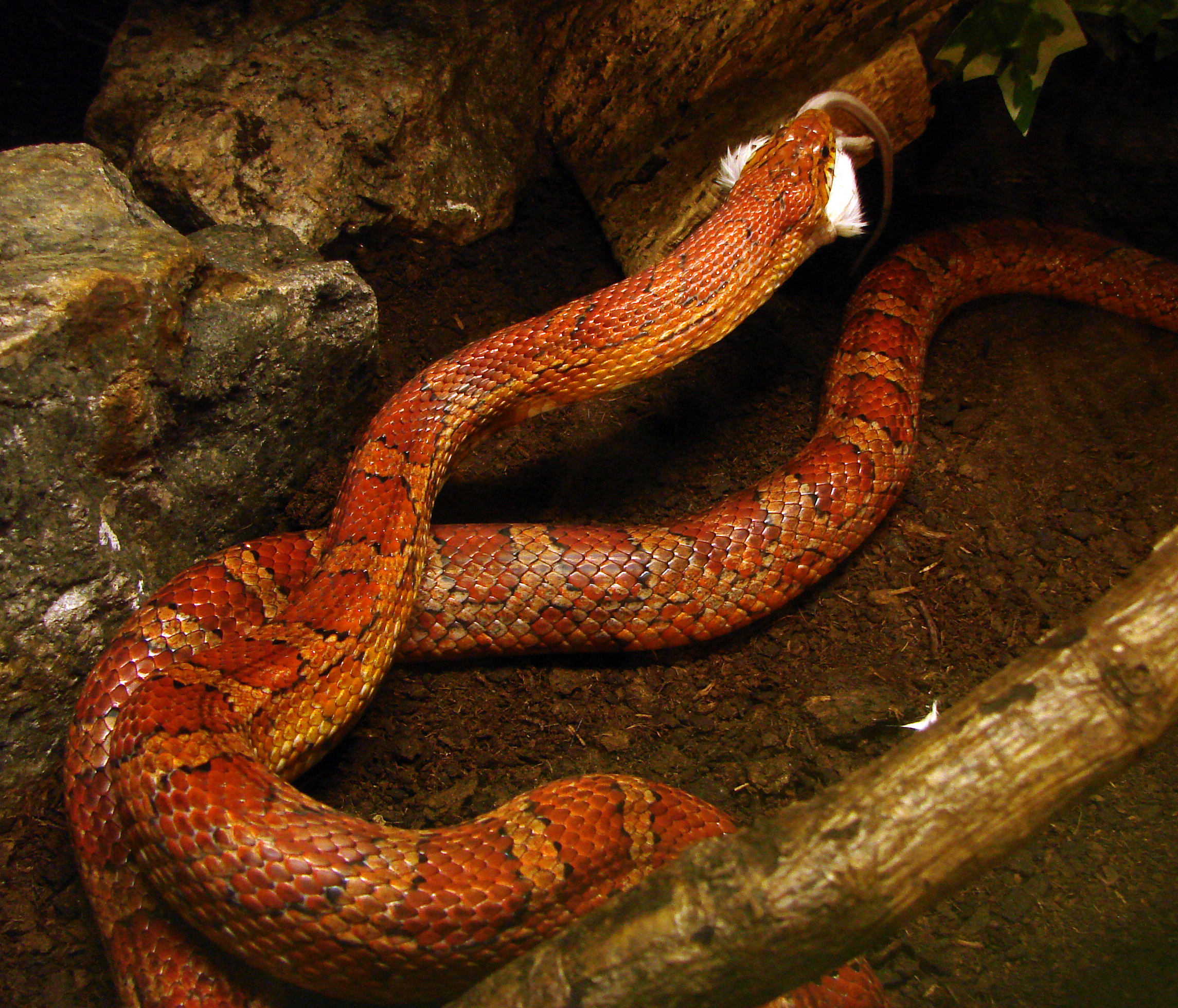
Corn snakes are non-venomous North American colubrids often considered the most beginner-appropriate pet snake. They are active, hardy, and relatively easy to handle, though their lifespan and escape skills demand commitment.
ℹ️
Educational only. KinStation content is reviewed by licensed veterinarians but cannot replace an in-person exam. Always consult a licensed veterinarian or board-certified specialist for diagnosis, treatment, or any decision affecting your pet's health.
🩺 Need expert help with your corn snake?
Connect with a specialist near you or ask a licensed vet — never substitute online guidance for hands-on care in an emergency.
Colubrids are the largest and most diverse snake family, encompassing most popular non-constricting and mildly constricting pet snakes. They range from hardy beginner species to specialized insectivores, and are generally non-venomous and manageable in captivity.
From the minimum an animal needs to be kept humanely, up to the ideal setup. Bigger is almost always better — minimums are floors, not targets.
Photo coming soon
Minimum
Adult enclosure
4 × 1.5 × 1.5 ft (≈ 40 gal)
An adult corn snake needs an enclosure roughly its own length, securely latched (they are escape artists), with a warm and cool hide and a thermal gradient.
Recommended
Front-opening vivarium
4 × 2 × 2 ft with climbing
Corn snakes are semi-arboreal and use vertical space — add branches and ledges, two+ hides, clutter, and a water bowl. Front-opening reduces handling stress.
Vassil / Public Domain (Wikimedia Commons)
Photo coming soon
Ideal
Bioactive enclosure
4–6 ft bioactive, planted
Larger planted bioactive enclosure with deep substrate, climbing structure, and multiple hides for exploration and natural behaviour.
Life & growth stages
How this animal changes through its life — each stage often has its own care, diet and space needs.
Photo coming soon
Egg / Neonate
Most reptiles lay leathery- or hard-shelled eggs incubated by ambient warmth, though some snakes and lizards give live birth. Incubation temperature can influence sex and development in many species.
Photo coming soon
Hatchling
Hatchlings emerge as fully formed miniatures of the adult, often using an egg tooth to slit the shell. They are independent from birth but small and vulnerable, and may show brighter or different juvenile patterning.
Photo coming soon
Juvenile
Juveniles grow steadily, shedding their skin periodically as they enlarge. Coloration and proportions shift toward the adult form, and growth rate depends heavily on temperature, diet, and basking/UVB access.
Adult
Adults reach the species' full length and mass and become sexually mature. Many reptiles show sex differences in size, coloration, or features (such as larger heads, hemipenal bulges, or femoral pores), and continue to shed throughout life.
Color & pattern variants
Natural variants occur in the wild; selectively bred (man-made) variants were developed in captivity.
Corn snakes are slender, active North American colubrids, and the single most important feature of their housing is that it be absolutely escape-proof. They are legendary escape artists that exploit the smallest gap, so a front-opening enclosure with secure latches, or a tank with a locking screen lid, is essential. Adults do well in an enclosure of around four feet in length, with floor space and security prioritized.
Provide a thermal gradient with a warm side and a cooler side maintained by a thermostat-controlled heat source, and a moderate ambient humidity that supports clean shedding. Suitable substrates include aspen shavings, cypress mulch, or even simple paper toweling; the substrate should let the snake burrow a little and stay clean and dry. A reliable thermometer and hygrometer take the guesswork out of monitoring conditions.
Furnish the enclosure with at least two hides (one on each side of the gradient) so the snake can feel secure at any temperature, plus some climbing branches, since corn snakes are semi-arboreal and enjoy exploring vertically. A sturdy water bowl large enough for an occasional soak completes the setup. A secure, well-furnished enclosure produces a calmer, healthier, and — crucially — still-present snake.
Substrate
Aspen shavings are the classic choice, allowing burrowing and easy spot-cleaning; cypress mulch or coconut husk work if slightly higher humidity is desired. Avoid cedar and pine and keep bedding dry to prevent scale rot.
Equipment & setup
Provide a thermostat-controlled UTH or heat tape giving a warm side of 85-88F and a cool side of 70-75F; a 20-40 gallon enclosure suits an adult, and no UVB is required (low-level UVB is a bonus). A tight-fitting, fully secure lid is vital, plus two snug hides and a water bowl.
Diet
Corn snakes are carnivores that eat whole prey, and the practical, generally recommended approach in captivity is feeding appropriately sized frozen-thawed rodents rather than live prey, which can injure a snake. Prey size is matched to the snake's girth, and feeding frequency decreases as the snake grows — hatchlings eat small prey more frequently, while adults eat larger items less often.
Clean water should always be available, and it is worth refreshing regularly, since snakes sometimes soak in or defecate in the bowl. As with other snakes, handling is best avoided for a day or two after a meal to prevent regurgitation, and the snake should be left to digest undisturbed.
Corn snakes are generally reliable, enthusiastic feeders, which is part of what makes them beginner-friendly, but appetite can dip naturally during shedding or cooler months, and this is usually normal in a healthy snake maintaining its weight. Persistent refusal combined with weight loss or other signs of illness, however, warrants a review of husbandry and a veterinary consult.
Behavior & temperament
Corn snakes are crepuscular to nocturnal, solitary animals that should be housed individually. They are widely regarded as one of the best beginner snakes because of their calm, tractable temperament: most acclimate quickly to gentle handling and rarely bite once they are used to their keeper, making them confident, easygoing snakes to interact with.
There are still sensible times to leave a corn snake alone. During shedding their eyes turn cloudy and bluish and their vision is impaired, which can make them defensive; for a day or two after feeding, handling risks regurgitation; and any time a snake is showing defensive posturing it should be given space. Recognizing these states keeps handling positive for both snake and keeper.
Corn snakes are notably curious and active explorers compared with some more sedentary species, often investigating their enclosure and climbing. This inquisitive, restless nature is also exactly why they escape so readily, and a snake that seems constantly to be probing the lid is usually just being a normal corn snake rather than signaling a problem — though persistent frantic activity is worth checking against husbandry.
Health
Corn snakes are hardy and, with good husbandry, can live for well over a decade and into their twenties, so they are a long-term commitment. As with other reptiles, most health problems are preventable through correct temperatures, humidity, hygiene, and feeding, and a reptile-experienced veterinarian is the right resource when issues arise.
Common conditions include respiratory infections (often linked to temperatures that are too low or poor conditions), retained shed — particularly the eye caps — when humidity is inadequate, external parasites such as snake mites, and, like other colubrids, susceptibility to certain infectious diseases. Good quarantine practice for new animals helps prevent introducing mites and pathogens.
Seek veterinary evaluation for signs such as wheezing, open-mouth breathing, or mucus around the mouth and nose; persistent food refusal accompanied by weight loss; retained shed or stuck eye caps; visible mites (tiny moving specks, sometimes seen as the snake soaks); or any unusual swelling, wound, or change in behavior. Treatment should always be guided by a veterinarian rather than over-the-counter products.
Tips, DIY & hacks
A textbook beginner snake — hardy, docile, and inexpensive to keep with simple heat tape on a thermostat. Use snug hides on both warm and cool ends (flowerpots, PVC, or commercial hides) since loose hides cause stress. Secure the lid firmly: corns are notorious escape artists that exploit any small gap.
Origin & history
The corn snake (Pantherophis guttatus) is a non-venomous rat snake native to the southeastern and central United States, where it lives in woodlands, fields, and farmland. Several explanations exist for the name 'corn snake' — its association with grain stores where it hunted rodents, and the corn-kernel-like checkered pattern on its belly — and it is also commonly called the red rat snake. Its docile nature and simple care quickly made it a foundational species in reptile keeping.
Corn snakes were among the earliest snakes to be bred extensively in captivity, and most pet corn snakes today are captive-bred. That long breeding history has produced an enormous variety of color and pattern 'morphs' — from amelanistic and snow to anerythristic, lavender, and countless designer combinations — making the corn snake, along with the ball python, one of the cornerstones of the snake-morph hobby.
Anecdotes & owner lore
Community experience and cultural notes — not veterinary advice. Every animal is an individual; treat these as colour, not care instructions.
If corn snakes had a motto, it would be 'I'm getting out of here.' Keepers swap endless cautionary tales about corn snakes that vanished through a gap no one believed a snake could fit through, only to turn up weeks later behind a bookshelf or inside a sofa, perfectly fine. The species' Houdini reputation is so well earned that 'lid clips' are practically a rite of passage for new corn-snake owners, and the first escape is often a formative lesson in just how strong and persistent a slim snake can be.
Alongside the ball python, the corn snake is a pillar of the morph-breeding world, and longtime hobbyists discuss bloodlines and color combinations with real enthusiasm — the amelanistic oranges, the ghostly snows, the soft lavenders. Beyond the genetics, corn snakes win people over with their easygoing curiosity: the gentle 'periscope' as a snake lifts its head to investigate a new hand, the slow exploratory glide around a room during supervised time out, and the calm, almost unflappable temperament that has made the corn snake the classic 'first snake' and a frequent ambassador animal in classrooms and nature centers.
Common ailments
Respiratory infection — common — Frequently tied to inadequate enclosure temperatures.
Retained shed (dysecdysis) — common — Retained eye caps are a common manifestation.
Snake mites (external parasites) — common
Reviewed and signed off by: KinStation Editorial - pre-launch draft (pending DVM review)