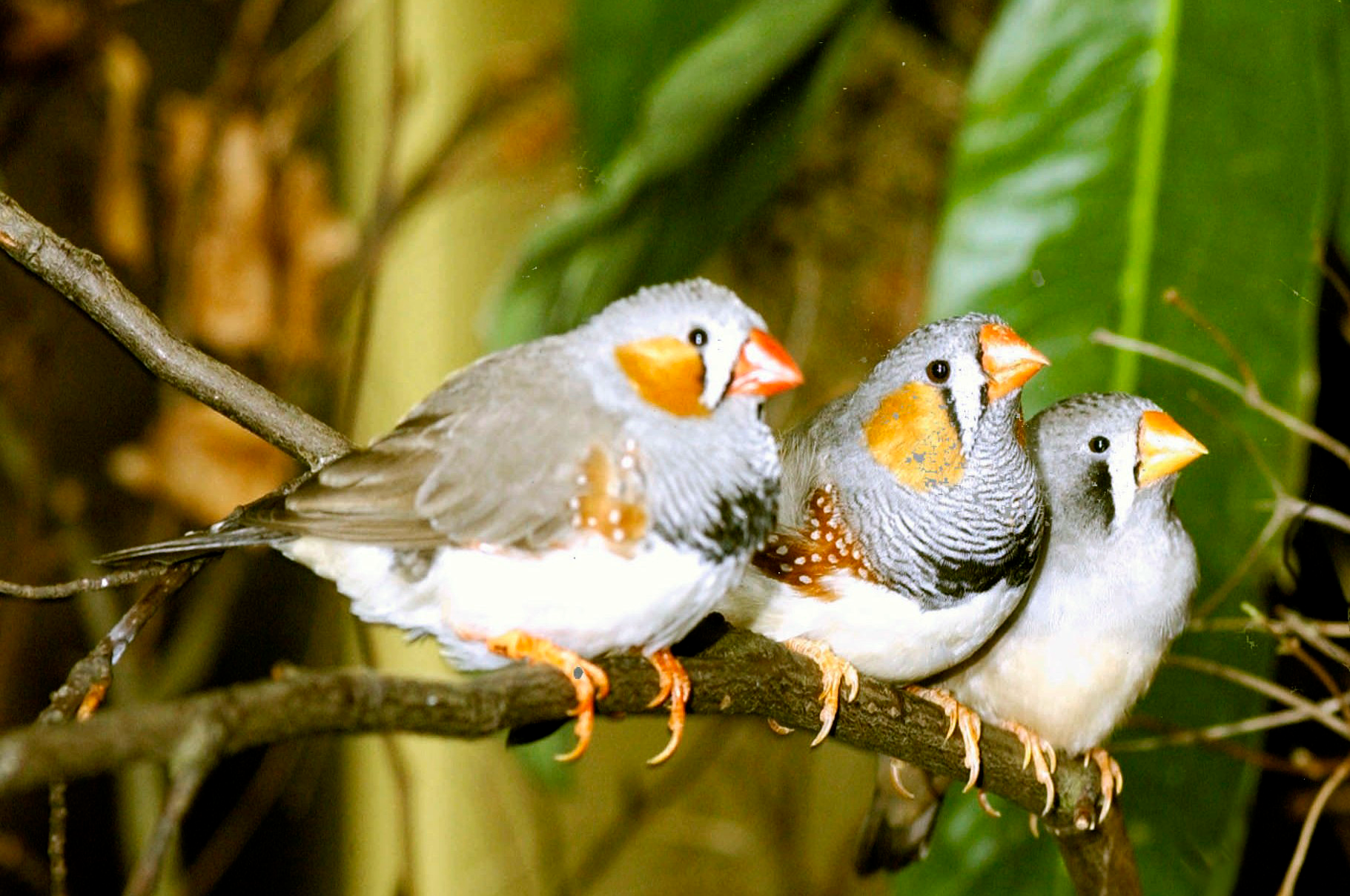
Zebra finches are small, hardy Australian songbirds widely kept in aviaries and flight cages. They are visually-oriented pets, best observed rather than handled, and need to be kept in pairs or small flocks.
ℹ️
Educational only. KinStation content is reviewed by licensed veterinarians but cannot replace an in-person exam. Always consult a licensed veterinarian or board-certified specialist for diagnosis, treatment, or any decision affecting your pet's health.
🩺 Need expert help with your zebra finch?
Connect with a specialist near you or ask a licensed vet — never substitute online guidance for hands-on care in an emergency.
Finches are small, social seed- and insect-eating songbirds kept primarily as aviary and cage birds for their color, song, and lively flocking behavior rather than for handling.
Eckmeier D, Geurten B, Kress D, Mertes M, Kern R, Egelhaaf M, Bischof H · Wikimedia Commons · CC BY 2.5
Habitat & space requirements
From the minimum an animal needs to be kept humanely, up to the ideal setup. Bigger is almost always better — minimums are floors, not targets.
Photo coming soon
Minimum
Pair flight cage
≈ 30 × 16 × 18 in (76 × 40 × 45 cm)
Zebra finches are highly social and must be kept at least as a bonded pair or small group — a lone zebra finch is inappropriate — in a cage that is wider than tall so they can fly side to side. Provide natural perches at varied heights, a daily shallow bath, millet and foraging, grit, and a stable room temperature (18–25 °C) away from draughts. This horizontal flight cage is the smallest humane home for a pair.
Recommended
Long flight cage
≈ 40 × 18 × 24 in (100 × 45 × 60 cm)
A long flight cage gives a pair or compatible group the room to fly properly, which these busy, active little birds need for fitness and to express natural hopping and chasing. Add multiple perch diameters, a swing, woven nest material, foraging, and a bath, with full-spectrum lighting in dim rooms. More space and good company prevent boredom, squabbling, and overcrowding stress.
Steven Bosworth / CC BY-SA 2.0 (Wikimedia Commons)
Photo coming soon
Ideal
Indoor/garden aviary
Walk-in aviary, ≥ 6 ft long
A planted aviary lets a flock fly real distances, forage in foliage, and bathe, which suits their gregarious, colony-living nature beautifully. Outdoors needs a dry, draught-free, frost-protected shelter and predator-proofing; zebra finches are hardy but should not endure freezing damp. A small flock in this kind of space is the most natural and enriching setup.
Life & growth stages
How this animal changes through its life — each stage often has its own care, diet and space needs.
Photo coming soon
Egg
Birds develop inside a hard-shelled egg incubated by the parent(s). Egg size, shell color, and clutch size vary by species; the embryo develops over days to weeks before hatching.
Photo coming soon
Hatchling / Chick
Hatchlings are either altricial — naked, blind, and dependent on parents (typical of parrots and songbirds) — or precocial — downy, mobile, and self-feeding soon after hatching (typical of poultry and waterfowl). Down gives way to the first feathers.
Photo coming soon
Juvenile / Fledgling
Fledglings grow in their juvenile plumage and begin to fly and feed themselves, though they may still beg from parents at first. Juvenile feathering is often duller than the adult and is replaced as the bird matures.
Adult
Adults attain full body size and mature plumage, and are capable of breeding. Many species show distinct adult coloration, and in sexually dimorphic birds males and females differ in plumage, size, or markings.
(c) Hannah D C 16:6 Heritage Trust, some rights reserved (CC BY-NC) via iNaturalist — https://www.inaturalist.org/observations/302024783
Color & pattern variants
Natural variants occur in the wild; selectively bred (man-made) variants were developed in captivity.
Zebra finches are built for flight, not perching in place, so the priority is a long flight cage wider than it is tall that gives them room to fly horizontally — a cramped, vertical cage does not suit them. Arrange perches of varying natural diameters at the ends so the flight path between them stays clear, and avoid cluttering the centre.
Provide a shallow bath dish (many bathe daily and enthusiastically), safe cuttlebone or a mineral block, and a calm location. A consistent light cycle with full darkness at night is important; interrupted sleep stresses them. Offer nesting material only when controlled breeding is genuinely intended, because zebra finches breed readily and a constant supply of nest material plus a nest can lead to relentless laying.
As with all birds, keep them away from PTFE/Teflon cookware fumes, aerosols, and scented products. Quarantining and screening newly acquired birds before introducing them to others is a sensible biosecurity step.
Substrate
Line the cage tray with paper or paper towels for easy cleaning; some keepers use millet-free fine bird sand or a sand sheet, but plain paper makes monitoring droppings simplest. Offer a separate dish of grit and crushed cuttlebone/eggshell for calcium rather than relying on substrate.
Equipment & setup
Zebra finches need a horizontal flight cage (at least 30 inches wide, the longer the better) with 1/4-3/8 inch bar spacing since they fly side to side and don't climb. Provide multiple perches at different levels and natural diameters, a shallow daily bath dish, and millet/seed and water dishes; they tolerate normal room temperatures and need no special heating but should be kept out of drafts.
Diet
A good-quality finch seed mix or finch pellet forms the base of the diet, supplemented with leafy greens, sprouted seeds, and small fresh-food offerings. During breeding, many keepers add an 'egg food' for extra protein. A cuttlebone or mineral block provides calcium, which is especially important for laying hens.
Fresh water should be available daily, and because finches enjoy bathing, the bath water is separate from drinking water. Offer fresh produce in small amounts and remove it before it spoils.
Avoid avocado, chocolate, caffeine, alcohol, and salty foods. As small seed-eaters, finches can become overly reliant on favourite seeds, so providing variety and some pelleted nutrition helps prevent deficiencies.
Behavior & temperament
Zebra finches are highly social and should not be kept singly — a bonded pair is the minimum, and many keepers maintain small flocks in a large flight cage. They are 'watch' birds rather than 'handle' birds: they are not tamed for cuddling and are enjoyed for their flight, flock interactions, and song.
Males sing a complex, individually learned song (a famous subject of birdsong research), while females are quieter, giving mostly calls. Within a group you will see constant low-level chatter, beak-fencing, allopreening between bonded birds, and busy flying. They are active throughout the day and rest at night.
Because they breed so easily, social dynamics and breeding drive are intertwined; managing nest access is as much a behavioural tool as a husbandry one.
Health
An avian veterinarian is the right resource even for small finches, and routine observation of breathing, posture, weight, and droppings catches most issues early. Finches hide illness, and a bird sitting fluffed at the bottom of the cage is often already seriously unwell and needs prompt attention.
Documented concerns include air sac mites (which cause clicking sounds and open-mouth, gaped breathing), scaly leg/face mites (crusty growths on the legs, feet, and beak base), egg binding in hens, and respiratory infection. These need veterinary diagnosis and treatment rather than guesswork.
Preventive themes are good ventilation, clean housing, quarantine of new birds, and not ignoring early respiratory or skin signs. Persistent open-mouth breathing, repeated clicking, leg crusting, or sudden quietness in a normally vocal bird all warrant evaluation.
Tips, DIY & hacks
Keep zebra finches in pairs or small groups as they are highly social and stress when alone. They breed easily, so only add a wicker or box nest with coconut fiber if you want chicks; remove nests or swap eggs for dummies to prevent exhausting hens, and provide extra cuttlebone and calcium to laying females.
Origin & history
The zebra finch (Taeniopygia guttata) is native to the dry grasslands and scrub of Australia (with a separate population in the Lesser Sunda Islands). Hardy and prolific, it became one of the most widely kept aviary birds worldwide and a cornerstone laboratory species, especially in neuroscience and the study of how birds learn song.
Captive breeding has produced numerous colour and pattern mutations, including fawn, pied, white, and crested birds. Pet and aviary zebra finches are entirely captive-bred and generally unrestricted, though as always, local rules are worth a quick check.
Anecdotes & owner lore
Community experience and cultural notes — not veterinary advice. Every animal is an individual; treat these as colour, not care instructions.
Zebra finches are a soundtrack as much as a pet: a small flock keeps up a cheerful, toy-trumpet 'meep meep' chatter that owners find oddly soothing background noise. The males' song is genuinely special — each one improvises and then fixes its own signature tune, learned from a tutor early in life, which is exactly why the species became a star of birdsong neuroscience.
Keepers are charmed by their busy domesticity: bonded pairs preen each other, fuss endlessly over nest-building, and pile together to sleep. The flip side, shared with every new finch owner, is how readily they breed — leave a nest and material in the cage and you may suddenly find yourself running an unplanned finch maternity ward.
Common ailments
Respiratory infection — common
Egg binding (dystocia) — common — Frequent breeders; hens that lay heavily are at higher risk, especially with calcium shortfalls.
Air sac mites — common — Clicking sounds and gaped breathing are classic signs; common in estrildid finches.
Scaly leg / face mites — common
Reviewed and signed off by: KinStation Editorial - pre-launch draft (pending DVM review)