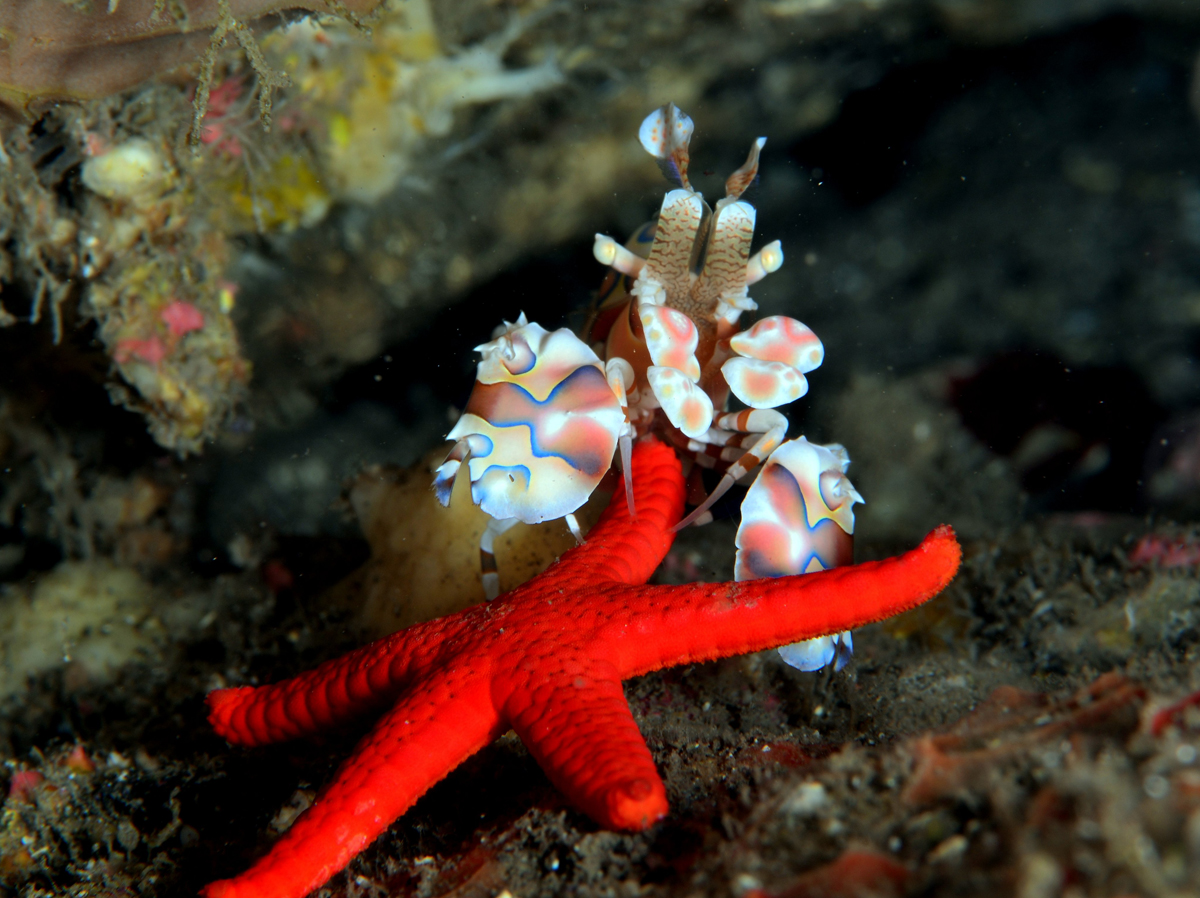
The harlequin shrimp is a stunningly ornate species with cream bodies splashed in blue, pink, or purple blotches and broad petal-shaped claws. It is an obligate predator of sea stars, which makes it advanced to keep because its diet must be supplied as live starfish, and it is best kept as a devoted bonded pair.
ℹ️
Educational only. KinStation content is reviewed by licensed veterinarians but cannot replace an in-person exam. Always consult a licensed veterinarian or board-certified specialist for diagnosis, treatment, or any decision affecting your pet's health.
🩺 Need expert help with your harlequin shrimp?
Connect with a specialist near you or ask a licensed vet — never substitute online guidance for hands-on care in an emergency.
About 3-5 cm (1.25-2 in) body length; flattened, ornate body with large petal-like claws.
Lifespan
2–7 years
Social needs
pair
Native region
Indo-Pacific reefs
Origin
Old World
Climate
🌴 Tropical
Water type
🌊 Marine
Family
Hymenoceridae
Genus
Hymenocera
Part of the Marine Shrimp
A varied group of saltwater shrimp kept for their behavior, color, and usefulness — from burrowing pistol shrimp and their goby partners to ornamental and scavenging species. Most are reef-safe inverts that appreciate stable, mature systems and copper-free water.
From the minimum an animal needs to be kept humanely, up to the ideal setup. Bigger is almost always better — minimums are floors, not targets.
Photo coming soon
Minimum
Specialist reef nano
20 gal (≈ 76 L) reef-ready nano
Hymenocera elegans / picta is a specialist obligate sea-star predator — you MUST be able to supply chocolate-chip sea stars (or sacrificial Asterias) for life. Don't buy on impulse. Keep as a bonded pair in a 20+ gal nano reef.
Photo coming soon
Recommended
Dedicated harlequin species reef
20–30 gal, rockwork, pair
A dedicated species-focused nano reef with rockwork hides, stable salinity (1.025), and a steady supply of sacrificial sea-star arms. Keep one male/female bonded pair — they are monogamous.
Photo coming soon
Ideal
Display nano reef
30+ gal nano reef with caves
A small display nano reef with extensive rockwork, stable parameters, and a reliable sea-star feeding programme. Among the most stunning and demanding marine shrimp.
Life & growth stages
How this animal changes through its life — each stage often has its own care, diet and space needs.
Photo coming soon
Larva
Most marine invertebrates hatch into microscopic planktonic larvae (such as the zoea of crustaceans or the bipinnaria/veliger of echinoderms and mollusks) that drift and feed in the water column. The larva looks nothing like the adult and undergoes major reorganization.
Photo coming soon
Juvenile
After settling out of the plankton, the juvenile takes on a recognizable miniature of the adult body plan — a tiny shell, a small star, or a translucent shrimp. Crustaceans grow by molting, shedding the exoskeleton to enlarge.
Adult
Adults reach full size and reproductive maturity with the species' mature shell, shape, or coloration. Many continue to molt or grow throughout life, and some show sex differences in size or claw/appendage shape.
Habitat & enclosure
Keep in an established reef tank of at least 40-75 L (10-20 gal) with abundant live rock, caves, and overhangs where the pair can shelter and hide their prey. Maintain temperature 24-27°C (75-80°F), pH 8.1-8.4, salinity SG 1.024-1.026, dKH 8-12, and low nitrate with very stable parameters. Moderate flow and standard reef lighting are suitable; the shrimp is shy and secretive, especially when molting.
Water quality must be pristine and steady, as this delicate specialist tolerates swings poorly.
Substrate
Aquascape with live rock providing caves and shaded ledges where the pair can retreat, molt, and stash captured stars. Fine sand or a shallow reef bed beneath is appropriate.
Equipment & setup
Run mature biological filtration with live rock and a sump or canister, a protein skimmer, and a heater for stable tropical temperatures. Gentle to moderate flow and standard reef lighting suffice; keep the system strictly copper-free.
Diet
Strict obligate predator of echinoderms — it eats the tube feet and tissue of live sea stars (and sometimes brittle stars/urchins), flipping them over and consuming them slowly while keeping them alive for days. Keepers must supply a steady source of starfish, commonly Asterias, Linckia, or chocolate chip stars, which raises both cost and ethical considerations. It will not survive on prepared foods.
Behavior & temperament
Peaceful toward fish and corals and reef-safe in the usual sense, but it is a dedicated starfish hunter and will wipe out any sea stars in the tank, including desirable Linckia and sand-sifting stars. Best kept as a bonded male-female pair, which hunt and share prey cooperatively; they are timid and easily outcompeted at feeding by bold fish.
Health
Sensitive to poor acclimation, copper, and unstable water; failed molts from low iodine or trace deficiency are a notable risk. The biggest practical welfare challenge is reliably and ethically sourcing live starfish prey, without which the shrimp slowly starves. Keep it only if you can commit to its specialized diet long-term.
Tips, DIY & hacks
Drip-acclimate very slowly and add as a confirmed pair for best behavior and breeding. Plan the starfish supply before buying — some keepers breed or culture chocolate chip stars and cut/feed them in portions to stretch the food source. Provide trace iodine and a secure cave for safe molting.