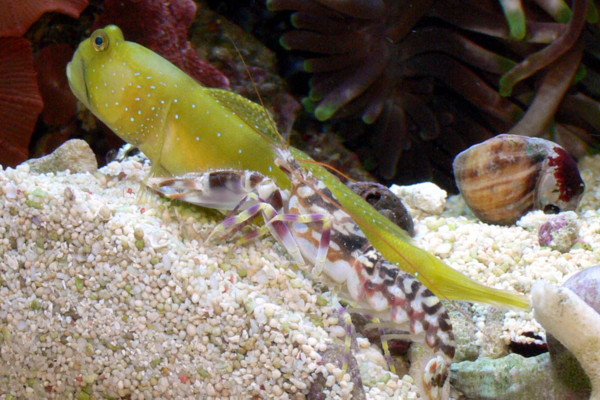
The tiger pistol shrimp is a banded burrowing snapping shrimp famous for its supersonic claw snap and its symbiotic partnership with watchman and shrimp gobies. Nearly blind, it digs and maintains a shared burrow while the goby acts as lookout, making this pairing one of the most fascinating relationships in the reef aquarium.
ℹ️
Educational only. KinStation content is reviewed by licensed veterinarians but cannot replace an in-person exam. Always consult a licensed veterinarian or board-certified specialist for diagnosis, treatment, or any decision affecting your pet's health.
🩺 Need expert help with your tiger pistol shrimp?
Connect with a specialist near you or ask a licensed vet — never substitute online guidance for hands-on care in an emergency.
About 4-5 cm (1.5-2 in) body length, with one greatly enlarged snapping claw.
Lifespan
2–4 years
Social needs
solo
Native region
Indo-West Pacific reefs and sandy lagoons
Origin
Old World
Climate
🌴 Tropical
Water type
🌊 Marine
Family
Alpheidae
Genus
Alpheus
Part of the Marine Shrimp
A varied group of saltwater shrimp kept for their behavior, color, and usefulness — from burrowing pistol shrimp and their goby partners to ornamental and scavenging species. Most are reef-safe inverts that appreciate stable, mature systems and copper-free water.
From the minimum an animal needs to be kept humanely, up to the ideal setup. Bigger is almost always better — minimums are floors, not targets.
Photo coming soon
Minimum
Reef nano with sand bed
20 gal (≈ 76 L) reef nano
Alpheus randalli ('tiger pistol') pairs with watchman/shrimp gobies. Provide a deep sand bed (3+ in) and rubble for burrow construction. Stable 1.025 salinity, peaceful tankmates. Loud snapping is normal.
Photo coming soon
Recommended
Goby-pistol pair tank
30 gal reef nano, deep sand + rubble
A 30 gal reef nano with deep sand, rubble pile, peaceful tankmates, and a watchman/yasha goby partner. The two share a burrow and the goby acts as 'eyes' — one of the best reef symbioses.
Photo coming soon
Ideal
Display nano reef
30+ gal nano reef, sand + rockwork
A display nano reef with deep sand, complex rockwork, and a bonded pistol-goby pair. Stable parameters and minimal disturbance let the pair maintain their burrow long-term.
Life & growth stages
How this animal changes through its life — each stage often has its own care, diet and space needs.
Photo coming soon
Larva
Most marine invertebrates hatch into microscopic planktonic larvae (such as the zoea of crustaceans or the bipinnaria/veliger of echinoderms and mollusks) that drift and feed in the water column. The larva looks nothing like the adult and undergoes major reorganization.
Photo coming soon
Juvenile
After settling out of the plankton, the juvenile takes on a recognizable miniature of the adult body plan — a tiny shell, a small star, or a translucent shrimp. Crustaceans grow by molting, shedding the exoskeleton to enlarge.
Adult
Adults reach full size and reproductive maturity with the species' mature shell, shape, or coloration. Many continue to molt or grow throughout life, and some show sex differences in size or claw/appendage shape.
Habitat & enclosure
Keep in an established marine or reef tank of at least 75 L (20 gal) with a deep sand bed and rubble for burrowing, plus live rock placed on the glass bottom (not on the sand) so tunnels cannot collapse onto it. Maintain temperature 24-27°C (75-80°F), pH 8.1-8.4, salinity SG 1.024-1.026, dKH 8-12, and low nitrate. Moderate flow and standard reef lighting are fine; the shrimp spends most of its time in and around its burrow.
A sand bed at least 5-7 cm (2-3 in) deep with mixed grain and rubble is essential for stable tunnel construction.
Substrate
A deep, varied sand bed (fine sand mixed with coarse sand, crushed coral, and rubble) is critical so the shrimp can build a stable, non-collapsing burrow. Set live rock directly on the tank bottom rather than on the sand to prevent rockslides.
Equipment & setup
Use mature biological filtration with live rock and a sump or canister, a protein skimmer, and a heater for steady tropical temperatures. Moderate-flow powerheads and standard reef lighting suffice; keep the system copper-free.
Diet
Omnivorous scavenger that feeds on detritus, leftover food, small invertebrates, and bits of meaty food it gathers near its burrow. It is largely self-sufficient in an established tank but benefits from occasional sinking pellets, mysis, or chopped seafood delivered near the entrance, often shared with its goby partner.
Behavior & temperament
Reef-safe and peaceful toward fish and corals, but reclusive and best kept one per tank unless a mated pair. It is renowned for pairing with shrimp gobies (e.g. Stonogobiops, Cryptocentrus, Amblyeleotris), which guard the entrance while the shrimp digs. The loud snap can occasionally stun or harass very small motile inverts, and the claw can deliver a sharp pop if handled.
Health
Hardy and disease-resistant; main risks are acclimation/copper sensitivity and collapsed burrows. Molting issues from low iodine or unstable chemistry can occur. It needs adequate sand depth and stable rockwork — rock stacked on shifting sand can topple as the shrimp excavates.
Tips, DIY & hacks
Drip-acclimate slowly and add the shrimp before or together with its goby partner to encourage pairing. Anchor rockwork on the glass and provide rubble pieces to help it brace its tunnels. Do not be alarmed by loud popping snaps — they are normal and rarely harm tankmates.