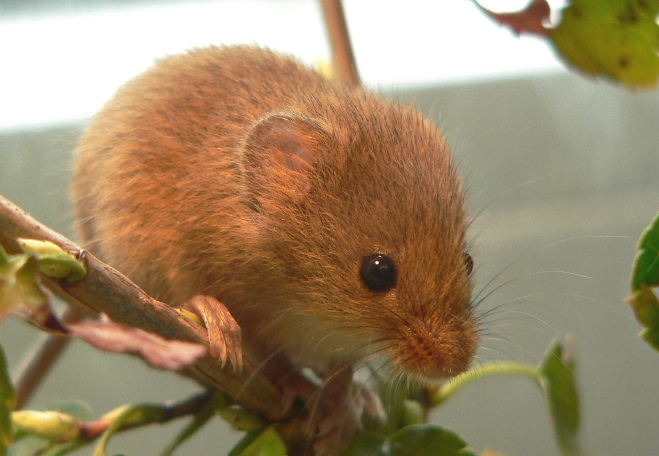
The harvest mouse is a tiny, delicate Old World rodent with a prehensile tail, famous for weaving spherical nests among tall grasses. It is a fragile, agile display animal for experienced keepers, and is a protected native species in parts of its range where keeping is regulated.
ℹ️
Educational only. KinStation content is reviewed by licensed veterinarians but cannot replace an in-person exam. Always consult a licensed veterinarian or board-certified specialist for diagnosis, treatment, or any decision affecting your pet's health.
🩺 Need expert help with your harvest mouse?
Connect with a specialist near you or ask a licensed vet — never substitute online guidance for hands-on care in an emergency.
One of the world's smallest rodents: body about 5-7 cm plus a prehensile tail of similar length; weight just 4-11 g.
Lifespan
1–3 years
Social needs
group
Native region
Across Europe and Asia, in tall grasslands, reedbeds, cereal fields, and hedgerows.
Origin
Old World
Climate
🍂 Temperate
Family
Muridae
Genus
Micromys
Part of the Fancy Mice
Small, fast-breeding murid rodents kept as colony pets and display animals, including domesticated house mice and specialty species like the spiny and grass mice. Most are highly social, best in single-sex groups, and prized more for watching than handling.
From the minimum an animal needs to be kept humanely, up to the ideal setup. Bigger is almost always better — minimums are floors, not targets.
Photo coming soon
Minimum
Tall vivarium with climbing
60 × 40 × 60 cm tall vivarium
Harvest mice are tiny arboreal climbers — height matters more than floor area. Need a fine-mesh or glass enclosure with dense branches, grass stems, and a thick bedding layer to nest near the top.
Photo coming soon
Recommended
Planted arboreal setup
80 × 40 × 80 cm planted
Tall planted vivarium with live grasses, twigs, and seed heads at multiple heights. Best kept as small same-sex groups or breeding pairs — they are social and stressed kept solo.
Photo coming soon
Ideal
Walk-in mesh aviary
Walk-in aviary or 100 cm+ vivarium
Tall walk-in mesh aviary or oversized planted vivarium with seasonal grasses, foraging clutter, and multiple nest cups. Closest to their hedgerow-edge wild habitat.
Life & growth stages
How this animal changes through its life — each stage often has its own care, diet and space needs.
Photo coming soon
Newborn
Newborn mammals are nursed on their mother's milk. Many are born helpless — blind, deaf, and sparsely furred (altricial, as in dogs, cats, and rodents) — while others stand and follow within hours (precocial, as in hoofed livestock).
Photo coming soon
Juvenile
After weaning, juveniles grow quickly and become increasingly active, playful, and independent. Adult coat, proportions, and (in many species) the permanent teeth come in as they approach full size.
Photo coming soon
Adult
Adults reach full body size and sexual maturity, with the species' mature coat and build. Sexual dimorphism — differences in size, mane, horns, or markings — is pronounced in some mammals and subtle in others.
Senior
Senior animals show aging signs such as graying fur, reduced activity, and a greater need for veterinary monitoring of joints, teeth, and organ function. Lifespan and the onset of old age vary widely by species and size.
Color & pattern variants
Natural variants occur in the wild; selectively bred (man-made) variants were developed in captivity.
Natural
representative
Wild-type
Warm russet-orange upperparts with a clean white belly and a long, sparsely haired prehensile tail; the only form seen, as this delicate species has not been selectively color-bred.
Habitat & enclosure
House a small group in a tall, densely planted, fully escape-proof enclosure — a glass or fine-mesh terrarium with very fine gaps, as they slip through astonishingly small openings. Vertical complexity is everything: pack the space with tall grasses, reeds, bamboo, twiggy branches, and climbing material so they can clamber and build aerial nests using their prehensile tails. Keep them at moderate room temperature, roughly 18-25 C (64-77 F), with good ventilation and moderate humidity, avoiding both damp and extreme heat. A small solid wheel and abundant cover reduce stress in these flighty mites.
Substrate
Use a soft, dry, dust-free substrate such as paper bedding or fine aspen, topped with abundant dried and living grasses, hay, and soft plant fibers that they use as both habitat and nest-weaving material. Keep it clean but disturb nests as little as possible. Avoid cedar and pine.
Equipment & setup
Tall, very fine-mesh or glass enclosure with an extremely secure lid, dense live and dried planting, climbing twigs and grasses, a small solid wheel, a drown-proof water source, a thermometer/hygrometer, and gentle background warmth for cool rooms. No UVB required, though natural light cycles help.
Diet
Feed a fine, low-fat seed mix (millet, grass seeds, small cereal seeds) as the base, supplemented with fresh greens, soft fruit in tiny amounts, and crucially a regular supply of small invertebrates such as small insects, aphids, or appropriately sized livefood, since wild harvest mice eat a lot of insects. Scatter and hide food in the foliage to encourage natural foraging. Provide water via a bottle with a small sipper or shallow dish they cannot drown in.
Behavior & temperament
Harvest mice are crepuscular-to-nocturnal, social, and best kept in compatible groups, though males can squabble. They are extremely small, fast, and fragile, essentially impossible to handle safely, and are strictly a display species. Their charm is in watching them climb and weave breeding nests among grass stems. Avoid all but essential handling; if they must be moved, coax them into a container rather than grasping. Stress, drafts, and rough handling are easily fatal at their size.
Health
Their tiny size makes them inherently delicate and short-lived, with little tolerance for chilling, dehydration, or stress; even minor husbandry lapses can be fatal. Watch for weight loss, respiratory issues in damp or drafty setups, and injuries from inappropriate cage furniture or other mice. Provide stable warmth, dense cover, and minimal disturbance. Because they are a protected native species in parts of Europe, captive stock should come from established legal breeding lines and keeping may require compliance with wildlife regulations.
Tips, DIY & hacks
Build the enclosure around vertical grass and reed structure so they can express natural climbing and nest-weaving. Obsess over escape-proofing — these are among the smallest rodents and exploit the tiniest gaps. Minimize handling entirely; appreciate them as living miniatures behind glass. Source only captive-bred stock and check local wildlife-protection laws before keeping.