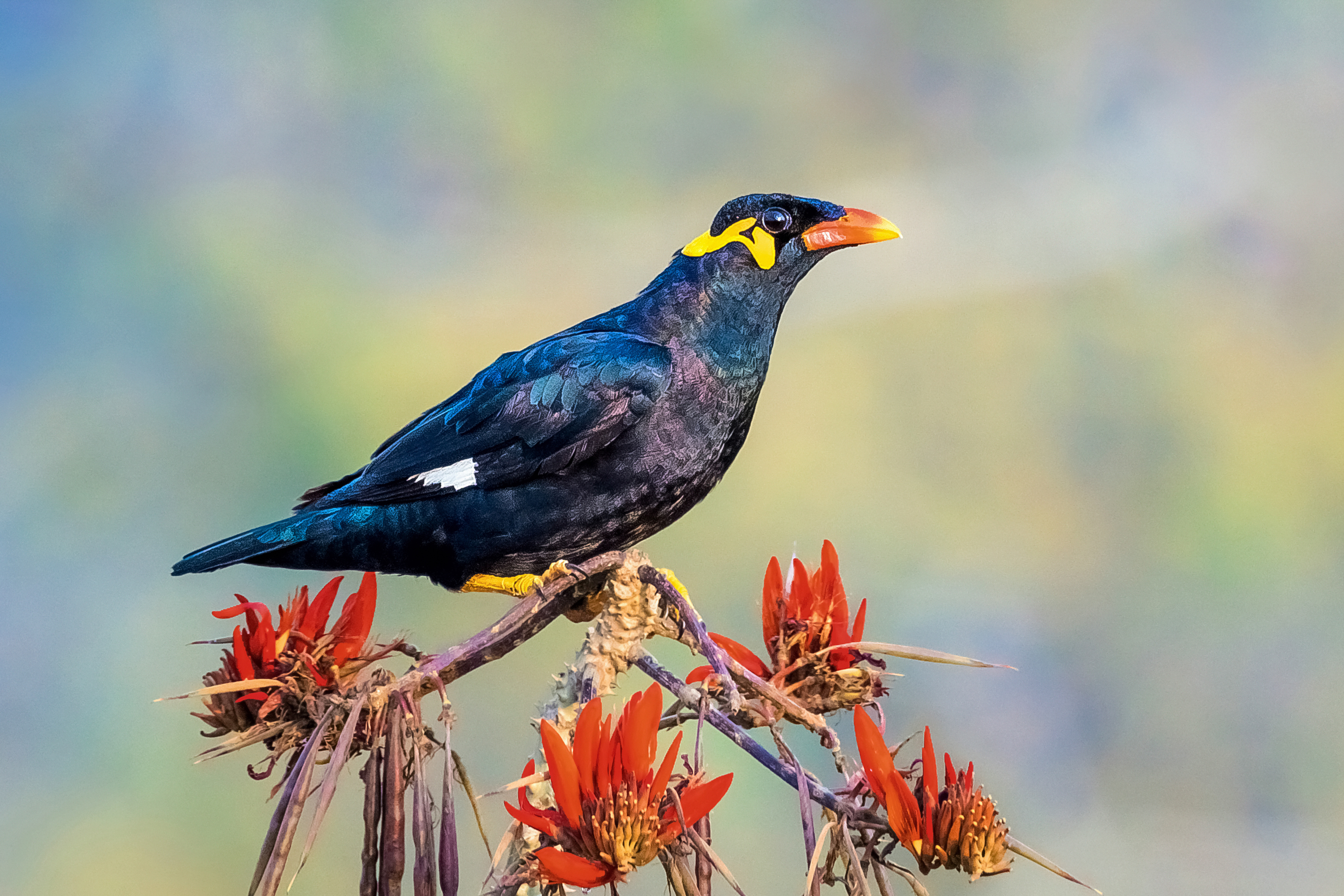
The hill mynah is a glossy black starling-relative famous as arguably the finest talking bird, mimicking human speech with uncanny clarity. It is a messy, demanding softbill that needs a large enclosure, a fruit-heavy diet, and careful hygiene.
ℹ️
Educational only. KinStation content is reviewed by licensed veterinarians but cannot replace an in-person exam. Always consult a licensed veterinarian or board-certified specialist for diagnosis, treatment, or any decision affecting your pet's health.
🩺 Need expert help with your hill mynah?
Connect with a specialist near you or ask a licensed vet — never substitute online guidance for hands-on care in an emergency.
About 25-30 cm (10-12 in) long; roughly 180-260 g.
Lifespan
12–25 years
Social needs
pair
Native region
South and Southeast Asia (Himalayan foothills, India, Sri Lanka, Indochina, and the Greater Sunda Islands)
Origin
Old World
Climate
🌴 Tropical
Family
Sturnidae
Genus
Gracula
Part of the Softbills
Fruit-, nectar-, and insect-eating birds (mynahs, leiothrix, and similar) kept for song, color, and personality. They need fresh soft foods, scrupulous hygiene, and spacious, warm flights rather than seed-and-perch parrot care.
From the minimum an animal needs to be kept humanely, up to the ideal setup. Bigger is almost always better — minimums are floors, not targets.
Photo coming soon
Minimum
Tall softbill cage
≈ 36 × 24 × 36 in, ½ in bar spacing
Hill Mynahs are large softbill starlings that fly horizontally and produce voluminous wet droppings. A welfare minimum is a 36 × 24 × 36 in cage with ½ in bar spacing, multiple perches, a deep bath dish, easy-clean removable tray, daily fresh fruit and softbill pellet diet, and several hours of out-of-cage time.
Photo coming soon
Recommended
Flight cage / aviary
≈ 60 × 24 × 36 in flight cage
A long 60 × 24 × 36 in flight cage with multiple perches across the long axis, bath, foraging substrate, and a daily-changed soft fruit and low-iron pellet diet keeps Hill Mynahs healthy. Iron storage disease is the #1 cause of premature death — diet must be low-iron, high-fruit.
Photo coming soon
Ideal
Walk-in softbill aviary
Walk-in aviary ≥ 8 ft long
A walk-in softbill aviary at least 8 ft long with horizontal flight space, deep bath, varied perches, and a strict low-iron fruit-based diet is the welfare ideal. Provide companionship (Mynahs are flock birds), regular dental-mimicking enrichment, and a draught-free, easy-clean floor — they are messy by nature.
Life & growth stages
How this animal changes through its life — each stage often has its own care, diet and space needs.
Photo coming soon
Egg
Birds develop inside a hard-shelled egg incubated by the parent(s). Egg size, shell color, and clutch size vary by species; the embryo develops over days to weeks before hatching.
Photo coming soon
Hatchling / Chick
Hatchlings are either altricial — naked, blind, and dependent on parents (typical of parrots and songbirds) — or precocial — downy, mobile, and self-feeding soon after hatching (typical of poultry and waterfowl). Down gives way to the first feathers.
Photo coming soon
Juvenile / Fledgling
Fledglings grow in their juvenile plumage and begin to fly and feed themselves, though they may still beg from parents at first. Juvenile feathering is often duller than the adult and is replaced as the bird matures.
Adult
Adults attain full body size and mature plumage, and are capable of breeding. Many species show distinct adult coloration, and in sexually dimorphic birds males and females differ in plumage, size, or markings.
(c) ChanSK, some rights reserved (CC BY-NC) via iNaturalist — https://www.inaturalist.org/observations/83066134
Color & pattern variants
Natural variants occur in the wild; selectively bred (man-made) variants were developed in captivity.
Natural
representative
Greater Indian hill mynah (nominate races)
Larger mainland and Sundaic forms most common in the pet trade; prized as talkers.
representative
Lesser / Java hill mynah forms
Several regional subspecies differ in size and wattle shape; the Javan/Nias populations are sometimes treated as distinct and are conservation-sensitive due to trapping.
Habitat & enclosure
Hill mynahs are big, active softbills needing a large flight cage or aviary, not a parrot cage. Provide at minimum roughly 120 x 90 x 90 cm (4 x 3 x 3 ft) per bird, larger is much better, with plenty of horizontal flight space. Keep them warm: comfortable around 18-29 C (65-85 F) with moderate-to-high humidity (50-70%) reflecting their tropical origins; protect from cold, drafts, and frost. Offer sturdy branch perches at several heights and a large bathing source.
Substrate
Use easily cleaned, absorbent substrate such as newspaper or paper liners changed daily, given their copious liquid droppings; avoid substrates that hold moisture or harbor mold. In aviaries, a washable concrete or sand floor that can be hosed and disinfected works well. Cleanliness is the single most important husbandry factor.
Equipment & setup
Provide a large, sturdy enclosure with secure perches, a big shallow bath or pan for daily bathing, and robust food/water stations placed to limit fouling. Indoor full-spectrum lighting supports wellbeing; supplemental heat is needed in cool climates to maintain tropical temperatures. Easy-to-clean, removable trays and frequent disinfection are key. No special UVB requirement, but good lighting and ventilation matter.
Diet
This is a frugivore/softbill, not a seedeater. Base the diet on a low-iron commercial softbill or mynah pellet plus a daily variety of fresh fruit (papaya, melon, grapes, berries, apple, banana). Offer some insects/animal protein (mealworms, crickets, soaked dog kibble in moderation). Critically, keep dietary iron low to prevent iron-storage disease (hemochromatosis): avoid iron-fortified foods and limit high-vitamin-C items (which boost iron uptake), and provide clean water for drinking and bathing. They eat and defecate copiously, so fresh food daily and frequent cleaning are essential.
Behavior & temperament
Highly intelligent, curious, and social, hand-raised hill mynahs bond strongly and can mimic human speech and household sounds remarkably well, though they are not 'cuddly' like parrots and dislike heavy handling. They are loud, splashy, and extremely messy, flinging food and producing liquid droppings. Keep singly for a pet talker (more likely to mimic) or as a pair for company; provide daily interaction and enrichment to prevent boredom.
Health
The signature concern is iron-storage disease (hemochromatosis), which can be fatal; strictly manage dietary iron. Obesity, vitamin-A deficiency, and respiratory infections occur on poor diets and in damp/dirty conditions. Their wet, frequent droppings demand rigorous hygiene to prevent bacterial and fungal disease. Use an avian vet experienced with softbills; quarantine new birds and watch for lethargy, fluffed posture, or labored breathing.
Tips, DIY & hacks
For talking, choose a young, hand-raised single bird and interact daily in a calm setting; they learn words and sounds best with consistent repetition. Expect a lot of cleanup, so position the cage where splashed fruit and droppings are manageable. Note CITES Appendix II status (international trade is regulated). Legality varies by jurisdiction: hill mynahs are widely kept in the U.S. mainland (California's restricted-animal list does NOT prohibit Gracula religiosa), but Hawaii bans the import of mynahs over invasive-species concerns, so verify local law before acquiring one.