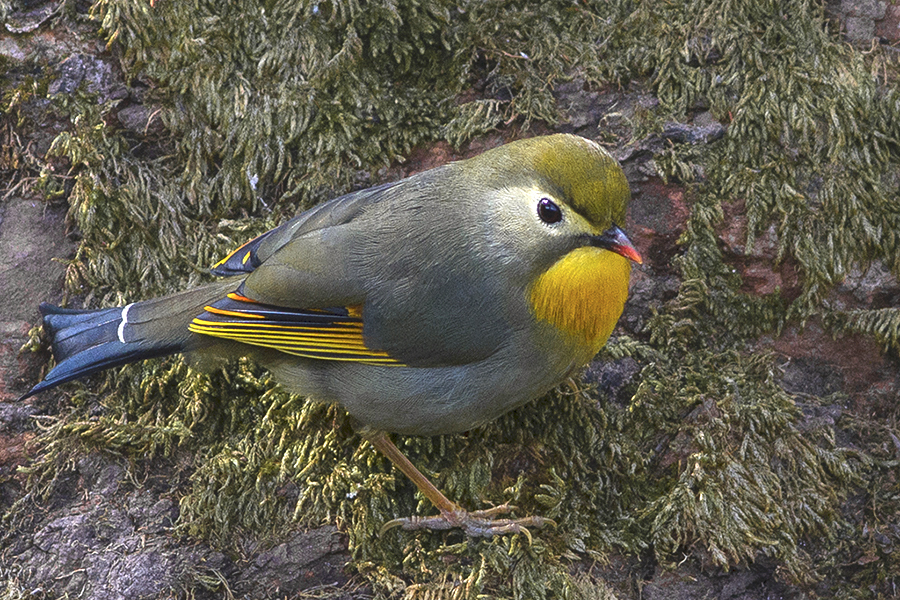
The Pekin robin (red-billed leiothrix) is a brightly colored, melodious Asian babbler popular as an aviary softbill. Active and musical, it needs a planted flight and a varied soft-food diet, and is a known invasive in Hawaii.
ℹ️
Educational only. KinStation content is reviewed by licensed veterinarians but cannot replace an in-person exam. Always consult a licensed veterinarian or board-certified specialist for diagnosis, treatment, or any decision affecting your pet's health.
🩺 Need expert help with your pekin robin?
Connect with a specialist near you or ask a licensed vet — never substitute online guidance for hands-on care in an emergency.
Southern China, the Himalayas, and Southeast Asia (introduced/invasive in Hawaii and parts of Japan)
Origin
Old World
Climate
⛅ Subtropical
Family
Leiothrichidae
Genus
Leiothrix
Part of the Softbills
Fruit-, nectar-, and insect-eating birds (mynahs, leiothrix, and similar) kept for song, color, and personality. They need fresh soft foods, scrupulous hygiene, and spacious, warm flights rather than seed-and-perch parrot care.
From the minimum an animal needs to be kept humanely, up to the ideal setup. Bigger is almost always better — minimums are floors, not targets.
Photo coming soon
Minimum
Pair softbill cage
48 × 24 × 30 in, bar spacing 3/8–1/2 in
Pekin robins (red-billed leiothrix) are active softbills that fly horizontally, so length matters more than height. Provide dense foliage hides, bathing dish daily (they bathe constantly), varied perches, and an insectivore/softbill pellet plus live food. Always keep in pairs or trios — never solo.
Photo coming soon
Recommended
Planted flight cage
60 × 30 × 36 in, planted
A long planted flight with live or artificial shrubs, multiple bathing options, and rotating live food (mealworms, crickets) keeps natural behaviour. Softbill droppings are wet — line trays daily.
Photo coming soon
Ideal
Planted indoor or outdoor aviary
6 × 3 × 6 ft+ planted aviary
A planted walk-in aviary (frost-protected) with bushes, bathing pools, and an invertebrate-rich diet. Pekin robins thrive in mixed softbill aviaries with non-aggressive companions, and an aviary lets them sing and forage as in the wild.
Life & growth stages
How this animal changes through its life — each stage often has its own care, diet and space needs.
Photo coming soon
Egg
Birds develop inside a hard-shelled egg incubated by the parent(s). Egg size, shell color, and clutch size vary by species; the embryo develops over days to weeks before hatching.
Photo coming soon
Hatchling / Chick
Hatchlings are either altricial — naked, blind, and dependent on parents (typical of parrots and songbirds) — or precocial — downy, mobile, and self-feeding soon after hatching (typical of poultry and waterfowl). Down gives way to the first feathers.
Photo coming soon
Juvenile / Fledgling
Fledglings grow in their juvenile plumage and begin to fly and feed themselves, though they may still beg from parents at first. Juvenile feathering is often duller than the adult and is replaced as the bird matures.
Adult
Adults attain full body size and mature plumage, and are capable of breeding. Many species show distinct adult coloration, and in sexually dimorphic birds males and females differ in plumage, size, or markings.
(c) Luís Lourenço, some rights reserved (CC BY-NC-SA) via iNaturalist — https://www.inaturalist.org/observations/203455905
Color & pattern variants
Natural variants occur in the wild; selectively bred (man-made) variants were developed in captivity.
Natural
representative
Wild type (red-billed)
Olive-green back, yellow-orange throat, and the diagnostic bright red bill; several regional subspecies vary in plumage intensity.
Habitat & enclosure
A planted aviary or large flight is ideal; these restless, agile birds need room to flit and forage. For indoor flights provide at least about 120 cm (4 ft) of length per pair, larger outdoors. They are reasonably cold-tolerant once acclimated but should be kept frost-free and dry, with a sheltered, draft-free roosting area; comfortable roughly 10-26 C (50-78 F). Moderate humidity and dense planting, branches, and cover suit their shy, skulking nature.
Substrate
In planted aviaries use natural soil with leaf litter, which supports foraging for live food; on flight or cage floors use paper, dust-extracted sand, or fine bark litter kept dry and cleaned regularly. Damp, soiled substrate encourages mold and parasites, so spot-clean often.
Equipment & setup
Provide dense perching and planting/cover, a shallow bath (they bathe enthusiastically), and multiple feeding stations for soft food and live food. Indoor full-spectrum lighting is beneficial; supplemental heat is needed only in cold climates to keep them frost-free. Secure, predator- and rodent-proof outdoor aviaries with a covered shelter are recommended.
Diet
Feed as an omnivorous softbill: a good softbill/insectivore pellet or softfood base plus daily diced fruit (apple, pear, berries, grapes) and a generous supply of live food (mealworms, crickets, fruit flies, waxworms), which they relish and need especially when breeding. Offer some softened/soaked seed and greens. Keep dietary iron moderate-to-low to reduce iron-storage risk common to softbills, and provide clean water for drinking and bathing.
Behavior & temperament
Lively, agile, and constantly active, Pekin robins are prized for the male's rich, flute-like song. They are generally peaceful in mixed aviaries outside the breeding season but can become territorial and aggressive toward conspecifics and smaller birds when nesting, so give breeding pairs their own space. They are not hand-tame but are bold and engaging; keep as a single pair or in a roomy mixed collection with cover.
Health
Hardy if kept dry and well fed. Watch for obesity, iron-storage disease (manage dietary iron), respiratory issues in damp conditions, and intestinal parasites/coccidiosis in aviaries. Provide live food and calcium for breeding hens to avoid egg-binding. Quarantine new birds; the species is largely resistant to avian malaria but can act as a reservoir host for it in introduced ranges, so good mosquito control and hygiene are prudent.
Tips, DIY & hacks
Pekin robins nest in dense shrubbery or thick foliage, so plant the aviary heavily and offer fine grasses, moss, and coconut fiber as nesting material; boost live food when chicks hatch. Important legality note: Leiothrix lutea is established and invasive in Hawaii (and implicated in spreading avian malaria to native honeycreepers), so keeping or releasing it is restricted there and in some other jurisdictions. Verify local law before acquiring.