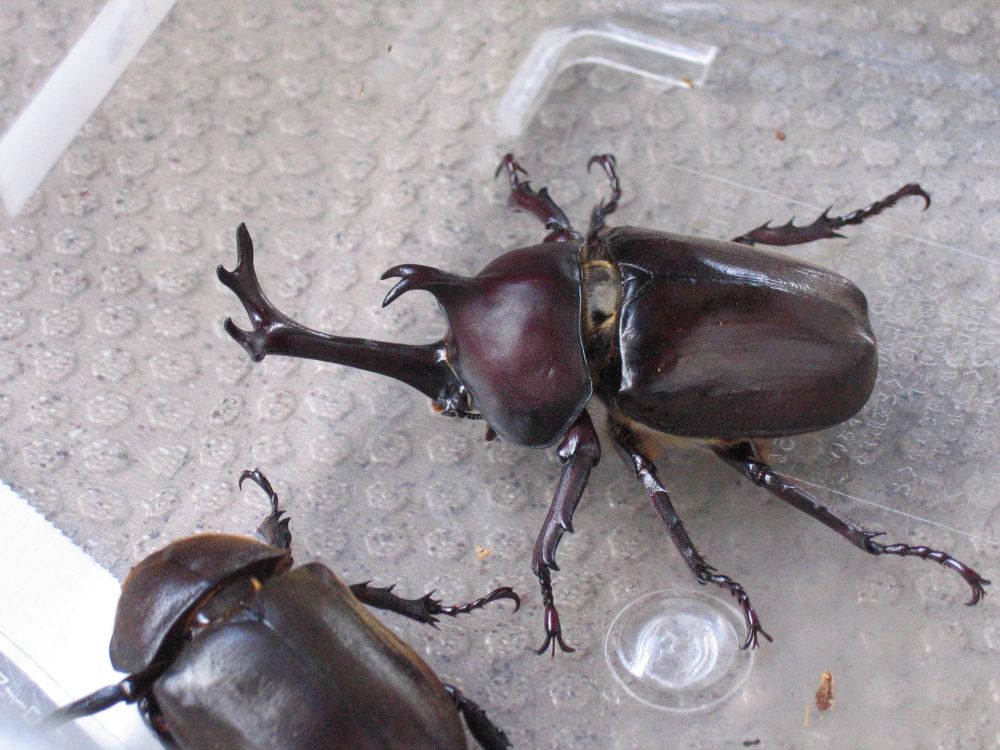
A large, iconic East Asian scarab beetle whose males bear a long forked horn; it is hugely popular as a pet in Japan (the 'kabutomushi'). Note that live import of this non-native beetle into the US is prohibited without a federal permit, so it is effectively not legal to keep there.
ℹ️
Educational only. KinStation content is reviewed by licensed veterinarians but cannot replace an in-person exam. Always consult a licensed veterinarian or board-certified specialist for diagnosis, treatment, or any decision affecting your pet's health.
🩺 Need expert help with your japanese rhinoceros beetle?
Connect with a specialist near you or ask a licensed vet — never substitute online guidance for hands-on care in an emergency.
Large; adults about 1.5-3.3 in (4-8.5 cm) including the male's forked horn.
Lifespan
1 years
Social needs
solo
Native region
East Asia (Japan, Korea, China, Taiwan)
Origin
Old World
Climate
🍂 Temperate
Family
Scarabaeidae
Genus
Trypoxylus
Part of the Beetles
Kept beetles (order Coleoptera), including rhinoceros, stag, and flower beetles, are display invertebrates with a buried larval (grub) stage that feeds on decaying wood or leaf litter and a short-lived adult stage. Most are docile and harmless to handle, but many are non-native and tightly regulated, with live import banned or permit-restricted in countries like the US.
From the minimum an animal needs to be kept humanely, up to the ideal setup. Bigger is almost always better — minimums are floors, not targets.
Photo coming soon
Minimum
Adult display enclosure
12 × 8 × 8 in, leaf litter floor
Allomyrina dichotoma ('kabuto') adults live a few months. Provide leaf litter, climbing wood, and a jelly feeder. Larvae spend ~10 months in deep flake-soil (1–2 L per larva) at ~22 °C — a separate rearing setup.
Photo coming soon
Recommended
Adult bioactive vivarium
18 × 12 × 12 in, bioactive
A bioactive adult vivarium with leaf litter, cork bark, jelly feeders, and gentle humidity. Pair larvae are reared in individual tubs of fermented oak flake-soil — the iconic Japanese hobbyist setup.
Photo coming soon
Ideal
Display vivarium + larva rack
24 × 18 × 18 in display + larva tubs
A naturalistic display vivarium for adults plus a dedicated larva-rearing rack. Stable temperatures and quality flake-soil produce the largest, healthiest adults.
Life & growth stages
How this animal changes through its life — each stage often has its own care, diet and space needs.
Photo coming soon
Egg
Insects begin as eggs, laid singly or in clusters on or near a food source. Egg size, shape, and incubation time vary widely; some are glued to surfaces, others inserted into plant tissue or soil.
Photo coming soon
Larva / Nymph
The immature stage either looks grub- or caterpillar-like and very different from the adult (a larva, in beetles, flies, and butterflies) or like a wingless miniature adult (a nymph, in roaches, mantises, and stick insects). It eats and molts repeatedly as it grows.
Photo coming soon
Pupa
In insects with complete metamorphosis, the larva pupates — often in a cocoon, chrysalis, or sealed cell — and its body is reorganized into the adult form. Nymph-developing insects skip a true pupa and molt straight to the adult.
Adult
The adult is the sexually mature, usually winged stage with the species' full coloration and form. Adults are typically the dispersing and reproducing stage, and in many insects do not grow further once mature.
Habitat & enclosure
House one adult (or a compatible pair for breeding) in a ventilated plastic or glass terrarium of at least 30x20 cm floor space, filled with deep substrate. Keep at 68-82F (20-28C) with moderate-to-high humidity, the substrate kept lightly damp. Adults are mostly active at dusk and night and can fly, so a secure lid is essential. Larvae (grubs) live buried in deep substrate for most of the life cycle. No UVB or special lighting is needed; provide climbing branches and bark for the adults.
Substrate
Use deep (15-20 cm or more for larvae), moist, fermented hardwood flake or specialized 'kabuto mat'; the larvae eat and grow entirely within this decaying-wood substrate. Keep it damp like a wrung-out sponge but not waterlogged. For adults a shallower layer with bark and branches suffices, but breeding and larval rearing require the deep fermented substrate that doubles as larval food.
Equipment & setup
A ventilated terrarium, deep fermented hardwood substrate, climbing bark or branches, and a feeding dish for beetle jelly or fruit are the essentials. No UVB or special lighting is required. No supplemental heat is needed at normal room temperature; a thermostatically controlled gentle heat source only if the room is cold. A mister or spray bottle keeps the substrate humid.
Diet
Adults feed on sugary fluids: in the wild, tree sap and ripe fruit. In captivity offer beetle jelly (the standard commercial food), or pieces of banana, apple, and other soft fruit, replaced daily to avoid mold and fruit flies. Avoid watery fruits like watermelon, which can cause loose droppings. The larvae are detritivores that eat decaying wood and leaf litter within the substrate (kabutomushi mat / fermented hardwood flake) and do not need separate feeding.
Behavior & temperament
A docile, non-venomous beetle that does not bite and is safe to handle gently; males may grip with their legs and the horn is blunt and harmless to people. Males use their forked horn to wrestle rival males for feeding sites and mates, so adult males should be housed separately to prevent combat injuries. Adults are nocturnal and can fly, sometimes buzzing loudly at night. Handle by letting it walk onto your hand rather than gripping the horn.
Health
Adults are short-lived, typically a few months after emerging, as the bulk of the roughly one-year life cycle is spent as a larva and pupa underground. Common issues are dehydration, leg or tarsus damage in old adults, and mold or mite buildup from spoiled fruit or wet substrate. Provide a low climbing structure and shallow footing so a flipped beetle can right itself. Do not disturb larvae or the pupal cell, as disturbance during pupation can cause deformities.
Tips, DIY & hacks
Legality is critical: Trypoxylus dichotomus is a non-native plant-feeding scarab, and USDA APHIS requires a PPQ 526 permit (with a containment facility) to import or move live specimens, eggs, or larvae into the United States, so keeping it is effectively illegal for ordinary hobbyists in the US even though it is a common pet in Japan and parts of Asia; check your own country's rules and never release it outdoors, as introduced scarabs can become agricultural pests. To breed, keep a mated pair on deep fermented substrate, then separate larvae into individual containers of the same substrate; rear cool and undisturbed through pupation. House adult males singly to prevent fighting.