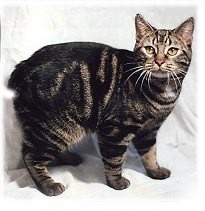
A tailless or short-tailed, round-bodied breed from the Isle of Man, famous for its rabbit-like hop and devoted, dog-like personality. The taillessness arises from a dominant mutation that carries serious welfare considerations.
ℹ️
Educational only. KinStation content is reviewed by licensed veterinarians but cannot replace an in-person exam. Always consult a licensed veterinarian or board-certified specialist for diagnosis, treatment, or any decision affecting your pet's health.
🩺 Need expert help with your manx?
Connect with a specialist near you or ask a licensed vet — never substitute online guidance for hands-on care in an emergency.
Welfare floor for a free-roam pet cat: a secure indoor home with one litter box per cat plus one extra (placed in different rooms), multiple scratching posts and a sturdy cat tree, food and water stations kept away from the litter, and 20–30 minutes of interactive wand/puzzle play every day. Outdoor access only via a fully-fenced catio or harness walks.
Photo coming soon
Recommended
Multi-room home with vertical territory
≥ 2 floors / wide rooms, cat trees, catio access
A multi-cat-friendly household with several tall cat trees and wall-mounted perches, window seats with a view, separate feeding stations per cat to reduce resource guarding, and access to a screened catio or balcony for sun and air. Vertical territory matters as much as floor space for cats.
Photo coming soon
Ideal
Indoor home + catio + enriched garden
House + outdoor catio + cat-proofed garden
Indoor home paired with a large outdoor catio (or a cat-proof-fenced garden), abundant environmental enrichment (climbing branches, foraging puzzles, water features), and group-compatible housing if multi-cat. This combines the safety of indoor-only living with the behavioural enrichment of supervised outdoor time.
Life & growth stages
How this animal changes through its life — each stage often has its own care, diet and space needs.
Photo coming soon
Newborn
Newborn mammals are nursed on their mother's milk. Many are born helpless — blind, deaf, and sparsely furred (altricial, as in dogs, cats, and rodents) — while others stand and follow within hours (precocial, as in hoofed livestock).
Photo coming soon
Juvenile
After weaning, juveniles grow quickly and become increasingly active, playful, and independent. Adult coat, proportions, and (in many species) the permanent teeth come in as they approach full size.
Photo coming soon
Adult
Adults reach full body size and sexual maturity, with the species' mature coat and build. Sexual dimorphism — differences in size, mane, horns, or markings — is pronounced in some mammals and subtle in others.
Senior
Senior animals show aging signs such as graying fur, reduced activity, and a greater need for veterinary monitoring of joints, teeth, and organ function. Lifespan and the onset of old age vary widely by species and size.
Color & pattern variants
Natural variants occur in the wild; selectively bred (man-made) variants were developed in captivity.
Adaptable house and apartment cats that are active, playful, and surprisingly athletic jumpers. Provide climbing furniture, interactive play, and puzzle feeders to satisfy their intelligence. Because some affected cats have spinal/neurological issues, keep litter boxes low-entry and easily accessible and watch for any signs of mobility or continence problems.
Diet
Standard complete adult/life-stage diet with portion control; the cobby build masks weight gain, so monitor body condition closely. Ensure good hydration to support urinary health. Cats with Manx-syndrome-related bowel or bladder issues may need veterinary dietary management.
Behavior & temperament
Affectionate, loyal, and people-focused — often called dog-like for following owners, fetching, and even tail-wag-like behavior. Intelligent and trainable with clicker/reward methods. Calm but playful, good with children and other pets when socialized. Known to be excellent, determined hunters.
Health
The Manx (tailless) gene is a dominant mutation; the homozygous form is lethal in utero. Affected cats can develop Manx syndrome — a spina-bifida-like spectrum with shortened spine causing fecal/urinary incontinence, megacolon, hind-limb weakness, and gait problems, usually evident by 4-6 months. Responsible breeding outcrosses rumpies to tailed/longer-tailed cats and never breeds two rumpies. Also predisposed to corneal dystrophy and arthritis at the tail-base in partial-tail ('stumpy') cats. Welfare-honest note: taillessness is an exaggerated trait with real disability risk — buy only from breeders who screen and prioritize spinal health.
Tips, DIY & hacks
Coat care depends on length: shorthaired Manx need weekly brushing; the longhaired variety (Cymric) needs combing 2-3x weekly to prevent mats. The dense double coat sheds seasonally. Handle the rump/back gently and avoid pressure on the spine. Keep the genital/anal area clean in any cat with continence issues. Routine claw, ear, and dental care.